Caring for magnolia trees comes down to five things: full sun to light shade, deep infrequent watering, slightly acidic well-drained soil, minimal pruning done at the right time, and patience while the roots establish for the first two to three years. Get those right and a magnolia is one of the lowest-maintenance flowering trees you can plant. Get them wrong early and you spend years fighting a tree that never quite settles in.
Most of the trouble I see traces back to one planting mistake that does not show up until the second or third summer, and by then it looks like a completely different problem. There is also a bloom-drop panic that hits almost every new magnolia owner in year one, and the real explanation is not what people assume.
Stick with me through the sections below and you will know exactly what your magnolia needs this week, not just in theory. Save the “Magnolia Trees at a Glance” card at the very bottom, it has the numbers you will want to check again next spring.
Light, Placement, and Temperature
Magnolias want at least six hours of direct sun for the best flowering and densest form, though many varieties, especially star magnolia and saucer magnolia, tolerate light afternoon shade in hot climates without much complaint. Full shade thins the canopy and cuts bloom count hard.
Placement matters more than most people expect. Give the tree room, mature spread runs anywhere from 15 to 40 feet depending on variety, and keep it away from foundations, walkways, and septic lines since magnolia roots are shallow and wide-spreading rather than deep.
Most magnolias handle USDA zones 5 through 9, with southern magnolia preferring zones 7 through 9 and star magnolia tolerating colder winters down into zone 4 in sheltered spots. A late frost after an early warm spell is the real threat, not winter cold itself.
That frost timing is exactly what explains the bloom problem everyone blames on themselves.
Watering: How Much and How Often
If you guessed that yellow leaves or dropped blooms mean the tree needs more water, that guess is wrong more often than it is right with magnolias. The real cause of early bloom drop is usually a late frost hitting flowers that opened too early during a warm spell, not thirst or overwatering.
Water is still critical, just in a different way. A newly planted magnolia needs deep watering two to three times a week for the first two to three months, then weekly through its first full year, tapering to every 10 to 14 days once established, more often during drought or extreme heat.
Check by hand, not by calendar. Push a finger or a screwdriver 3 to 4 inches into the soil near the root zone, if it is dry at that depth, water deeply until it runs 12 to 18 inches down.
Established magnolias with several years of root growth rarely need supplemental water except in prolonged dry spells.
Soil is the other half of that root story, and it is where the real long-term mistake usually starts.
Soil, Feeding, and the Planting Mistake That Takes Years to Show
Magnolias want slightly acidic, well-drained soil, ideally a pH between 5.5 and 6.5, rich in organic matter. Heavy clay that holds water around the roots is the single biggest killer of young magnolias, and it is also the mistake that hides the longest.
Here is the delayed damage: a tree planted in a hole dug straight into clay looks fine for a season or two on stored energy, then starts declining in year three as the roots hit compacted, waterlogged soil they never actually escaped. By the time the canopy thins, the root system is already years behind where it should be.
Fix it at planting, not after. Dig the hole two to three times as wide as the root ball but no deeper, so the root crown sits slightly above grade, and backfill with native soil amended with compost rather than pure potting mix, which can create a bathtub effect in heavy ground.
Feed lightly. An acid-forming, slow-release fertilizer formulated for trees and shrubs applied once in early spring is plenty, skip fertilizing entirely in the first year and let root establishment do the work.
Mulch is doing more for this tree than fertilizer ever will.
Mulching, Pruning, and the Timing Nobody Gets Right
Mulch 2 to 3 inches deep in a ring 3 to 4 feet out from the trunk, keeping it a few inches clear of the bark itself. This protects the shallow roots from temperature swings and cuts down on the watering you need to do.
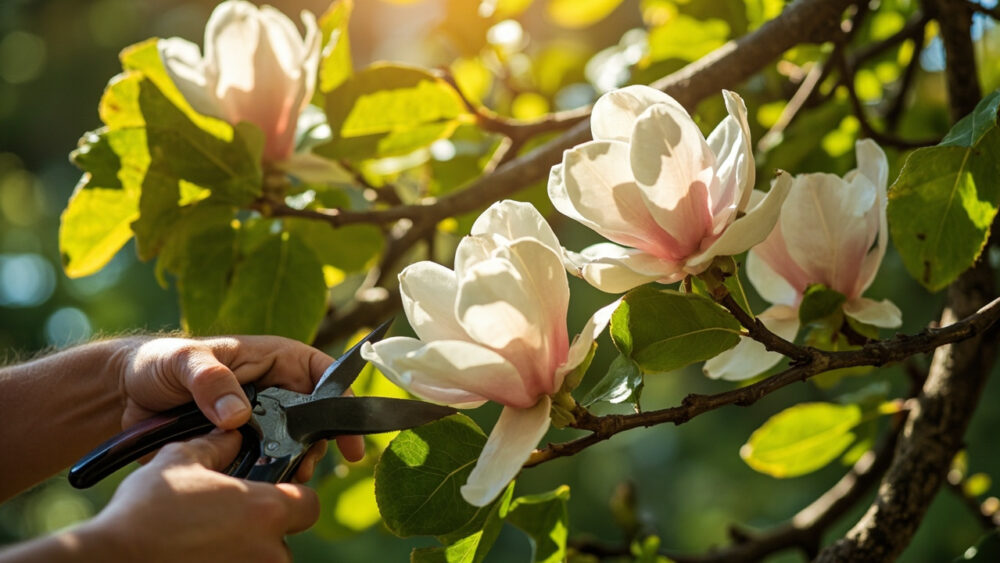
Pruning is where good intentions do the most damage. Magnolias heal cuts slowly and bleed sap heavily if pruned in late winter or early spring while sap is rising, so the correct window is right after flowering finishes, typically late spring to early summer depending on variety.
Keep pruning minimal. Remove dead, crossing, or damaged wood and shape lightly, magnolias do not respond well to hard cutting back and can take years to recover a natural form after aggressive pruning.
Skip fall and winter pruning entirely, wounds made then are slower to callus and more open to disease.
Get the timing right and you rarely need to think about pruning again until next year’s clean-up pass.
Problems That Actually Show Up
The most common magnolia problems are leaf spot fungus, scale insects, and the frost-damaged blooms mentioned earlier. None of them are usually fatal if you catch them early.
- Brown or black leaf spots: usually a fungal leaf spot, worse in wet, humid springs. Rake and dispose of fallen leaves, improve air circulation, and treat with a fungicide labeled for ornamental trees if it recurs yearly, following the label exactly.
- Sticky residue or sooty black coating on leaves: a sign of scale insects, which secrete honeydew that grows sooty mold. Horticultural oil applied per the label during the dormant season is the standard fix.
- Flowers turning brown and mushy right after opening: late frost damage, not disease. There is no fix once it happens, but it does not harm the tree, next year’s buds are unaffected.
- Yellowing leaves with green veins: usually iron chlorosis from soil pH that has drifted too alkaline. An acid-forming fertilizer and mulch with pine bark or pine needles will bring it back over a season.
If you ever see a magnolia’s leaves wilting fast with no drought or heat to explain it, and the tree is otherwise healthy, that is worth a call to a local extension office rather than guessing your way through it, root and vascular diseases are less common but do happen and are easier to manage caught early.
Most of the time, though, a healthy magnolia looks the part, and knowing what “thriving” actually looks like saves you from treating a normal tree as a sick one.
What a Thriving Magnolia Actually Looks Like
A healthy magnolia pushes new leaf growth every spring in a flush of glossy, deep green leaves, with older leaves dropping gradually rather than all at once. Some leaf drop in late winter on evergreen types like southern magnolia is completely normal, not a symptom.
Bloom count is the best long-term signal. A young tree may only produce a handful of flowers in its first few years, ramping up steadily as the root system matures, typically reaching full flowering potential by year five to seven depending on variety and starting size.
Bark should be smooth to slightly furrowed with no cracking, oozing, or fungal growth, and branches should feel firm, not brittle, when gently flexed.
That steady, unhurried buildup is exactly what you want, magnolias are not a fast-growth tree and treating slow as sick is its own mistake.
Everything above compresses down into the card below, the numbers worth keeping on hand.
Magnolia Trees at a Glance
- Light: full sun to light afternoon shade, at least six hours of direct sun for best blooming.
- Watering: deep watering two to three times weekly at planting, weekly through year one, every 10 to 14 days once established.
- Soil: well-drained, slightly acidic, pH 5.5 to 6.5, amended with compost rather than heavy clay or pure potting mix.
- Planting depth: root crown slightly above grade, hole two to three times the width of the root ball, never deeper.
- Feeding: acid-forming slow-release fertilizer once in early spring, skip entirely the first year.
- Pruning window: right after flowering finishes in late spring to early summer, never in late winter or early spring.
- Hardiness: zones 5 through 9 for most varieties, zone 4 for star magnolia in sheltered spots, zones 7 through 9 for southern magnolia.
If you remember one thing, remember this: plant it right in soil that drains, and prune it only right after the blooms fade.
Everything else about magnolia care is patience, the tree does the rest on its own schedule.