Growing eggplant means giving it heat, patience, and consistent water from a transplant set out two to three weeks after your last frost, once nights stay above 55°F. Skip that heat requirement and you get a stunted plant that sulks all summer instead of a productive one. That is the short version, but there are a few things about growing eggplant that trip up almost everyone.
Most failed attempts trace back to one mistake: planting too early because tomatoes and peppers went in the same weekend. Eggplant is fussier about cold than both of them, and it does not forget a rough start. There is also a sign on the plant itself that people misread constantly, mistaking a normal growth pause for a problem that needs fixing.
Stick around and you will also get the honest answer to the question every eggplant grower eventually asks: why are there so many flowers and so little fruit. Save the scrolling energy for the bottom of this guide too, where there’s an Eggplant at a Glance card built to save to your phone for the whole season.
When to Plant Eggplant
Eggplant wants heat more than almost any other vegetable in the home garden. Soil temperature should be at least 65°F, and air temperatures should be reliably staying above 55°F at night before transplants go in. That is usually two to three weeks after your last spring frost date, not right on top of it.
In cooler zones (5 and lower), warming the soil with black plastic or waiting until early summer beats rushing it. In hot zones (8 and up), get plants in as soon as nights cooperate, since eggplant needs a long season, typically 60 to 85 days from transplant to first harvest depending on variety.
Direct-seeding outdoors rarely works well except in the hottest climates. Start seed indoors 8 to 10 weeks before your target transplant date if you’re growing from seed.
Get the timing right and the next decision, where you actually put the plant, matters just as much.
Choosing the Spot and Prepping the Soil
Eggplant needs full sunsix to eight hours minimum, and it needs it consistently. A spot that’s shaded half the afternoon will grow a plant that survives but never really produces.
Soil should be loose, well-drained, and rich. Work in two to three inches of compost before planting, and aim for a pH between 6.0 and 6.8. Heavy clay that stays wet is the enemy here, since eggplant roots are prone to rot in soggy ground.
If your soil is dense or compacted, raised beds or large containers (at least five gallons per plant) solve the problem fast without a season of soil-building.
Once the bed is ready, how you actually get the plant into the ground decides a lot of what happens next.
Planting Eggplant Step by Step
Step 1: Harden off transplants
Whether store-bought or homegrown, give transplants 5 to 7 days outside in increasing sun and wind before planting. Skipping this leaves plants scorched and set back for weeks.
Step 2: Set the depth
Plant at the same depth it was growing in its pot, maybe an inch deeper at most. Unlike tomatoes, eggplant does not root readily along a buried stem, so burying it deep does not help.
Step 3: Space them out
Give each plant 18 to 24 inches, with rows 24 to 30 inches apart. Crowded eggplant gets poor airflow, which invites the fungal problems covered below.
Step 4: Water in and mulch
Water thoroughly right after planting, then lay 2 to 3 inches of mulch around (not touching) the stem to hold soil moisture and heat.
The plant is in the ground, but the real work of the season is what happens over the next ten weeks.
Watering and Feeding Through the Season
Eggplant wants about 1 to 1.5 inches of water a week, delivered steadily rather than in a flood-and-drought cycle. Check the soil two inches down; if it’s dry at that depth, it’s time to water.
Inconsistent watering is the top cause of bitter fruit and blossom drop, so a drip line or soaker hose beats hand-watering on a schedule you might skip.
Feed at planting with a balanced fertilizer, then side-dress with a lower-nitrogen, higher-phosphorus and potassium feed once the first flowers appear. Too much nitrogen late in the season builds leaves at the expense of fruit, which is exactly the flowers-but-no-eggplant complaint most growers eventually run into.
If you assumed more flowers automatically means more eggplant coming, that guess is what leads people to over-fertilize right when they should ease off nitrogen instead.
Feeding right prevents some problems, but eggplant still draws its share of pests and disease no matter how well you feed it.
Problems That Actually Show Up
Flea beetles are the classic eggplant pest, leaving small round shot-holes in leaves, especially on young plants. Row covers before pests arrive, removed once flowering starts for pollination, are the most reliable prevention; for active infestations, an insecticide labeled for flea beetles on vegetables, applied per the label, is the next step.
Aphids and spider mites show up in hot, dry stretches. A strong water spray knocks back light infestations. Insecticidal soap, applied per label directions, handles heavier ones.
Verticillium wilt causes sudden yellowing and wilting of lower leaves, usually mid-season, and there is no cure once a plant has it. Prevention is the only real fix: rotate eggplant, peppers, and tomatoes out of that soil for three to four years if wilt shows up.
Blossom end rota leathery dark patch on the fruit’s bottom, usually means inconsistent watering rather than a calcium shortage in the soil. Even watering solves most cases.
Here’s the sign people misread most: a plant that stalls out and stops setting new flowers in the peak of summer heat isn’t necessarily sick.
Eggplant often pauses fruit-set when daytime temperatures push past 90°F for stretches, then picks back up once things cool slightly. That’s a heat response, not disease, and it needs patience and steady water, not intervention.
Once the plant pushes through that stretch, the only question left is knowing exactly when to pick.
When and How to Harvest Eggplant
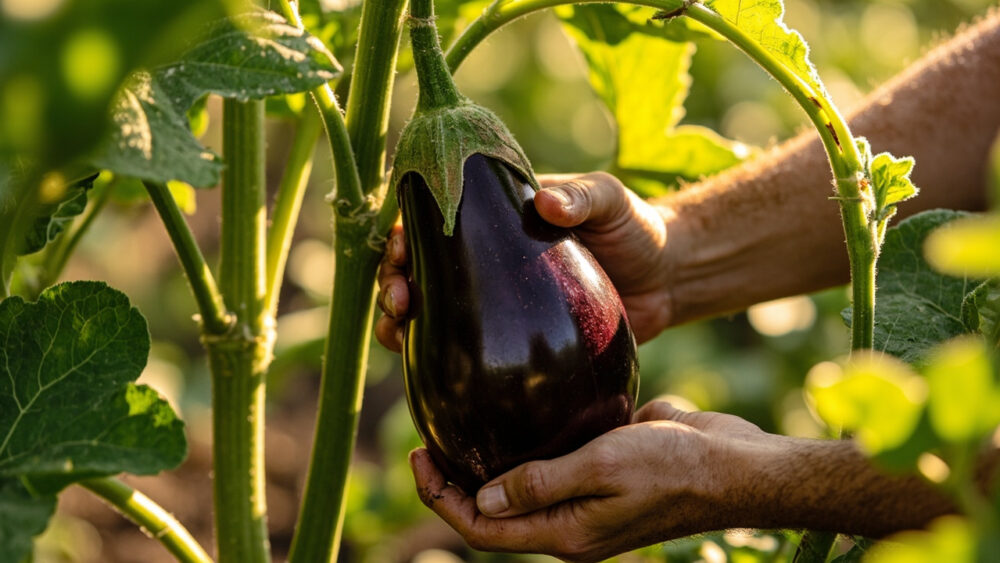
Harvest eggplant when the skin is glossy and taut, not dull. A dull, tough skin means you waited too long, and the fruit inside will be bitter and full of hard seeds.
The press test settles it fast: press a finger gently into the skin. If it springs back, it’s ready. If the dent stays, it’s overripe.
Most varieties reach harvest size in 60 to 85 days from transplant, but size varies wildly by type, from small 3-inch Asian varieties to large globe types 6 inches or more across. Go by shine and spring, not by size alone.
Cut, don’t pull, using pruning shears or a knife, leaving a short stub of stem attached to each fruit. The stems are stiff and the calyx is often mildly spiny, so pulling can tear the branch.
Regular picking, every few days once fruiting starts, keeps the plant producing instead of pouring energy into a few oversized fruits.
That’s the whole cycle start to finish, and here’s the card to keep it all in one place.
Eggplant at a Glance
- When to plant: Set transplants out 2 to 3 weeks after last frost, once soil is at least 65°F and nights stay above 55°F.
- Sun and soil: Full sun, 6 to 8 hours minimum, in loose, well-drained, compost-rich soil with a pH of 6.0 to 6.8.
- Spacing and depth: Plant at the same depth as the pot, spaced 18 to 24 inches apart in rows 24 to 30 inches apart.
- Watering: About 1 to 1.5 inches per week, steady rather than in swings, checked by feeling soil moisture 2 inches down.
- Feeding: Balanced fertilizer at planting, then a lower-nitrogen feed once flowering starts to avoid all-leaf, no-fruit plants.
- Watch for: Flea beetles, aphids, spider mites, verticillium wilt, and blossom end rot from uneven watering.
- Harvest: Pick when skin is glossy and springs back under gentle pressure, typically 60 to 85 days from transplant, cutting rather than pulling.
Get the transplant timing and steady watering right, and eggplant mostly takes care of itself from there.
Everything else on this list is just cleanup around those two decisions.