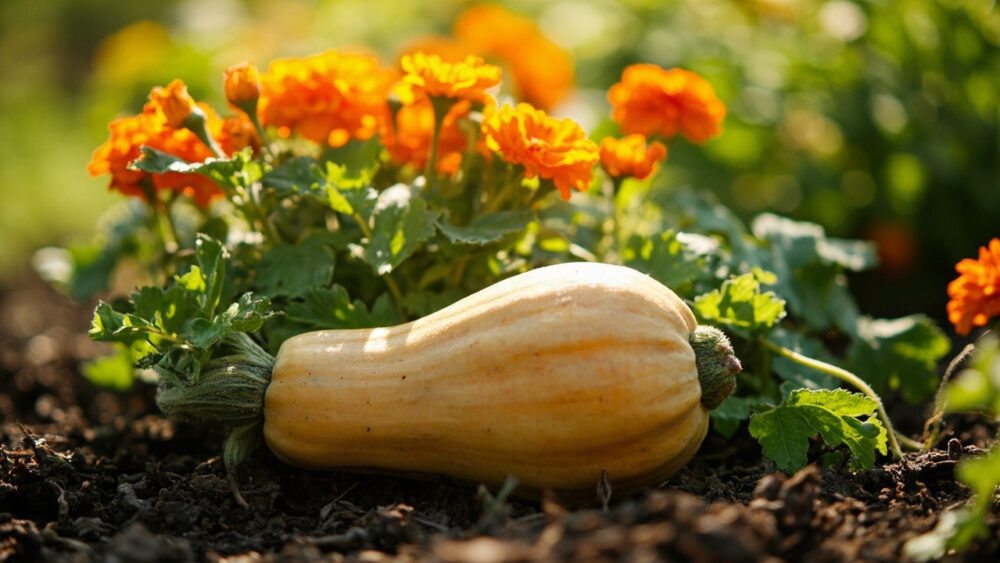
The best companion plants for butternut squash are bush beans, corn, radishes, dill, nasturtiums, and marigolds, planted so the squash’s sprawling vines get to do their job while the others handle pest control, pollination, and soil nitrogen. Skip anything in the cucurbit family nearby, and go easy on potatoes too. That much solves the basic question.
But there is a mistake that wrecks most butternut companion plantings before July even shows up, and it has nothing to do with which plants you picked. It is spacing. Butternut vines run 8 to 12 feet, and if you plant your companions inside that footprint without accounting for where the vine is headed, you will spend August ripping out plants that got buried alive.
There is also a sign most people misread completely: a butternut plant loaded with big yellow blossoms and zero fruit. Everyone assumes pest damage or bad soil. The real answer is almost always about the flowers themselves, and I will get to it below. Stick around, because the save-able Butternut Squash at a Glance card at the bottom has the spacing, timing, and companion list in one place for your phone.
Why Companion Planting Actually Matters Here
Butternut squash is a heavy feeder with shallow roots and a long season, roughly 90 to 110 days from transplant to harvest. That is a lot of time for squash bugs, vine borers, and cucumber beetles to find it.
Good companions do one of three jobs: they pull pollinators in for those big one-day blossoms, they repel or confuse the pests that specifically target squash, or they fix nitrogen in soil that a heavy feeder will otherwise strip bare by mid-season.
None of this is decoration. Skip it and you are just growing squash in isolation, hoping for the best.
Here is what earns a spot in the bed, and what does not.
The Best Companions, and What Each One Actually Does
Bush Beans
Beans fix nitrogen in the soil through bacteria on their roots, feeding the heavy appetite of squash without you having to add extra fertilizer mid-season. Bush varieties, not pole beans, stay low enough to coexist with sprawling vines. Plant them a few weeks before or alongside your squash, spaced about 4 to 6 inches apart along the bed edges.
That nitrogen boost only helps if the beans get enough light of their own.
Corn
This is the classic Three Sisters logic, and it holds up. Corn gives the squash vines dappled shade at the soil line, which helps keep roots cooler and slows moisture loss on hot afternoons.
The squash’s big leaves in turn shade out weeds around the corn’s shallow roots. Plant corn about 12 inches apart in blocks, not single rows, for better pollination.
It is a genuine partnership, not folklore.
Radishes
Radishes are a sacrificial crop and a scout in one. Squash bugs and cucumber beetles will often hit radishes first, buying your squash time. Radishes also mature in 25 to 30 days, so they are gone before the squash vines need the space.
Tuck them in early, right at planting, in the gaps between squash mounds.
Fast crops like this are the easiest companion win most gardeners skip entirely.
Dill and Other Umbellifers
Dill, fennel flowers, and cilantro left to bolt all attract parasitic wasps and hoverflies, both of which prey on squash bug eggs and aphids. This is pest control that works while you are doing something else.
Let a few plants flower on purpose. A dill plant that never bolts is not doing this job.
This is also where the “flowers but no fruit” mystery starts to make sense.
Nasturtiums and Marigolds
Nasturtiums act as a trap crop, pulling aphids and squash bugs onto themselves and away from your main plants. Marigolds are a mixed bag, some gardeners see real nematode suppression in the soil, others mostly get the pollinator draw from the blooms.
Either way, both plants pull in the bees your squash flowers depend on.
Which brings us to the actual reason for all those flowers with nothing behind them.
The Blossom Mystery, Solved
Squash plants produce male flowers first, sometimes for two to three weeks, before any female flowers show up. Male flowers have a thin straight stem. Female flowers have a small bulb, the baby fruit, right behind the petals.
If your plant is all bloom and no squash early on, it is not disease and it is not your soil. It is just male flowers doing their thing before the plant is ready to fruit.
Once females appear, poor pollination is the next likely culprit, especially if bee traffic is low. This is exactly why nasturtiums, marigolds, and bolting dill earn their space in this bed, they are working pollinator insurance, not just pretty filler.
Guessed pests. It was timing and bees the whole time.
What to Never Plant Near Butternut Squash
Other cucurbits top this list: cucumbers, melons, pumpkins, and zucchini. They share the exact same pests and diseases, powdery mildew, squash bugs, cucumber beetles, and squash vine borer, so planting them together just concentrates the problem instead of spreading the risk.
Worse, they cross-pollinate readily within some species groups, which will not hurt this year’s fruit but can produce strange results if you save seed.
Potatoes are a softer no. Both are heavy feeders competing for the same nutrients and both attract overlapping pests, so yields on both crops tend to suffer when they share a bed.
Space matters as much as species here, and that is the next mistake worth avoiding.
Laying Out the Bed So Nothing Gets Smothered
Give each butternut plant a mound with 3 to 4 feet between plants and rows 6 to 8 feet apart, because those vines are going somewhere and you need to know where before you plant anything else.
Put fast, low companions like radishes and bush beans on the outer edges of that footprint, not in the direct path where a vine will run by midsummer.
Save corn or trellised companions for the north or east side of the bed so they do not shade out the squash’s sun once the vines fill in.
Nasturtiums can go right at the base of the mound. They will get overrun eventually, and that is fine, they have already done their pollinator-pulling and trap-cropping work by then.
Get the layout right at planting, because you cannot fix crowding in July without cutting something back.
The Companion Myths That Do Not Hold Up
Marigolds as a total pest repellent is the biggest overstatement in companion planting. They help with certain soil nematodes and draw pollinators, but they will not stop a squash bug infestation on their own.
Another common claim: that basil or garlic planted nearby will meaningfully repel squash vine borers. There is no strong evidence for this, and gardeners who rely on it as their only defense usually get surprised in August when the vine collapses anyway.
Companion planting improves odds. It is not a substitute for scouting your plants weekly for eggs, frass, or wilting vines.
Treat it as one layer of defense, not the whole strategy, and the rest of your season goes a lot smoother.
Butternut Squash at a Glance
- When to plant: direct sow or transplant 1 to 2 weeks after your last frost, once soil hits at least 65 F.
- Spacing: 3 to 4 feet between plants, 6 to 8 feet between rows, since vines run 8 to 12 feet.
- Planting depth: seeds about 1 inch deep, transplants set at the same depth they grew in the pot.
- Best companions: bush beans, corn, radishes, dill left to flower, nasturtiums, marigolds.
- Never plant nearby: cucumbers, melons, pumpkins, zucchini, and go easy on potatoes.
- Days to harvest: roughly 90 to 110 days from transplant, when the rind is deep tan and resists a fingernail.
- Watch for: squash bugs, cucumber beetles, and vine borers, all worth scouting weekly rather than trusting companions alone.
Pick companions that earn their space through nitrogen, pollinators, or pest distraction, not folklore.
Give the vine room before you plant anything else, and the rest of the bed takes care of itself.