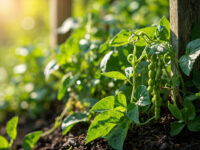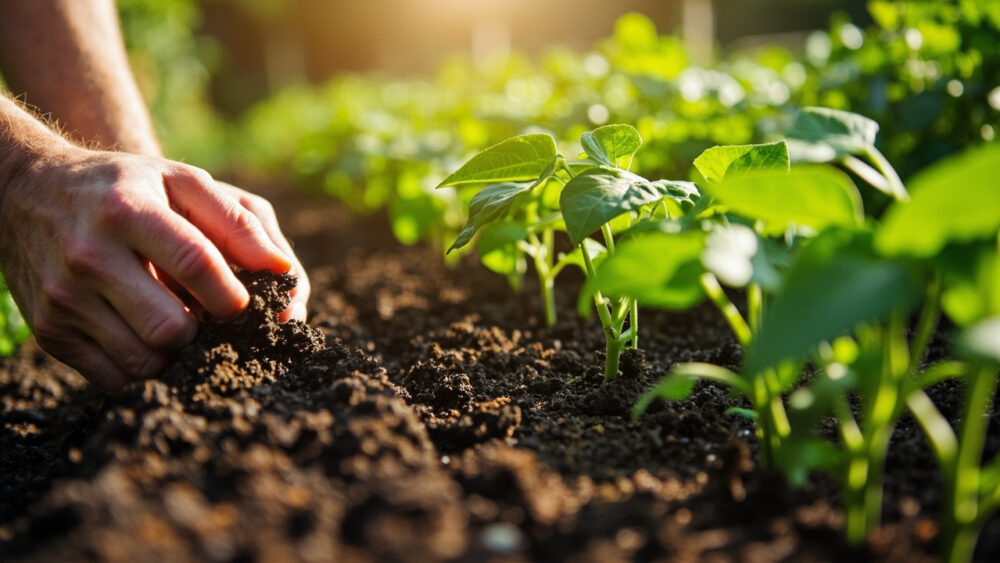
Plant bush beans 3 to 4 inches apart within the row, with rows spaced 18 to 24 inches apart, and push each seed 1 inch deep into warm soil. That is the number that matters most when you’re figuring out how far apart to plant bush beans, and if you only came for that, you have it. But the spacing on the seed packet is a starting point, not the whole story, and getting it wrong is the single most common reason a bean row looks great in June and turns into a moldy, low-yielding mess by August.
Here’s what most people get backwards: they think tighter spacing means more beans per square foot. It doesn’t, past a certain point, and I’ll show you exactly where that point is and what happens on both sides of it.
There’s also a fix for the overcrowded row you probably already planted too thick, and a straight answer on container spacing that most guides skip entirely. Stick around, because the save-able Bush Beans at a Glance card is waiting at the bottom with every number in one place.
The Exact Spacing and Depth, and Why These Numbers Aren’t Arbitrary
Bush beans want 3 to 4 inches between plants in the row, seeds sown 1 inch deep in soil that has warmed to at least 60°F. Colder soil just sits there and rots the seed instead of sprouting it.
That 3 to 4 inch number isn’t a random average from a seed company. Bush bean plants top out around 12 to 18 inches tall and nearly as wide, and each one needs enough root room to pull the water and nitrogen it takes to fill pods.
Crowd them closer than 3 inches and you’re not getting more beans, you’re getting more competition. Space them wider than 6 inches and you’re wasting bed space the plants would have filled anyway.
Depth matters almost as much as spacing, and it’s the part people rush.
The Depth Mistake Almost Everyone Makes
If you assumed deeper planting means a sturdier, more drought-resistant plant, that guess is exactly backwards for beans. Bean seeds are shallow-rooted starters, and planted too deep, many simply never make it to the surface with enough energy left to open their first leaves.
One inch deep is the real number, maybe 1.5 inches in sandy soil that dries fast, slightly shallower in heavy clay that crusts over. Press the soil down firmly after planting so the seed has good contact with moisture, but don’t compact it into a brick.
Water right after planting, then keep the top inch of soil consistently damp, not soaked, until you see the seedlings’ hooked stems break the surface, usually in 7 to 14 days depending on soil temperature.
Get the depth right and you’ve solved half the battle before the plant even shows a leaf.
Row Spacing and Bed Layout Options
Between rows, give bush beans 18 to 24 inches. That gap isn’t just for your feet and a hoe, it’s airflow, and airflow is what keeps bean foliage dry enough to dodge fungal disease.
In a traditional row garden, plant single rows 18 to 24 inches apart, seeds 3 to 4 inches apart within each row. That’s the classic layout and it works.
In a raised bed or square-foot style garden, you can plant a grid instead, with plants on 4 inch centers in every direction. Beds let you skip the wasted walking-path space that row gardens need.
- Traditional rows: 18 to 24 inches between rows, 3 to 4 inches within the row.
- Raised bed grid: roughly 4 inch centers, no true “rows” needed.
- Wide row/band planting: a 6 to 8 inch wide band with seeds scattered 3 to 4 inches apart, rows of bands 24 inches apart.
Whichever layout you pick, the plant-to-plant distance matters more than the shape of the garden around it.
What Actually Goes Wrong When Beans Are Too Close
Here’s the mistake that costs most people their harvest: they plant thick “for insurance” against poor germination, then don’t thin. The result isn’t a fuller row, it’s a weaker one.
Overcrowded bush beans compete hard for light, so plants grow tall and leggy instead of bushy, and pod production drops because the plant is spending its energy reaching for sun instead of filling pods. Airflow disappears between plants, and damp, still air sitting on wet leaves is exactly what invites white mold, rust, and bacterial blight, the diseases that turn a bean patch brown from the ground up in a wet summer.
Crowding also makes harvest miserable. You’ll be parting a solid wall of foliage to find pods, and you will miss plenty, letting them go tough and stringy while you’re not looking.
Too far apart has its own quiet cost, and it’s the one nobody warns you about.
The Honest Answer About Planting Too Far Apart
Spacing wider than 6 inches doesn’t hurt individual plants, they’ll actually grow bigger and bushier with all that elbow room. The real cost is yield per square foot.
Wide spacing wastes garden space you could have used, and it opens bare soil between plants where weeds move in fast and where summer sun bakes moisture out quicker. You’ll be watering and weeding more for the same total harvest.
Bush beans aren’t like tomatoes or squash, where one oversized plant can dominate a bed and justify the room. Beans max out at a modest size no matter how much space you give them, so extra spacing past 6 inches buys you nothing but more open dirt.
If tight spacing is the disease-and-yield mistake, wide spacing is the quiet efficiency mistake, and both are fixable before it’s too late.
Fixing an Overcrowded Planting
If your seedlings are already up and clearly touching leaves at 1 to 2 inches apart, thin them now, don’t wait. The longer crowded seedlings compete, the more stunted the whole row gets.
Snip, don’t pull. Use small scissors to cut unwanted seedlings at the soil line instead of yanking them, since pulling disturbs the roots of the neighboring plant you’re trying to keep.
Thin to your target 3 to 4 inch spacing, choosing the strongest, most upright seedlings to keep and removing the weak or leaning ones first. Do this once plants have their first true leaves, generally 10 to 14 days after emergence.
It feels wasteful to cut healthy seedlings, but a thinned row of 3 inch spacing will outproduce an unthinned wall of 1 inch spacing every time.
Container and Small-Space Spacing
Growing bush beans in a container instead of a bed doesn’t change the plant’s needs, just the math. Use a container at least 8 to 10 inches deep so roots have room, and space plants 4 to 6 inches apart within it, erring toward the wider end since containers have less buffer for root competition and drain faster than garden soil.
A 12 inch diameter pot comfortably holds 3 to 4 bush bean plants. A standard half whiskey barrel or large grow bag can handle 6 to 8.
Container beans dry out faster than ground beans, so check soil moisture daily in hot weather, not just every couple of days like you might with an in-ground row.
Get the container spacing right and you can grow a real bean harvest on a deck or patio, no row garden required.
Bush Beans at a Glance
- When to plant: after your last frost, once soil hits at least 60°F, ideally 65 to 85°F for fastest germination.
- Seed spacing: 3 to 4 inches apart within the row.
- Row spacing: 18 to 24 inches between rows.
- Planting depth: 1 inch deep, slightly deeper in sandy soil, slightly shallower in heavy clay.
- Germination time: 7 to 14 days depending on soil temperature.
- Container spacing: 4 to 6 inches apart, in a pot at least 8 to 10 inches deep.
- Thin overcrowded seedlings: at the first true leaf stage, cutting extras at the soil line rather than pulling.
Get the spacing right once at planting, and you skip the thinning, the mildew, and the disappointing pod count later.
That’s the whole job: 1 inch deep, 3 to 4 inches apart, and enough room between rows for air to move.