You grow coconuts by planting a whole, mature, husked coconut about two-thirds buried at an angle in warm, sandy, well-draining soil, in a spot that never sees temperatures below about 50°F, and then waiting. That last part is the honest answer nobody wants: a coconut palm takes six to ten years to fruit from seed, longer if conditions are marginal. If you’re learning how to grow coconuts because you want fruit soon, you need to know that going in.
Here’s what trips people up almost every time. They plant the nut too deep, or fully buried, and it rots before it ever sprouts. They plant it somewhere that dips into the 40s some winter night and wonder why a “tropical plant” just stalled out and died. And nearly everyone underestimates how much room the root system and the eventual 60 to 80 foot canopy actually need.
I’ll walk through timing, siting, planting technique, feeding, the problems that actually kill these palms, and when you can finally expect a harvest. Save the “Coconuts at a Glance” card at the very bottom for the numbers you’ll want on hand later.
When to Plant a Coconut
Coconuts are strictly tropical to warm-subtropical plants. You need USDA zone 10b or 11, essentially frost-free ground, with average lows staying above 50°F even on cold nights.
Plant in spring or early summer, once nighttime temperatures are reliably in the 60s and soil has warmed. A cool snap while the sprout is establishing can stall or kill it outright.
If you’re outside true tropical zones, you’re growing this in a container as a houseplant or greenhouse specimen, and you should set expectations for foliage, not fruit.
Your climate decides almost everything else that follows.
Choosing the Spot and Prepping the Soil
Coconut palms want full sun, at minimum six to eight hours, and they want it from day one. Pick a spot with at least 20 to 25 feet of clearance from structures, power lines, and walkways, because a mature palm and its falling nuts are heavier and more dangerous than people expect.
Soil should be sandy and fast-draining, ideally with a pH between 5.5 and 7.5. These palms are famously tolerant of poor, sandy, even slightly saline soil, which is exactly why they line beaches. What they will not tolerate is standing water around the roots.
If your ground is heavy clay, amend generously with coarse sand and organic matter, or build a raised mound 8 to 12 inches high so water sheds away from the planting site.
Get the drainage wrong here and nothing you do later will fix it.
Planting a Coconut Step by Step
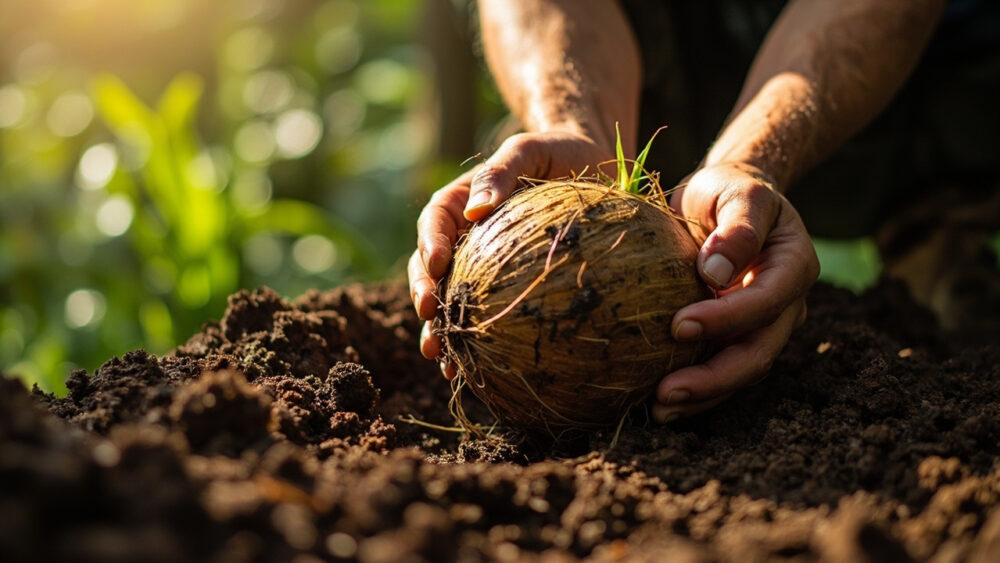
The biggest guess people make is that a coconut needs to be fully buried, like a bulb or a big seed. It doesn’t, and burying it completely is one of the fastest ways to rot it before it sprouts.
Step-by-step
- Start with a viable nut: use a mature, brown, husked coconut, ideally one that already shows a sprout or sloshes with water when shaken, confirming it’s still fertile.
- Dig a shallow hole or trench: depth should bury only about two-thirds of the nut, roughly 6 to 8 inches deep depending on the nut’s size.
- Angle it, don’t stand it straight up: lay the coconut on its side at a slight tilt, with the pointed “eye” end angled slightly upward and partly exposed to air.
- Space generously: if planting more than one, give each nut a minimum of 25 to 30 feet from the next, matching the palm’s mature spread.
- Water in, then back off: soak thoroughly at planting, then let the top few inches dry between waterings while you wait for germination.
Germination is slow by any normal garden standard, often three to six months, sometimes longer.
Once you see a shoot, the real waiting game for feeding and watering begins.
Watering and Feeding Through the Season
Young coconut palms want consistent moisture, not soggy soil. Water two to three times a week during establishment, checking that the top 2 to 3 inches of soil dry out slightly between soakings.
Mature palms are drought-tolerant once established but still perform best with regular water through hot, dry stretches, especially in the first two to three years.
Feed with a palm-specific fertilizer formulated with extra magnesium, manganese, and potassium, since coconut palms are notorious for deficiencies in exactly these nutrients. Apply on the schedule listed on the product label, typically three to four times a year during the growing season.
Yellowing or translucent streaking in new fronds is usually a nutrient deficiency, not a watering problem, and it’s the sign most people misread.
That misread symptom is also your first clue something in the next section is worth watching for.
Problems That Actually Take These Palms Down
If you assumed pests would be the main threat, that’s a reasonable guess, but nutrient deficiency and cold damage kill far more backyard coconut palms than any bug does.
Cold snaps below the mid-40s can brown fronds and stunt or kill young palms outright. There’s no real recovery protocol beyond removing dead tissue and hoping the growing point survived; a damaged growing point usually means starting over.
Lethal yellowing, a disease spread by insects, causes premature nut drop and progressive frond death, and it has wiped out coconut plantings across parts of Florida and the Caribbean. There’s no home cure; management is cultural and preventive, and severely affected palms typically need removal.
Watch too for rhinoceros beetles and scale insects, which show up as chewed new growth or sticky, spotted fronds. Follow any pesticide label exactly if treatment becomes necessary, and lean on good sanitation and plant vigor as your first defense.
Get the palm through its first few winters and past deficiency symptoms, and you’re finally in harvest territory.
When and How to Harvest
A coconut palm typically starts flowering and setting its first nuts at six to ten years of age, though some vigorous dwarf varieties can begin closer to four or five years. This is the follow-up question everyone has and the honest answer disappoints a lot of first-time growers.
Nuts mature roughly 10 to 12 months after the flower is pollinated. For drinking coconuts, harvest green, when the husk is still bright and the water inside is abundant and sweet, usually 6 to 7 months after pollination.
For mature coconuts destined for meat, oil, or milk, wait until the husk turns brown and the nut sounds full and sloshy when shaken, and you’ll often see nuts drop naturally to the ground when fully ripe.
Harvest by cutting the stem with a long-handled pole knife or by letting ripe nuts fall onto cleared, soft ground, never by climbing without proper safety gear.
Once you’re harvesting regularly, a healthy palm can produce 50 to 100 or more nuts a year for decades.
Coconuts at a Glance
- When to plant: spring to early summer, once nights stay reliably above 60°F and soil has warmed.
- Where it grows outdoors: USDA zones 10b to 11, frost-free areas with lows staying above 50°F.
- Planting depth: bury the nut about two-thirds deep, roughly 6 to 8 inches, angled with the eye end partly exposed.
- Spacing: at least 25 to 30 feet between palms to match mature canopy spread.
- Water needs: consistent moisture while young, drought-tolerant once established, never soggy soil.
- Feeding: palm-specific fertilizer with added magnesium, manganese, and potassium, three to four times yearly.
- Time to harvest: six to ten years to first fruit, then 10 to 12 months from flower to mature nut.
Coconuts reward patience more than skill, the soil and sun matter less than the years you’re willing to give it.
Get the drainage and the depth right at planting, and time is the only ingredient left to add.