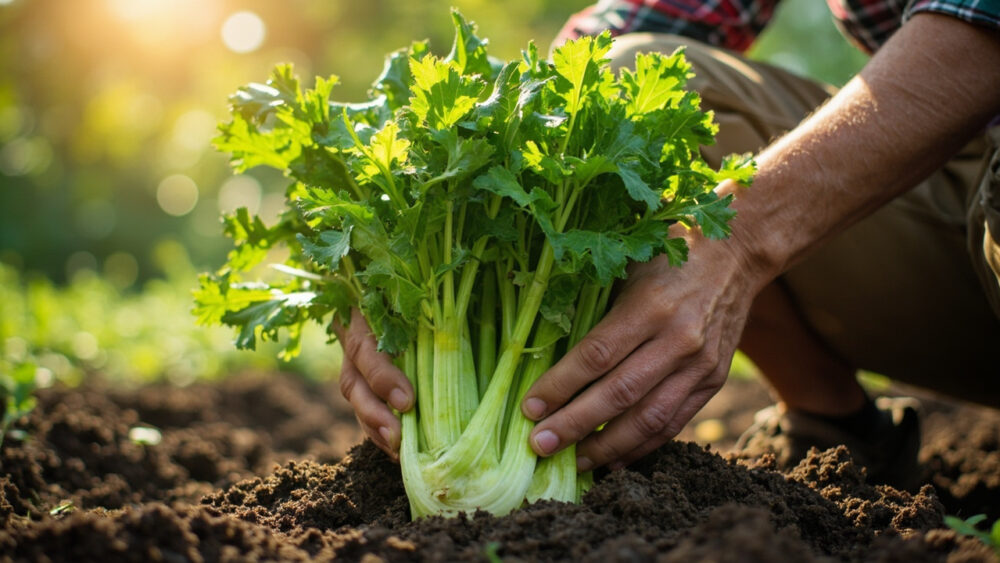
Here is how to grow celery without the frustration most first-timers hit: start with transplants (not direct-seeded, unless you have a long cool season), give it rich, constantly moist soil, and expect a long haul of 85 to 130 days from transplant to harvest. Celery is not hard to grow so much as it is unforgiving of shortcuts, and it wants steady moisture and steady cool-to-mild temperatures more than any vegetable in the average garden.
Most home attempts stall out for one specific reason that has nothing to do with fertilizer or sun. There is also a sign gardeners see in July that they almost always misread as a nutrient problem when it is actually something else entirely.
And there is an honest answer coming about whether you really need to blanch your celery stalks white, because a lot of what you have read about that is optional theater, not a requirement. Stick around for the Celery at a Glance card at the bottom, it is the quick-reference version of everything below, worth saving to your phone before you head out to the garden.
When to Plant Celery
Celery is a cool-season crop with a strange split personality: the seedlings need warmth to germinate, but the mature plant hates heat and will bolt or turn bitter above about 80°F for extended stretches.
Start seed indoors 10 to 12 weeks before your last spring frost date, since celery seed is slow, often taking 2 to 3 weeks just to germinate at 70 to 75°F. Transplant outside 2 to 3 weeks after your last frost, once nighttime temperatures reliably stay above 40°F and soil has warmed into the 50s.
In zones 3 to 6, that spring window is your main shot. In zones 7 to 10, a fall crop timed to mature in cool weather often outperforms spring celery, since it never has to fight summer heat while sizing up.
Get the timing right and the rest of this gets much easier.
Choosing the Spot and Prepping the Soil
Celery wants full sun in cool climates, but in hot-summer regions it does better with afternoon shade to keep roots cool. Either way, the soil matters more than the sun exposure.
Work in 2 to 3 inches of compost or aged manure before planting. Celery has a shallow, fibrous root system and cannot chase down nutrients or moisture the way a tomato can, so it depends entirely on soil that is already loaded and holds water well.
Aim for a pH between 6.0 and 6.8. Raised beds or heavily amended garden soil both work, but thin, sandy, fast-draining soil is genuinely a bad match for this crop unless you are prepared to water almost daily.
This is also where most celery crops are quietly won or lost, before a single seedling goes in the ground.
Planting Celery Step by Step
Hardening Off and Transplanting
- Harden off transplants over 5 to 7 days, giving them increasing outdoor time to toughen up before the move.
- Space plants 8 to 10 inches apart in rows 18 to 24 inches apart. Tighter spacing gives smaller stalks; wider spacing gives you bigger, thicker ones.
- Plant at the same depth the seedling was growing in its container. Celery does not like being buried deeper, unlike tomatoes.
- Water in immediately and keep the soil surface consistently damp for the first 2 weeks while roots establish.
If you’re direct-seeding in a long, cool-season climate, sow seed 1/8 inch deep, since it needs light to germinate and buried seed often fails to sprout at all.
Getting plants in the ground correctly buys you nothing if the watering routine falls apart next, and that is where celery usually gets punished.
Watering and Feeding Through the Season
This is the mistake that sinks most attempts: letting the soil dry out, even briefly, between waterings. Celery’s shallow roots cannot tolerate drought stress, and the plant responds by turning stringy, hollow, and bitter, sometimes permanently.
Water enough to keep the top 2 to 3 inches of soil consistently moist, not soggy, checking by feel every couple of days. In hot or windy weather that can mean watering every day. A 2 to 3 inch layer of mulch around the base helps enormously by holding that moisture and keeping soil temperature down.
Feed every 3 to 4 weeks with a balanced fertilizer, or side-dress with compost, since celery is a heavy feeder that runs out of gas in average garden soil by midseason.
Now for that midsummer sign almost everyone misreads: if the inner stalks start looking pale, thin, and the plant seems stalled, the reflex is to blame nitrogen. Usually it is heat stress or inconsistent watering, not a hungry plant, and dumping on more fertilizer at that point does nothing but waste it.
Keep that root zone evenly damp and most of celery’s other problems shrink on their own.
Problems That Actually Show Up
Bolting is the big one: a sudden hot spell or a cold snap below about 40°F can trigger the plant to send up a flower stalk and give up on making good eating stalks. There is no fix once it bolts, only prevention through steady temperatures and consistent moisture.
Blackheart shows up as blackened, dying growth at the center of the plant, caused by a calcium shortage that is almost always really a watering-consistency problem, not a soil-additive problem. Even moisture solves it far more reliably than a calcium spray.
Slugs, aphids, and celery leaf miners are the common pests. Handpick slugs or use a bait labeled for them, and for aphids or leaf miners, follow the label on an insecticidal soap or appropriate product rather than improvising a treatment.
Fungal leaf spots (often called early blight or late blight of celery) show up as brown or yellow spots on leaves in humid weather. Improve airflow, avoid wetting foliage when you water, and treat with a labeled fungicide if it spreads.
Get through these and you’re on the home stretch, which brings up the blanching question.
Do You Need to Blanch Celery, and When to Harvest
Here is the honest answer: blanching, wrapping stalks in cardboard or soil to block light and turn them pale, is optional, not required. It produces the mild, pale-green stalks you see in stores, but unblanched celery is fully edible, just a bit stronger-flavored and greener. Skip it if you don’t feel like fussing with it.
Harvest is ready 85 to 130 days after transplanting, depending on variety, once stalks reach 12 to 18 inches tall and feel firm and crisp when snapped, not spongy.
You can harvest the whole plant at once by cutting at soil level, or take outer stalks a few at a time over several weeks and let the center keep growing, which stretches your harvest window considerably.
Harvest before a hard freeze, since celery tolerates light frost fine but real cold turns it limp and ruins texture fast.
That is the full arc, start to finish, and here is the quick version to keep on hand.
Celery at a Glance
- When to plant: start seed indoors 10 to 12 weeks before last frost, transplant out 2 to 3 weeks after last frost once soil is in the 50s.
- Spacing and depth: 8 to 10 inches apart, rows 18 to 24 inches apart, planted at the same depth as the container.
- Soil: rich, moisture-retentive, amended with 2 to 3 inches of compost, pH 6.0 to 6.8.
- Watering: keep the top 2 to 3 inches of soil consistently moist, daily in hot weather, mulch to help hold it.
- Feeding: balanced fertilizer or compost every 3 to 4 weeks through the season.
- Watch for: bolting from heat or cold swings, blackheart from inconsistent watering, slugs and aphids.
- Harvest: 85 to 130 days from transplant, stalks 12 to 18 inches tall and firm, before hard frost.
If you remember one thing, remember this: celery forgives almost nothing when it comes to moisture, and forgives almost everything else.
Keep that root zone damp all season and the rest of this guide is mostly backup.