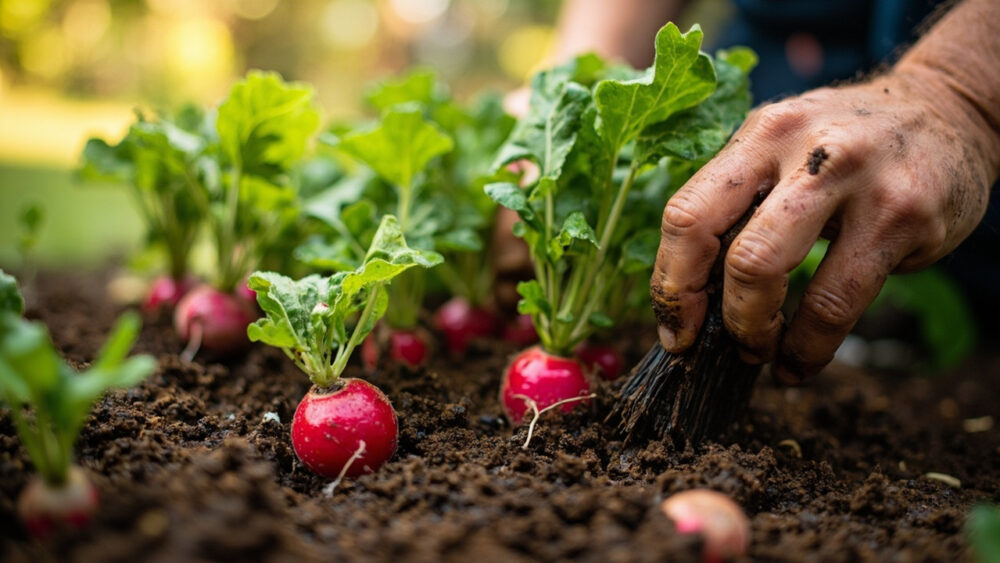
Radishes move through five distinct stages between seed and harvest, and the whole trip takes just 21 to 35 days depending on the variety and how warm the soil is. You’ll see a seedling with two rounded leaves inside a week, a rosette of true leaves by week two, and a swelling root you can feel at the soil line by week three. Understanding these radishes growing stages is really the whole game, because radishes don’t give you many chances to correct course once you’re behind.
Here’s the thing almost nobody expects: the stage where most radish crops quietly fail isn’t germination, it’s the leafy stretch right in the middle, and the damage doesn’t show up until it’s too late to fix. There’s also a sign gardeners misread constantly, mistaking a totally normal growth phase for a stalled or dying crop and pulling perfectly good radishes a week too early.
Stick around and I’ll walk through every stage, tell you exactly what a healthy radish looks like at each point versus one that’s in trouble, and hand you a save-able Radishes at a Glance card at the bottom with every number you need for this season.
Stage 1: Germination, Days 1 to 7
Radish seeds need soil temperature between 45 and 85 F to sprout, and they’re fastest around 65 to 70 F, popping up in as little as 3 days. Below 50 F, germination stretches to 10 days or more and gets patchy.
Sow seeds a half inch deep, about 1 inch apart, in loose soil free of rocks and clumps. Radishes push a straight taproot down immediately, and anything that blocks it produces a forked or stunted root later.
Keep the top inch of soil consistently damp during this week. Dry out even once and germination stalls hard.
Once you see the first pair of round seed leaves, called cotyledons, standing up, germination is done and the real growing begins.
Stage 2: Seedling and True Leaves, Days 7 to 14
This is when the plant grows its first true leaves, the jagged, slightly fuzzy ones that look nothing like the smooth cotyledons. By day 14 you should have 3 to 5 true leaves and a small rosette shape close to the ground.
Thinning happens now, and it is the single most skipped step in growing radishes. Crowded seedlings fight for root space and you’ll harvest a bunch of skinny, mostly-green nothing at the end.
Thin to one plant every 2 inches for small round varieties, 3 inches for larger French breakfast or daikon types. Snip at soil level with scissors instead of pulling, so you don’t disturb the roots of the seedlings you’re keeping.
This is also the stage everyone underestimates, and skipping it is the mistake that ruins more radish crops than pests, disease, and bad weather combined.
Stage 3: Vegetative Growth, Days 14 to 25
Leaves get bigger, greener, and more upright, and the plant is now building the sugar reserves it will dump into the root. This is the stretch where most things quietly go wrong, because the plant looks fine above ground while trouble builds below it.
Consistent moisture matters more here than at any other stage. Radishes want roughly 1 inch of water a week, delivered evenly rather than in a flood-then-drought cycle.
Uneven watering during this phase is the real cause behind cracked, woody, or fiercely hot-tasting radishes, not overwatering, which is the guess most people make and get wrong. A radish that dries out and then gets soaked doesn’t slow down, it panics and turns bitter and tough as a defense response.
Full sun, at least 6 hours a day, keeps growth moving instead of stretching the leaves at the root’s expense.
If the leaves look lush but the base at soil level still feels thread-thin, the plant isn’t stalled, it just hasn’t started swelling yet, and that’s the next stage to watch for.
Stage 4: Root Swelling, Days 20 to 30
This is the stage everyone misreads. The root visibly pushes up out of the soil, sometimes cracking the surface, and a lot of gardeners assume that means the plant is stressed or bolting and yank it early.
That shoulder poking above ground is completely normal for most round varieties. It’s a sign the root is filling out, not a warning sign at all.
Check size by feel, not by sight alone. Gently brush soil away from the top and judge the diameter: most standard round radishes are ready between 3/4 inch and 1.5 inches across.
Stop nitrogen fertilizer completely by this point if you used any. Extra nitrogen now pushes leaf growth at the root’s expense and you’ll end up with a beautiful top and a marble-sized radish.
Once that root hits harvest size, the clock starts working against you instead of for you.
Stage 5: Maturity and the Harvest Window
Most radish varieties mature between 21 and 35 days from seeding, with small round types like Cherry Belle on the fast end and daikon or watermelon radishes taking closer to 50 to 60 days. Warmer weather speeds every stage up, but it also shortens your harvest window on the back end.
The honest answer to the question you’re probably about to ask: no, you can’t just leave mature radishes in the ground like carrots. Once they hit peak size, you’ve usually got 5 to 7 days before they start turning spongy, cracking, or going hollow in the center, especially once temperatures climb above 75 F.
Pull one to check. If the flesh is dense and crisp with no hollow ring in the center, harvest the rest of the bed within a few days.
Miss that window in hot weather and the whole planting can go from perfect to pithy in under a week, which is why successive small sowings every 10 to 14 days beat one big planting almost every time.
Healthy Progress Versus a Real Stall
A radish that’s genuinely stalled has pale, small true leaves that stay purplish or yellow past day 10, and roots that are still hair-thin by day 20. That usually points to cold soil, dense clay, or seedlings that never got thinned.
A radish that just looks stalled but isn’t will have dark green, upright leaves and a root you can feel thickening under the surface even if nothing shows above ground yet.
When in doubt, dig one up. Sacrificing a single plant to check root size tells you more in ten seconds than another week of guessing.
With the timeline clear, here’s everything worth saving before you head back out to the garden.
Radishes at a Glance
- When to plant: as soon as soil can be worked in spring, 3 to 4 weeks before your last frost, and again in late summer for a fall crop once soil cools below 75 F.
- Soil temperature for germination: 45 to 85 F, ideal around 65 to 70 F, sprouting in 3 to 10 days depending on warmth.
- Planting depth and spacing: sow 1/2 inch deep, 1 inch apart, then thin to 2 inches for small round types and 3 inches for larger varieties.
- Days to maturity: 21 to 35 days for most round varieties, 50 to 60 days for daikon and other large types.
- Water needs: about 1 inch per week, kept even, since inconsistent watering is the top cause of cracked, hot, or woody roots.
- Harvest size and window: pull round varieties at 3/4 to 1.5 inches across, and harvest within 5 to 7 days of reaching size before they turn spongy or hollow.
- Biggest mistake to avoid: skipping thinning, which crowds roots and produces mostly leafy, undersized radishes.
Radishes reward attention more than effort. Check size by feel around day 20, keep the water steady, and you’ll rarely miss the window.