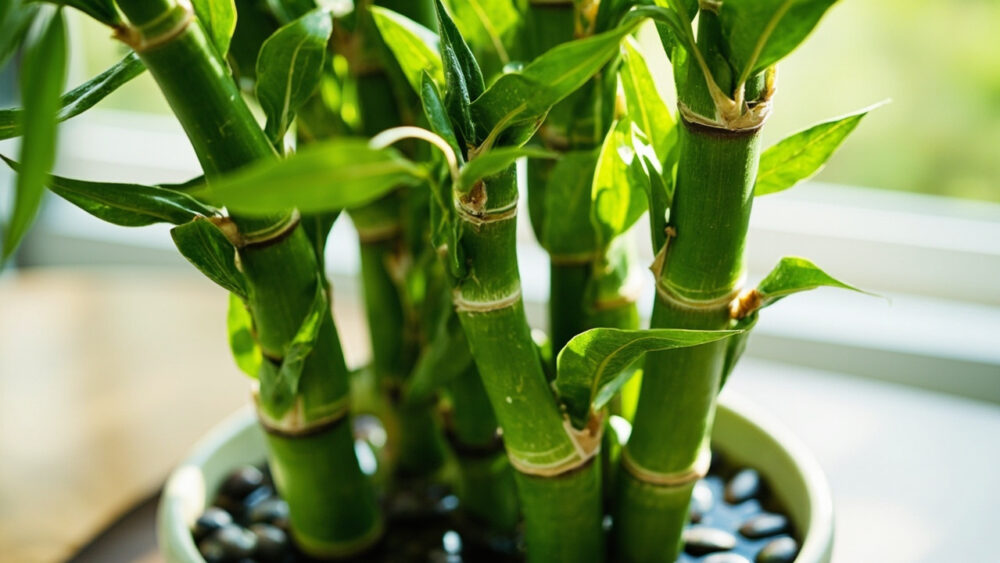
If your lucky bamboo lives in water, the honest answer to how often to water lucky bamboo is: top off or change the water every 7 to 10 days, and do a full water change every 2 to 3 weeks. If it’s planted in soil, water when the top inch of soil is dry to the touch, which usually lands somewhere around once a week.
That sounds simple, and it is, right up until the plant’s leaves start going yellow and you realize the schedule was never really the problem. Most lucky bamboo deaths trace back to the water itself, not the frequency. Tap water fresh from the faucet is loaded with chlorine and fluoride that this plant handles worse than almost anything else in your houseplant collection.
There’s also a sign nearly everyone misreads: yellowing stalks that people water more, when that’s often the exact opposite of what the plant needs. Stick with me and you’ll get the real fix for that, the tell-apart list for over versus under watering, and a save-able Lucky Bamboo at a Glance card at the very bottom of this page.
The Real Schedule, and What Changes It
Lucky bamboo (Dracaena sanderiana, despite the name) is almost always grown in one of two setups, and the schedule depends entirely on which one you’ve got.
In water only: top off the container every week to keep roots submerged about 1 to 2 inches deep, and do a complete water swap every 2 to 3 weeks, rinsing the roots and container while you’re at it.
In soil: water when the top inch feels dry, keeping the soil lightly moist but never soggy, which in most homes means roughly once a week, sometimes less in a cool room.
Light, room temperature, and container size all shift that timing. A stalk in a warm, bright spot drinks faster than one tucked in a dim hallway.
None of that matters much if you’re guessing instead of checking, so let’s fix that next.
Check, Don’t Guess: The Finger Test and Other Real Signals
Calendars lie. Your plant doesn’t, if you know where to look.
For water-grown bamboo, check the water level itself. If it’s dropped below the roots, top it off today, no waiting for a scheduled day.
Cloudy or slimy water is your cue for an early full change, regardless of how many days it’s been.
For soil-grown bamboo, push a finger into the pot to the first knuckle. Dry at that depth means water now; any dampness means wait a couple more days and check again.
Pot weight is the sneaky-good trick here. Lift the pot right after watering so you know what “hydrated” feels like, then lift it again before you’re about to water on schedule. A pot that still feels heavy doesn’t need water yet, no matter what the calendar says.
Leaves talk too: crisp, curling, or browning tips often mean the air is too dry or the water quality is off, not that the plant is thirsty in the way you’d assume.
Checking tells you when to water, but how you actually do it is where most people quietly sabotage themselves.
Watering It Properly, Since This Is Where the Mistake Actually Lives
Here’s the mistake that ruins more lucky bamboo than any missed schedule ever does: straight tap water.
Chlorine, fluoride, and softened-water salts build up in this plant fast, and lucky bamboo has almost no tolerance for it compared to other houseplants. The classic yellow-leaf, brown-tip decline that gets blamed on “not enough water” is very often a water quality problem instead.
Use distilled water, rainwater, or tap water that’s been left uncovered for 24 to 48 hours so chlorine can gas off. If your tap water is heavily treated or softened, distilled water is worth the small cost for a plant this sensitive.
When you do a full change, rinse the roots gently under lukewarm water and wipe down the inside of the vase before refilling. Slime on the roots or container walls means bacteria have moved in, and a rinse now saves you a much bigger problem later.
Get the water right and the schedule almost takes care of itself, but you still need to know what a struggling plant is actually telling you.
Overwatering vs Underwatering: Telling Them Apart
If you assumed yellow stalks mean the plant needs more water, that guess is responsible for a lot of dead lucky bamboo. Yellowing is far more often a sign of too much water, bad water quality, or a change that’s overdue, not thirst.
Overwatered or stale-water signs:
- Yellowing that starts at the base of the stalk and creeps upward
- Soft, mushy, or blackened roots visible through a clear vase
- Cloudy, smelly, or slimy water
- Soil that stays wet for more than a week between waterings
Underwatered signs:
- Crispy, browning leaf tips that curl inward
- Water level dropped well below the roots for days
- Soil pulling away from the pot edges, visibly dry and cracked
The fix for overwatering isn’t skipping a week and hoping. Change the water completely, trim away any soft or blackened roots with clean scissors, and let the plant recover in fresh water before resuming a normal schedule.
Get the season wrong, though, and you’ll be fighting this cycle all year long.
Seasonal Adjustments That Actually Matter
Lucky bamboo doesn’t go fully dormant like an outdoor perennial, but it does slow down, and your schedule should slow down with it.
Spring and summer, with more light and warmth, the plant uses water faster. Check more often, since a weekly top-off can turn into every 4 or 5 days near a bright window or in a warm room.
Fall and winter growth slows, and heated indoor air gets drier, which is a strange combination: the plant needs less water in the vase but the air itself may call for occasional misting to keep leaf tips from crisping.
Keep it away from heating vents and cold drafty windows in winter, both of which stress this plant more than a slightly late water change ever will.
Once you’ve got the seasonal rhythm down, the whole routine boils down to a handful of facts worth keeping on your phone.
Lucky Bamboo at a Glance
- Water-grown schedule: top off weekly, full water change every 2 to 3 weeks.
- Soil-grown schedule: water when the top inch of soil is dry, roughly once a week.
- Water type: distilled, rainwater, or dechlorinated tap water left out 24 to 48 hours, never straight from the tap.
- Water depth: keep roots submerged 1 to 2 inches in a vase, never the whole stalk.
- Yellowing stalk: usually means overwatering or stale water, not thirst, so change the water and check the roots.
- Light needs: bright, indirect light, no direct sun which scorches leaves and speeds up water use.
- Seasonal shift: check more often in spring and summer, ease off in fall and winter, and keep it off heating vents.
Nail the water quality and you’ve solved most of what actually kills this plant.
Everything else is just checking the vase instead of trusting the calendar.