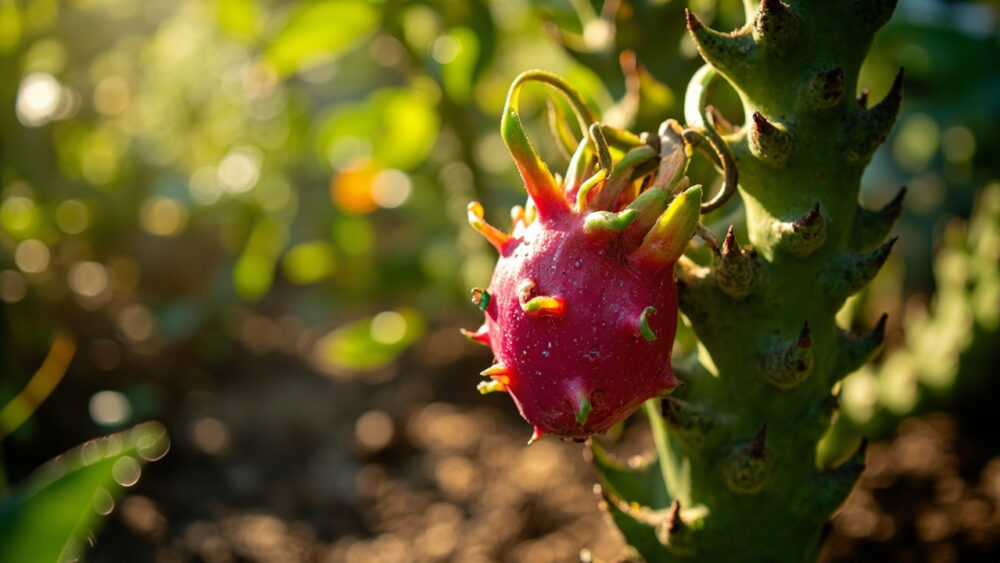
From cutting to first fruit, expect one to two years for dragon fruit grown from a rooted cutting, and three to five years or more if you started from seed. That is the honest range, and it is wider than most nursery tags admit. A mature, well-established plant that already fruits will keep producing new flushes every year after that, often several times per summer.
But the number that matters is not the average, it is what changes it. Climate, container size, and how the plant was propagated can shrink that timeline to twelve months or stretch it past four years with nothing wrong at all.
There is also a stage almost everyone misreads as failure when it is actually just dragon fruit being dragon fruit. Stick around, because the quick-reference card at the bottom lays out the whole timeline plus the conditions that shift it, so you can check your own plant against it in ten seconds.
The Realistic Timeline, Cutting vs Seed
Cuttings are the fast path. A healthy 12 to 18 inch cutting, rooted and planted in warm weather, can produce its first flowers and fruit in as little as 12 to 18 months under good conditions. Many growers see year two as the real first harvest, with year one spent building a strong root system and enough mature stem growth to support flowering.
Seed-grown plants take much longer and are honestly more of a novelty project than a fruiting strategy. Three to five years to first fruit is typical, sometimes longer, because the plant has to grow from a tiny seedling all the way to flowering size with no head start.
If you want fruit sooner rather than later, the propagation method you start with matters more than almost anything else on this list.
What Actually Controls the Speed
Climate does more work here than variety. Dragon fruit is a tropical and subtropical cactus, and it wants nighttime temperatures reliably above 65°F through the growing season. In USDA zones 10 to 11, outdoor plants can grow and fruit on the faster end of the range.
In zone 9 and colder, where the plant spends part of the year indoors or gets occasional cold stress, add six months to a year onto every stage. Container size also caps growth speed directly, since a rootbound plant in a small pot simply cannot put on the vegetative mass needed to flower, no matter how warm the yard is.
Light matters just as much as heat. Dragon fruit fruits best with six or more hours of strong sun or very bright filtered light, and a plant kept in partial shade will grow but delay flowering for years.
So before you judge your plant’s pace against anyone else’s, you have to judge your own light and pot size first.
Stage by Stage, What to Actually Expect
Here is roughly how the timeline breaks down for a cutting-grown plant in good conditions:
- Months 1 to 3: rooting and establishment, minimal visible top growth, most of the work is underground.
- Months 3 to 12: vigorous stem growth, the plant sends up new segmented pads and needs a sturdy trellis or post to climb.
- Year 1 to 2: the plant reaches flowering maturity, meaning enough mature stem length and thickness to support a bloom.
- First flowering: large, night-blooming white flowers that open for one night only and must be pollinated within that window to set fruit.
- 30 to 50 days after successful pollination: fruit ripens and is ready to pick.
That one-night flower window is the part that trips people up, and it is coming up next.
If You Assumed Flowers Mean Fruit Is Guaranteed, That Is the Mistake
A lot of readers assume that once a dragon fruit plant flowers, fruit is automatic. It is not. Many dragon fruit varieties are self-incompatible, meaning a flower needs pollen from a genetically different plant to set fruit at all, and even self-fertile varieties set more reliably with help.
Because the flowers open at night and close by morning, natural pollinators like moths or bats do the job in the tropics, but backyard growers usually get better results hand-pollinating with a small brush, moving pollen from one open flower to another, or even between two different plants if you have them.
This single step is responsible for more “my plant flowered but never fruited” stories than pests, disease, or bad luck combined.
Get the pollination right and the ripening clock is short and predictable from there.
How to Legitimately Speed Things Up
You can shave real time off the timeline, but only within limits. Starting from a large, already-established cutting instead of a small rooted one skips six months to a year of pure vegetative growth.
Maximizing sun, feeding with a balanced fertilizer through the growing season, and keeping the plant warm year-round (moving containers indoors before nights drop below 50°F) all keep growth continuous instead of stalling every winter. A sturdy, tall trellis matters too, since a plant sprawling on the ground grows slower and rots faster than one climbing upright.
What does not work is heavy nitrogen fertilizer pushed to force fast growth, which tends to produce soft, weak stems prone to rot rather than earlier flowers. There is no shortcut around the plant’s minimum maturity size, so forcing growth without giving it structure just delays things further.
Even with everything done right, there is a point where slow is simply normal, and that is worth knowing before you assume something is wrong.
When Slow Growth Is Normal vs an Actual Problem
A cutting that shows no new growth for the first 4 to 8 weeks after planting is normal, it is rooting. A plant that has grown vigorously for two years but still has not flowered is also normal if it is still short of mature stem length, roughly 3 to 6 feet of primary growth depending on variety.
Actual problems look different: shriveling or yellowing stem segments, no new growth at all for an entire warm season, or soft, mushy patches at the base. Those point to rot from overwatering, poor drainage, or cold damage, not simple slowness.
Dragon fruit is a cactus underneath the tropical look, and it wants well-draining soil and a chance to dry out between waterings, not constant moisture.
If your plant is green, firm, and still putting on new pads each season, it is on schedule even if that schedule feels long.
Dragon Fruit: Quick Reference
- Time to first fruit from a cutting: 1 to 2 years under good warmth and light.
- Time to first fruit from seed: 3 to 5 years or more, and less reliable overall.
- Ideal climate: USDA zones 10 to 11 outdoors, or warm containers brought indoors below 50°F elsewhere.
- Light needed: 6 or more hours of strong sun or very bright light daily.
- Flower to fruit: flowers open one night only, need hand pollination for reliable fruit, then 30 to 50 days to ripen.
- Biggest speed factor: starting size of the cutting and consistent warmth, not fertilizer.
- Normal vs problem: no growth for weeks after planting is normal, shriveling or mushy stems are not.
Dragon fruit rewards patience more than effort, and most of the waiting is just the plant getting big enough to bother flowering.
Get the sun, the trellis, and the pollination right, and the rest of the timeline takes care of itself.