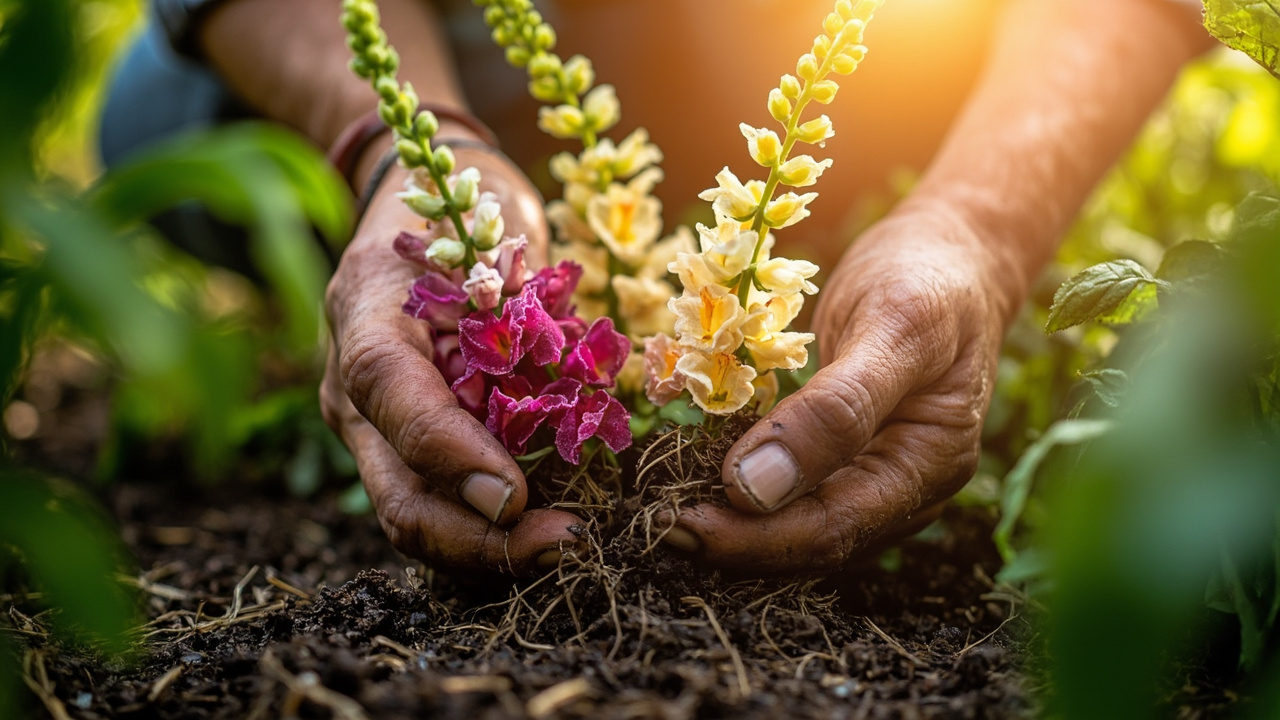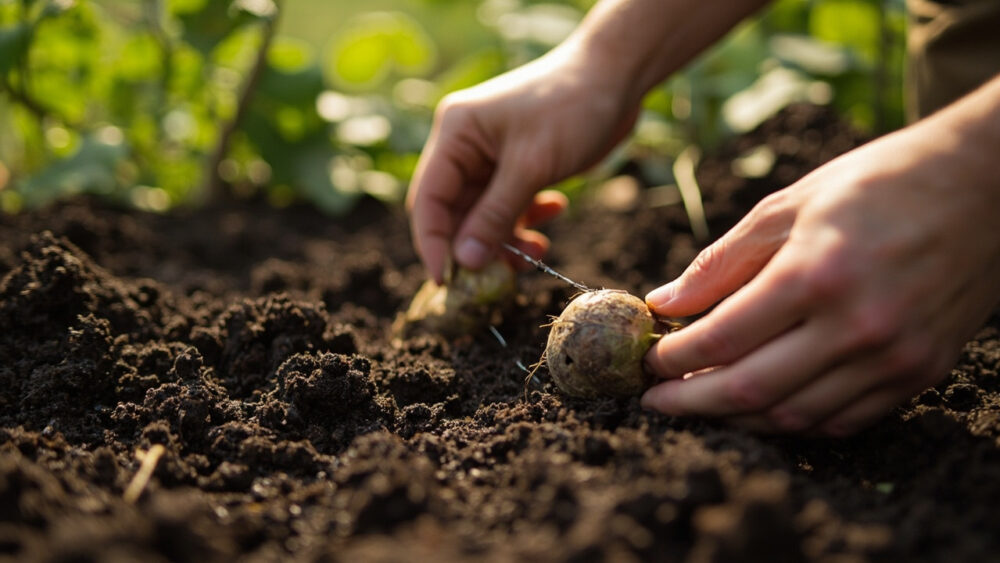
Dinner-plate dahlias want 18 to 24 inches between plants, and border or bedding types can go as close as 9 to 12 inches. Plant the tuber horizontally, 4 to 6 inches deep, eye pointing up. That is the honest answer to how far apart to plant dahlias, but the number you pick depends on the variety, and getting it wrong is the single most common reason dahlia plantings turn into a floppy, disease-prone mess by August.
Here is what most people get backward. They assume tighter spacing means more flowers per square foot, so they cram tubers in like they are planting garlic. It does the opposite. It also is not the only mistake that costs a season, there is a depth error almost as common that either rots the tuber or delays sprouting by weeks.
Stick around and I will also give you the fix if you already planted too close together, plus row and bed layouts that actually hold up once these things hit five feet tall. Save the “Dahlias at a Glance” card at the very bottom for your phone, it has the numbers you will want standing in the garden with a trowel in hand.
The Real Spacing Numbers, and Why They Change by Type
Dahlias are not one plant, they are a size range. Dinner-plate and large decorative varieties get 4 to 5 feet tall and just as wide, so they need 18 to 24 inches between plants, sometimes 30 inches for the biggest cultivars like Cafe au Lait types.
Border dahlias and dwarf bedding types, the ones topping out around 12 to 18 inches, can sit 9 to 12 inches apart. Pompon and ball varieties usually land in the middle, 12 to 15 inches.
If you do not know which category your tuber falls into, check the tag or the mature height listed on the source. Height tells you spacing almost every time.
Next up is the mistake that ruins the planting before it even sprouts.
Planting Depth: The Error Nobody Warns You About
You’d guess deeper is safer, like most bulbs. With dahlia tubers, deeper is often worse.
Plant tubers 4 to 6 inches deep, laid on their side with the eye or growing point angled upward, not straight down. Cover with loose soil, do not pack it.
Go deeper than 6 inches and cool, damp spring soil around the tuber can rot it before the eye ever pushes up. Go shallower than 4 inches and the tuber dries out or gets nicked by your hoe all summer.
Wait until soil hits at least 60°F, roughly two to three weeks after your last frost date, before you plant. Cold, wet soil is what actually kills more dahlia tubers than any spacing mistake does.
Get the depth right and spacing is the next thing that determines whether this planting thrives or fights itself all season.
What Actually Goes Wrong When Plants Are Too Close
Crowd dahlias and you do not get more blooms, you get fewer, smaller ones on weaker stems. The plants stretch for light and shade each other’s lower leaves, which cuts photosynthesis right when tubers need energy to bulk up for next year.
Airflow is the bigger problem. Dahlias planted closer than about 12 inches apart hold humidity in their foliage overnight. That is exactly what powdery mildew and botrytis need to take hold, especially by late summer when nights cool off but days stay warm.
Tight spacing also makes staking a nightmare. You cannot get a stake or cage in without damaging roots once the plants have filled in, so stake at planting time, not after.
Too far apart has its own cost, and it is not one you’d expect.
The Honest Problem With Spacing Too Far Apart
You would think generous spacing has no downside. It has one real one: wasted bed space and weaker wind resistance.
A single dahlia standing alone with 3 feet of open soil on every side gets battered by wind from every direction with nothing to break it. Plants spaced properly in a group actually shelter each other somewhat, the way a windbreak works.
Overly wide spacing also invites weeds into all that open soil, and weeds compete with young tubers for exactly the moisture and nutrients they need in their first six weeks.
The fix in both directions comes down to layout, which is where most people never plan at all.
Row and Bed Layout That Actually Works
For cutting gardens, rows spaced 2 to 3 feet apart with plants 18 to 24 inches apart within the row give you walking room for harvest and staking without wasting bed space.
In mixed borders, stagger dahlias in a loose triangular pattern rather than a straight grid. It fills gaps better and still gives each plant its full spacing allowance in every direction.
For a dedicated dahlia bed, a good rule is to plant in blocks of 3 to 4 rows, then leave a 2-foot access path before the next block. You need to reach every plant to disbud, stake, and cut without stepping on soil above the tubers.
- Cutting row: 18 to 24 inches within row, 24 to 36 inches between rows.
- Mixed border: stagger at full spacing for the variety, triangular pattern.
- Dedicated block: 3 to 4 rows, then a 2-foot path.
Containers change these numbers considerably, and that is worth knowing before you plant one dahlia per pot out of habit.
Dahlias in Containers: A Different Set of Numbers
One dahlia per container is the safe default, and for dinner-plate types it is close to mandatory. Use a pot at least 14 to 16 inches across and equally deep, since dahlia roots and tubers need real room to bulk up.
Border and dwarf varieties can share a larger container, spaced the same 9 to 12 inches you would use in the ground, in a pot 18 to 24 inches across.
Containers dry out faster than garden soil, so check moisture at the same 4 to 6 inch depth where the tuber sits rather than judging by the surface. A dry surface with damp soil below is normal, not a reason to water again.
If you already planted too tight in the ground, though, there is still a way to salvage the season.
How to Fix a Planting That’s Already Too Crowded
If plants are still under a foot tall, you can dig and move them. Wait for an overcast day or evening, water first to loosen soil, and lift with as much root intact as possible.
Once dahlias are budding or in bloom, moving them risks the whole plant. At that point your best move is selective removal: cut out the weakest one or two plants in an overcrowded cluster at the base rather than trying to transplant them.
For a planting that is crowded but not disastrous, improve airflow instead of digging anything up. Remove a few lower leaves and any interior stems crossing through the center of each plant.
That buys you one season, but next spring is when you actually fix the spacing for good.
Dahlias at a Glance
- When to plant: two to three weeks after your last frost, once soil reaches at least 60°F.
- Planting depth: 4 to 6 inches, tuber on its side, eye pointing up.
- Spacing, dinner-plate and large decorative: 18 to 24 inches, up to 30 inches for the biggest varieties.
- Spacing, border and dwarf types: 9 to 12 inches.
- Spacing, pompon and ball types: 12 to 15 inches.
- Row spacing for cutting gardens: 24 to 36 inches between rows.
- Containers: one large dahlia per 14 to 16 inch pot, or dwarf types 9 to 12 inches apart in an 18 to 24 inch pot.
Get the depth and spacing right at planting and you avoid nearly every problem dahlias run into later.
Everything else, staking, feeding, disbudding, is easy once the layout underneath it is right.