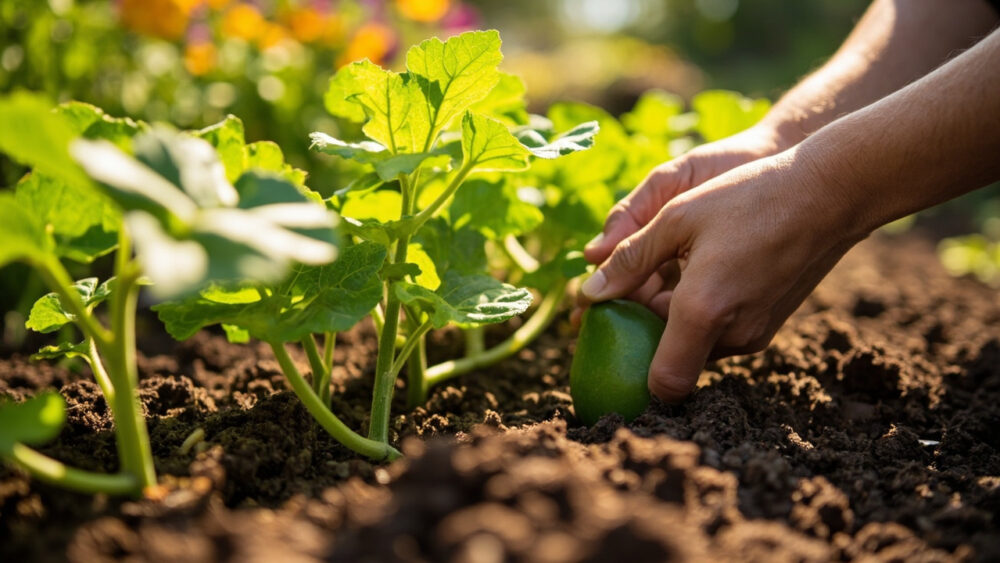
Plant butternut squash 3 to 4 feet apart within the row, with rows spaced 6 to 8 feet apart, or set them in hills spaced 4 to 5 feet apart in every direction. Seeds go in about 1 inch deep in warm soil, deeper doesn’t help and just delays germination. That’s the number you came for, but how far apart to plant butternut squash correctly also depends on your layout, your soil, and one very common mistake that doesn’t show up until midsummer.
Here’s the thing almost nobody tells you: the spacing that looks way too generous in May is exactly right by August. Butternut vines don’t just sit near the base of the plant, they run. A single plant can sprawl 8 to 10 feet if you let it, and if you crammed your seedlings in close because the bed looked empty on planting day, you’re setting up a jungle you’ll be fighting with pruners by July.
Below I’ll cover the exact depth and spacing logic, how to lay out rows versus hills versus a raised bed, what overcrowding actually costs you in yield and disease, whether containers are even realistic for this plant, and how to salvage a planting you already spaced too tight. Save-able specifics are in the “Butternut Squash at a Glance” card at the very bottom, so keep scrolling once you’ve got the reasoning.
The Exact Spacing and Depth Numbers, and the Reasoning Behind Them
Seeds go 1 inch deep, no deeper, in soil that has warmed to at least 60 to 65°F. Butternut squash is a warm-season crop through and through: seeds sown in cold, wet soil rot before they sprout more often than they germinate.
Spacing within the row runs 3 to 4 feet between plants. That’s not arbitrary. Butternut squash sends out vines 8 to 10 feet long over the season, and each plant needs room for leaves the size of dinner plates to spread without shading out its neighbor.
If you’re thinking that seems like a lot of empty dirt in June, you’re right, and that’s the trap. The bed looks underplanted for about six weeks. Then it doesn’t.
That gap in time is exactly where the layout decision matters most.
Rows, Hills, or Raised Beds: Picking Your Layout
Traditional rows put plants 3 to 4 feet apart within the row and space rows 6 to 8 feet apart, giving vines room to run down the aisles. This is the standard for anyone with real garden acreage.
Hills (really just slightly mounded planting spots, not steep piles) work better for smaller plots. Sow 4 to 5 seeds per hill, thin to the 2 or 3 strongest seedlings, and space hills 4 to 5 feet apart in all directions. Mounding helps drainage, which butternut squash appreciates since wet feet invite rot.
In a raised bed, one butternut plant per 16 square feet is a realistic rule of thumb, and even then expect vines to spill over the bed’s edge onto surrounding paths or lawn.
Whichever layout you pick, the real test of whether you spaced correctly won’t show up until the vines start running.
What Actually Goes Wrong When Plants Are Too Close
If you assumed tight spacing just means a smaller harvest, that’s not quite it, and it’s the more forgiving of the two guesses. The real cost of overcrowding is disease and rot, not just fewer squash.
Packed plants create a dense leaf canopy that traps humidity at soil level. That’s exactly the environment powdery mildew and downy mildew want. You’ll see it as a white or grayish coating on leaf surfaces, usually starting on older leaves near the base, and it spreads fast once the canopy stays damp overnight.
Poor airflow also means fruit sits directly on wet soil longer, which invites soft rot on the blossom end. And because pollinators need to actually find and move between flowers, dense tangled vines reduce fruit set even when the plant looks lush and healthy.
Crowded roots compete hard for water and nutrients too, so you end up with more vine and less squash, the opposite of what you wanted when you planted extra “just in case.”
Too far apart has its own quieter problem, and it’s the one gardeners rarely expect.
The Other Mistake: Spacing Plants Too Far Apart
Spacing much wider than 5 feet between plants doesn’t cause disease, but it wastes bed space and can actually hurt pollination. Squash relies on bees moving between male and female flowers on the same plant and often between neighboring plants.
Spread plants out too far and pollinators have more ground to cover between blooms, which can mean more flowers drop without setting fruit. You’ll also see more bare soil exposed to sun and weeds, since the leaf canopy that’s supposed to shade out competition never closes.
The sweet spot is a canopy that touches its neighbors by midsummer but isn’t fighting for the same square foot of soil. That’s what 3 to 4 feet in-row spacing is built to deliver.
If your garden doesn’t have room for that at all, there’s still a path forward.
Growing Butternut Squash in Containers: Realistic or Not
Butternut squash can work in containers, but only in large ones, and only if you manage the vine. You need a minimum 15 to 20 gallon container, ideally larger, with real drainage holes and a trellis or stake system to train the vine upward instead of letting it sprawl.
One plant per container is the rule, full stop. There’s no spacing math to apply because you’re not fitting multiples in, you’re just giving one plant enough root volume to support a fruit that can weigh 2 to 3 pounds or more.
Bush-type butternut varieties, where available, are more forgiving in containers than the long-vining standard types, since they don’t need as much trellis real estate.
Container-grown squash also dries out faster than in-ground plants, so check soil moisture daily once temperatures climb.
Now, if you’ve already got seedlings in the ground and they’re closer than any of this recommends, here’s your actual move.
How to Fix an Overcrowded Planting Without Losing the Season
The honest answer: you cannot move established squash plants without serious root damage, since squash roots resent disturbance even more than most vine crops. Transplanting a squash plant that’s more than a couple weeks old usually sets it back hard or kills it outright.
What you can do instead is thin. If you sowed multiple seeds per spot and they all came up, cut (don’t pull, cutting avoids disturbing neighboring roots) the weaker seedlings at soil level while they’re still small, leaving only the strongest one or two per hill or spot.
For plants already established and crowded, prune vines instead of moving roots. Snip growing tips to direct vine growth away from neighboring plants, and remove a few oldest, most shaded leaves near the base to open up airflow.
Watch those thinned-out spots closely for the first sign of powdery mildew for the rest of the season, since crowded plants that got pruned late are still playing catch-up on airflow.
That brings you to the numbers worth actually saving.
Butternut Squash at a Glance
- When to plant: after all frost danger has passed and soil has warmed to at least 60 to 65°F, usually 1 to 2 weeks after your last frost date.
- Seed depth: 1 inch deep, no deeper, in warm soil.
- Row spacing: plants 3 to 4 feet apart within the row, rows 6 to 8 feet apart.
- Hill spacing: hills 4 to 5 feet apart in all directions, thinned to 2 to 3 strong seedlings per hill.
- Raised bed guideline: one plant per roughly 16 square feet of bed space.
- Container minimum: 15 to 20 gallon container, one plant only, trellised if possible.
- Days to maturity: roughly 80 to 110 days from seed, depending on variety, so plan your season length accordingly.
Get the spacing right and butternut squash mostly takes care of itself from there. Everything else, the mildew, the poor fruit set, the tangled mess by August, traces straight back to how much room you gave it on planting day.