The best companion plants for pole beans are corn, sunflowers, radishes, and summer squash, because pole beans need something tall to climb and their roots feed nitrogen to hungry neighbors. The one plant to keep out of that bed entirely is any member of the onion family, since alliums actively stunt bean growth. Get the pairing right and you also get free pest control and better use of a small footprint.
Here is the part almost nobody tells you: the classic “Three Sisters” corn-beans-squash combo, the one everyone recommends first, only works if you plant them on a real timing offset, not all on the same day. Get that sequence wrong and the corn gets swallowed before it is knee-high.
There is also a sign that your companions are fighting instead of helping, and it shows up in the leaves two to three weeks before the yield drops. Stick around and I will tell you what to look for, plus a pairing myth involving marigolds that will not actually save your beans from the pest you think it does.
Save the Pole Beans at a Glance card at the very bottom of this page. It has the planting numbers, spacing, and the exact plants to avoid, all in one place you can pull up from your phone while standing in the bed.
Why Pole Beans Need the Right Neighbors
Pole beans are nitrogen fixers. Their roots host bacteria that pull nitrogen from the air and stash it in the soil, which is a gift to any nearby plant that eats heavily, especially corn and squash.
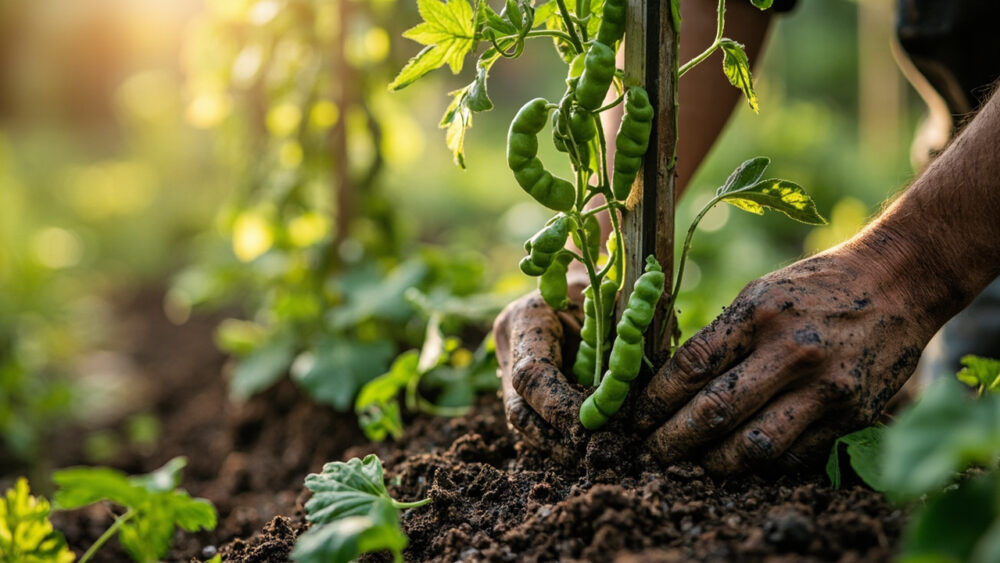
In return, pole beans need a trellis or a tall companion to climb, six to eight feet of vertical space is typical for most varieties. Plant them without support and you get a tangled mat on the ground, poor air flow, and rot.
Good companions solve at least one of three problems: they give beans something to climb, they repel a pest that targets beans, or they use the nitrogen beans leave behind.
The right pairing turns one bed into three crops worth of harvest.
Corn: The Living Trellis
Corn is the classic climbing structure for pole beans, tall, sturdy stalks that need no building. Beans in turn feed the corn nitrogen through the season, which matters because corn is one of the heaviest nitrogen feeders in the vegetable garden.
Timing is the trick. Plant corn first and let it reach 4 to 6 inches tall, roughly two to three weeks, before you plant beans at its base. Plant them together on the same day and the beans will out-race and smother young corn before it establishes.
That timing gap is the detail most “Three Sisters” advice skips entirely.
Sunflowers: A Sturdier Backup Trellis
A single row of sunflowers works almost as well as corn, and in windy sites, better. Choose a tall, sturdy variety and plant it two to three weeks ahead of your beans for the same reason as corn: give it a head start so it is not buried in vines before it can bear its own weight.
Sunflowers also draw in pollinators, which pole beans do not strictly need since they are self-pollinating, but the extra bee traffic helps everything else nearby set fruit.
Not every trellis in the garden needs to be lumber and twine.
Radishes: The Underground Pest Trap
Radishes mature fast, 22 to 30 days, and their sharp scent is thought to confuse or repel Mexican bean beetles and some root maggots working the soil near your beans. Even without perfect pest control, radishes are worth the space because they loosen soil ahead of the beans’ roots and are pulled and eaten long before the beans need the room.
Tuck them along the base of the bean row at planting time. You will harvest radishes before the beans even start climbing in earnest.
A fast crop like this is the easiest win in the whole bed.
Summer Squash and Cucumbers: Ground Cover That Earns Its Keep
Squash and cucumbers sprawl low while beans climb high, so they are not competing for the same light or space. Squash leaves shade the soil, which keeps moisture in and suppresses weeds, and beans return the favor by feeding squash’s heavy nitrogen appetite.
Give squash 3 to 4 feet of room to run even in a shared bed, since it spreads more than gardeners expect. Cucumbers can also climb their own light trellis nearby without competing directly with beans for support.
That ground-level partnership is doing more work than it gets credit for.
What to Never Plant Near Pole Beans
Onions, garlic, leeks, and shallots are the one hard no. Alliums release compounds into the soil that inhibit the rhizobia bacteria living on bean roots, the same bacteria responsible for fixing nitrogen. Plant beans next to onions and you get smaller plants, fewer pods, and yellowing that looks like a nutrient problem but is not.
Fennel is nearly as bad. It releases root compounds that suppress growth in most vegetables nearby, beans included, and it rarely plays well with anything in a shared bed.
Beets and gladiolus also stunt pole beans, though the effect is milder than alliums, more a slow yield drag than outright failure.
If your beans look stunted and pale and you already ruled out nitrogen and water, check what is planted upwind of the roots.
Laying Out the Bed So It Actually Works
Plant corn or sunflowers in the center or north side of the bed so they do not shade the beans as the season goes on. Space corn 8 to 12 inches apart in blocks rather than single rows, since corn pollinates by wind and needs neighbors close by to set ears.
Sow pole beans 4 to 6 inches from each corn stalk or sunflower stem, one to two seeds per spot, once soil has warmed to at least 60°F, usually two to three weeks after your last frost. Beans planted in cold, wet soil rot before they sprout, so do not rush this by the calendar.
Tuck squash or cucumbers along the sunniest edge, and scatter radishes wherever there is bare soil between young plants.
Get the layout right once and you can reuse the same footprint every season.
The Pairing Myths That Do Not Hold Up
Marigolds get recommended next to everything, including pole beans, as a blanket pest fix. The truth is more limited: marigolds have some real effect on root nematodes in soil over time, but they do little to nothing against the Mexican bean beetle or aphids that actually bother pole beans. They will not hurt anything planted nearby, but do not count on them as your main defense.
Planting beans and potatoes together is another one that gets repeated constantly. In practice they compete for the same nutrients and can share some pest pressure, particularly from certain beetles, and most experienced growers keep real distance between the two rather than tucking them side by side.
Good companion planting is about solving a specific problem, not stacking every “friendly” plant into one bed and hoping.
That is the whole philosophy behind the quick-reference list below.
Pole Beans at a Glance
- When to plant: two to three weeks after your last frost, once soil is reliably at least 60°F.
- Spacing: pole beans 4 to 6 inches apart at the base of a trellis, corn or sunflowers as support planted 2 to 3 weeks earlier.
- Depth: sow bean seeds 1 to 1.5 inches deep directly in the garden.
- Best companions: corn or sunflowers for climbing support, radishes for fast pest-confusing ground cover, summer squash and cucumbers for shaded, weed-suppressing ground cover.
- Never plant nearby: onions, garlic, leeks, shallots, and fennel, all of which suppress the nitrogen-fixing bacteria on bean roots.
- Mild yield drag if nearby: beets and gladiolus, worth avoiding but not a total loss if space is tight.
- Support height: plan for 6 to 8 feet of vertical climbing space depending on variety.
If you remember one thing, remember the allium rule: keep onions and garlic out of the bean bed, full stop. Everything else on this list is a bonus, that one is a requirement.