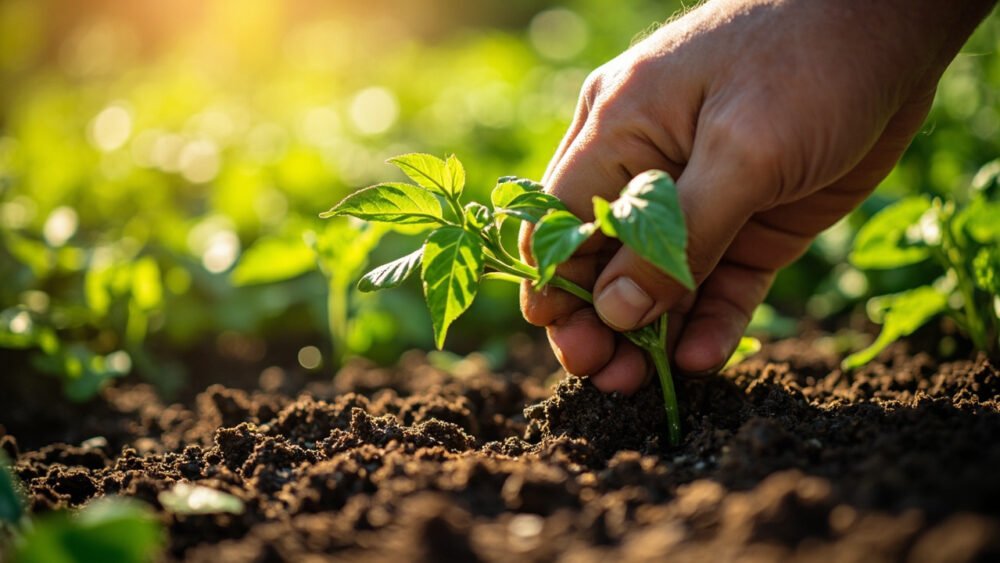
Plant pepper transplants at the same depth they’re sitting in the pot, maybe half an inch deeper, and space them 18 to 24 inches apart in the row. That’s the whole answer for how deep to plant peppers if you need it right now and you’re standing there with a tray of seedlings. But depth is the easy part. Spacing is where most people quietly sabotage their whole season without realizing it until August.
Here’s what nobody tells you at the garden center: the mistake that ruins the most pepper plantings isn’t planting too shallow or too deep, it’s planting too close together because the seedlings look so small and harmless in April. By July they’re a jungle, and you’re wondering why you have a hundred flowers and six peppers.
Stick with me and I’ll walk you through the exact numbers, the layout that actually works in a real backyard bed, what too-close and too-far both cost you, and how to bail yourself out if you already planted too tight. The full save-it-to-your-phone rundown, every number in one place, is waiting at the bottom.
The Real Depth Rule, and Why Peppers Are Different from Tomatoes
If you’ve grown tomatoes, you know the trick of burying the stem deep because tiny hairs along it turn into roots underground. Peppers do not do this.
Bury a pepper stem and you’re not encouraging more roots, you’re inviting stem rot right at soil level, especially in cool or wet spring soil. Plant it at the same depth it was growing in the pot.
The only exception is a leggy, stretched seedling grown under weak light. In that case you can bury it an inch deeper than the pot line, no more, and it’ll usually hold fine without rotting.
Depth handled. Spacing is the part that actually decides how much you harvest.
Spacing That Actually Matters: 18 to 24 Inches, Not Less
Give each pepper plant 18 to 24 inches of space in every direction. Bell peppers and other large, bushy types want the full 24 inches. Compact types like most hot peppers can get away with 18.
Rows should sit 24 to 36 inches apart so you can actually walk between them without snapping branches, which peppers do easily once they’re loaded with fruit.
If you assumed tighter spacing means more peppers per square foot, that’s the guess that costs people their whole crop. It’s the opposite. Crowded pepper plants produce fewer, smaller peppers per plant, and the yield-per-square-foot math actually favors the wider spacing once you count real, ripe fruit instead of flowers that dropped.
The reason for that gap is airflow, and airflow is where the real damage happens.
What Actually Goes Wrong When Plants Are Too Close
Crowd peppers and the first thing you lose is air movement between plants. Humidity sits in that canopy overnight and doesn’t leave, and that’s exactly the condition that invites foliar diseases like bacterial spot and various fungal leaf spots.
The sign everyone misreads is yellowing lower leaves on a packed planting. Most people reach for fertilizer. Nine times out of ten it’s not a nutrient problem, it’s leaves in permanent shade and poor airflow, and no amount of feeding fixes that.
Crowded plants also compete hard for root space, which means smaller root systems, less drought tolerance, and a plant that wilts fast on a hot afternoon even with adequate water at the base.
- Fewer peppers per plant, even though total flower count looks fine early on
- Higher disease pressure, especially in humid climates or rainy summers
- Weak, leggy growth as plants stretch sideways looking for light
- Harder harvesting, since you can’t get a hand into a solid wall of foliage without breaking stems
Too far apart has its own quiet cost, and it’s the one gardeners almost never expect.
Can You Space Peppers Too Far Apart?
Yes, and it’s not just wasted space. Peppers planted much wider than 24 to 30 inches apart, in an open, exposed spot, are more prone to sunscald on the fruit itself because there’s less leaf canopy shading the peppers as they develop.
You’ll also see more wind stress on the stems since there’s no neighboring foliage to buffer gusts, and in hot climates the soil around isolated plants dries out and heats up faster, stressing roots.
The honest answer is that 18 to 24 inches isn’t just a minimum, it’s close to the sweet spot. Wider isn’t automatically better, it’s just a different set of problems.
Rows and beds have their own layout logic worth getting right before you dig a single hole.
Row and Bed Layout: Two Ways to Lay It Out
In a traditional row garden, space plants 18 to 24 inches apart within the row and leave 24 to 36 inches between rows. That gap is for your feet, your wheelbarrow, and airflow, don’t shrink it to squeeze in one more plant.
In a raised bed or block planting, use a staggered grid instead of straight rows. Set plants 18 to 24 inches apart in every direction, offsetting each row like a checkerboard rather than lining them up in a grid.
Staggering lets you fit slightly more plants into the same square footage than a strict grid, while keeping the same real distance between any two neighboring plants.
A 4 by 8 foot raised bed comfortably holds 8 to 10 pepper plants staggered this way, not the 16 to 20 people try to cram in.
Containers follow a different set of rules entirely, and this is where a lot of patio gardeners go wrong before they even get to spacing.
Growing Peppers in Containers: The Depth and Spacing Equivalent
One pepper plant per container, and the container matters more than people expect. Give each plant at least a 3 to 5 gallon pot, with 5 gallons being far more forgiving for bell peppers and other large types.
Planting depth in a pot follows the same rule as the ground: soil line at the same level as the pot it came from, not buried deeper.
If you’re doing multiple plants in one large container or trough, keep that same 18 to 24 inch center-to-center spacing. A 24 inch wide trough holds one plant comfortably, not three.
Drainage holes are non-negotiable here, since a pepper sitting in wet, waterlogged container soil will rot at the stem far faster than one in the ground.
If your containers are already crowded from an overly optimistic spring, there’s a real fix, and it’s not just “let it ride.”
Already Planted Too Close? Here’s the Real Fix
If your peppers are still under 6 inches tall and you catch this early, you can dig and transplant the extras to proper spacing with minimal shock, ideally on a cloudy day or in the evening.
Water both the donor spot and the new hole well beforehand, move as much root ball as you can, and expect a few droopy days before recovery.
If the plants are already tall, flowering, or fruiting, don’t transplant. The root disturbance at that stage costs you more than the crowding does. Instead, thin by removal: pick the weakest plant in each crowded cluster and cut it at the soil line rather than pulling, which avoids disturbing the roots of the ones you’re keeping.
Prune inward-facing branches on the remaining plants to open up airflow through the middle of the planting, and that alone fixes a good chunk of the disease risk even without more space.
That’s every real number and every fix. Here’s the whole thing in one place so you can pull it up in the garden without rereading any of this.
Peppers at a Glance
- Planting depth: same level as the pot, at most half an inch to an inch deeper only if the seedling is leggy.
- Spacing in rows: 18 to 24 inches between plants, 24 to 36 inches between rows.
- Spacing in raised beds: 18 to 24 inches in a staggered grid, roughly 8 to 10 plants per 4 by 8 foot bed.
- Container size: 3 to 5 gallons per plant, one plant per container, drainage holes required.
- When to transplant outdoors: two to three weeks after your last frost, once soil is consistently above 60°F.
- Sign of overcrowding: yellowing lower leaves plus fewer, smaller peppers, not a fertilizer problem.
- Fixing a crowded planting: transplant only while small, otherwise thin by cutting at the soil line and prune for airflow.
Get the spacing right and the depth right and peppers mostly take care of themselves from there.
When in doubt, give them the extra few inches. You’ll harvest more, not less.