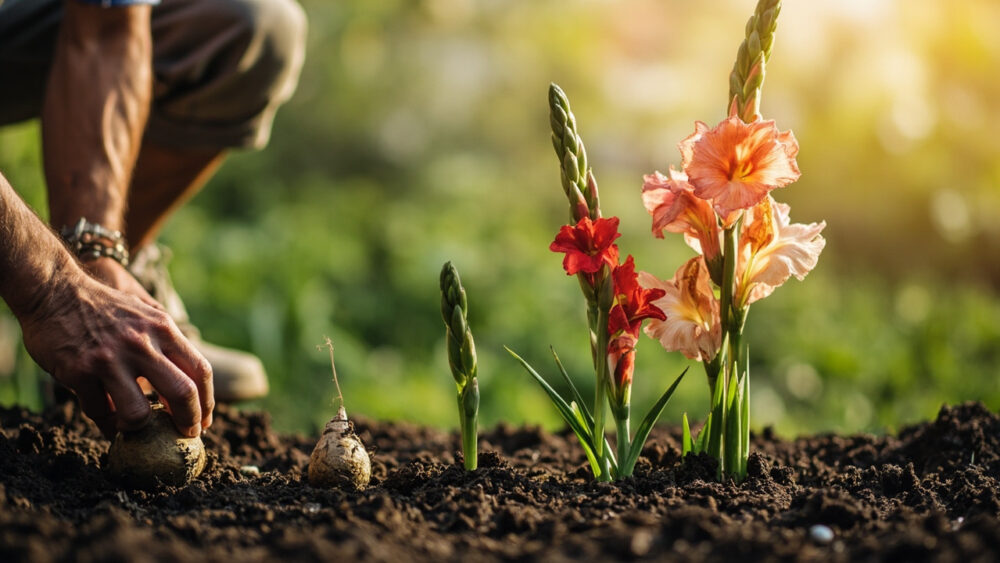
A gladiolus corm moves through six recognizable stages between planting and bloom, and the whole run takes about 70 to 100 days depending on the variety and how warm your soil is. You will see a spike of grassy leaves first, then a fast vertical shoot, then a flower spike that swells for a week or two before the bottom buds crack open. Once you know what each gladiolus growing stages phase looks like, you can tell in five seconds whether your plant is right on schedule or quietly stuck.
Most people lose the season at one specific point, and it is not the planting. It is the stretch between sprouting and the first real growth spurt, when the plant looks fine but is actually starving underground for something you cannot see from the porch.
There is also a sign almost everyone misreads as disease when it is actually completely normal. And a fair number of gladiolus stall out for a boring reason that has nothing to do with pests or soil. Stick around for the save-able Gladiolus at a Glance card at the bottom, it has the planting depth, spacing, and timing all in one place for your phone.
Stage 1: The Dormant Corm (before planting)
Before anything happens above ground, you are working with a flattened, papery-skinned corm that looks a little like a crocus bulb. A firm, heavy corm with dry, tight skin is ready to go. A soft spot, a moldy smell, or a corm that feels light for its size means it will not perform, and no amount of good soil fixes that.
Plant once your soil has warmed to at least 55 to 60 F, roughly two weeks after your last frost date. Set corms pointed end up, 4 inches deep and 4 to 6 inches apart, in full sun with soil that drains well.
The corm you choose here decides most of what happens later.
Stage 2: Sprouting (7 to 21 days after planting)
The first sign of life is a single upright shoot pushing through the soil, pale green and pointed like a blade of thick grass. In warm soil this shows up in a week. In cool spring soil it can take three weeks, and that wait feels a lot longer than it is.
There is nothing to do here except leave it alone. Overwatering at this stage, before there are real roots or leaves to use the moisture, is the single most common way gladiolus rot in the ground before they ever get going. Water only if the top 2 inches of soil are fully dry.
This is also the exact point where the “starving underground” problem starts, and it shows up in the next stage.
Stage 3: Vegetative Growth, the Stage Most People Get Wrong
Over the next 3 to 5 weeks the single shoot becomes a fan of 4 to 6 sword-shaped leaves, and the plant is now building the flower spike inside that fan even though you cannot see it yet. This is the stage that decides whether you get a strong bloom or a disappointing one.
If you assumed a gladiolus just needs water and sun to reach this point, that guess is what leaves people with short, thin, flopping spikes later. What the plant actually needs here is nitrogen early and potassium as it grows, because it is building the stalk’s structure and the flower buds at the same time, underground, before you see any hint of a spike.
Feed lightly every 3 to 4 weeks through this stage with a balanced fertilizer, and keep the soil evenly moist, about 1 inch of water a week, never soggy. Skip this feeding window and the plant still grows leaves, it just skimps on the flower.
Get the feeding right here and the next stage arrives fast and obvious.
Stage 4: The Flower Spike Emerges (roughly 8 to 10 weeks after planting)
A thick, pointed stalk rises from the center of the leaf fan, noticeably different from the flat leaves, and it grows fast, sometimes an inch or more a day once it gets going. This is where gladiolus earn their height, often 2 to 4 feet, occasionally more with the tall exhibition types.
Staking matters most right now, not later. Set a stake or run garden twine between posts while the spike is still short and flexible, because trying to prop up a top-heavy stalk after a summer storm has already bent it rarely works.
This is also when buds start forming in a tight row up the spike, still green, still closed.
What those green buds do next surprises almost everyone who has not grown gladiolus before.
Stage 5: Budding and the “Is Something Wrong” Stage
The buds swell for 1 to 2 weeks, and partway through, the lowest few often turn slightly papery or faintly discolored at the tip before they open. That looks like disease to a lot of first-time growers, and it is almost always just the natural color break right before the bud opens.
True trouble looks different: buds that shrivel brown and dry without ever swelling, or a spike that stalls for over two weeks with no change at all. That points to heat stress, drought at the root zone, or thrips feeding inside the buds, which you can often confirm by tapping a bud over white paper and watching for tiny slivers of moving insect.
Keep watering consistently and stake the spike so its own weight does not stress the stem.
Once that lowest bud actually cracks open, everything after happens in order, bottom to top.
Stage 6: Bloom (opens over 1 to 2 weeks per spike)
Flowers open sequentially starting at the bottom of the spike and working upward, so a single stalk stays in bloom for one to two weeks even though any individual flower only lasts a few days. This staggered opening is normal, not a sign of a weak plant.
Cut flowers for a vase when the bottom one or two blooms are open and the rest are still tight buds, they will keep opening indoors. Left on the plant, deadhead spent blooms from the bottom as they fade to keep the display looking fresh and to stop the plant from wasting energy on seed.
Once the last bloom fades, the plant is not done working, it is just switching jobs.
After Bloom: Storing Energy for Next Year
The leaves keep photosynthesizing for 6 to 8 weeks after the flowers finish, and that time is what rebuilds the corm underground for next season. Cut the spent flower stalk down but leave the leaves standing.
Cutting the foliage back early is the second big mistake, right behind overwatering at sprouting, and it is the reason some gladiolus come back weaker every year until they quit blooming altogether.
In zones colder than about 7, dig the corms after the leaves yellow and frost threatens, cure them a few days in a dry spot, and store them cool and dry over winter.
That six-stage arc is the whole story, and here it is condensed for your phone.
Gladiolus at a Glance
- When to plant: once soil hits 55 to 60 F, about two weeks after your last frost date, staggering plantings every two weeks for continuous bloom.
- Depth and spacing: 4 inches deep, pointed end up, 4 to 6 inches apart, full sun.
- Time to bloom: roughly 70 to 100 days from planting depending on variety and warmth.
- Water needs: keep soil barely moist while sprouting, then about 1 inch per week once leaves are established, never soggy.
- Feeding window: light balanced fertilizer every 3 to 4 weeks during leaf growth, before the spike appears.
- Support: stake or twine-tie while the spike is still short, not after it leans.
- After bloom: leave foliage standing 6 to 8 weeks to recharge the corm, then dig and store before hard frost in zones colder than 7.
Get the feeding right in the leaf stage and the staking right before the spike leans, and the rest of the season mostly takes care of itself.
Everything else is just patience while the corm does its work underground.