Endless Summer hydrangeas care boils down to four things: morning sun with afternoon shade, soil that stays evenly moist but never soggy, a spring feeding or two, and pruning only the dead wood since this variety blooms on both old and new growth. Get those four right and the plant more or less takes care of itself.
Where most people go sideways is chasing blue flowers with the wrong product, at the wrong time, in soil that was never going to hold the color anyway. There is also a pruning myth about this specific hydrangea that trips up even gardeners who have grown other hydrangeas for years. And the question everyone asks right after “how do I care for it” is “why didn’t it bloom,” which has a less satisfying answer than most people want.
Stick with me through the sections below and you will get all of it, plus a save-able Endless Summer Hydrangeas at a Glance card at the very bottom with the numbers you’ll actually want on your phone in the garden.
Light, Placement, and Temperature
Morning sun and afternoon shade is the placement Endless Summer wants, roughly four to six hours of direct light with the harshest afternoon rays broken up by a tree, a fence, or the house itself. In hot climates, zone 7 and south, more shade is better; the leaves will wilt dramatically in afternoon heat even when the roots have plenty of water. In cooler zones, 4 through 6, it can handle more sun and still hold its leaves flat and glossy.
This hydrangea is hardy in zones 4 through 9, which is the whole reason it exists. Older mophead hydrangeas set next year’s buds in fall and lose them to a hard winter; Endless Summer also blooms on new wood, so a rough winter costs you the old buds but not the whole season.
Next up is the part that actually determines whether you’re watering too much or not enough.
Watering: How Much, How Often, and How to Tell
Hydrangea means “water vessel” for a reason: these plants drink. Check the soil an inch or two down with a finger before watering rather than going by a schedule. If it’s dry at that depth, water deeply until it runs from the drainage holes or soaks a foot down in the ground.
In summer heat, that often means two to three times a week for in-ground plants and every day or every other day for containers, since pots dry out fast. Wilting at midday on a hot day is not automatically a cry for water, this plant droops in scorching afternoon sun even when moist, and often perks back up by evening.
The real test is the morning check: if it’s still droopy at 8 a.m., it’s thirsty and you water immediately.
Mulch two to three inches deep around the base holds that moisture and keeps roots cooler through summer.
Soil, Feeding, and the Color Myth
Endless Summer wants soil that’s rich in organic matter and drains well, never waterlogged. If you’re planting in clay, work in compost at planting time. If you’re in a container, use a quality potting mix, not garden soil, which compacts and suffocates roots in a pot.
Feed once in early spring as new growth starts, and again in early summer if you want, with a balanced or bloom-formulated fertilizer, following the label rate. Stop feeding by mid to late summer. Late fertilizer pushes soft new growth that won’t harden off before frost.
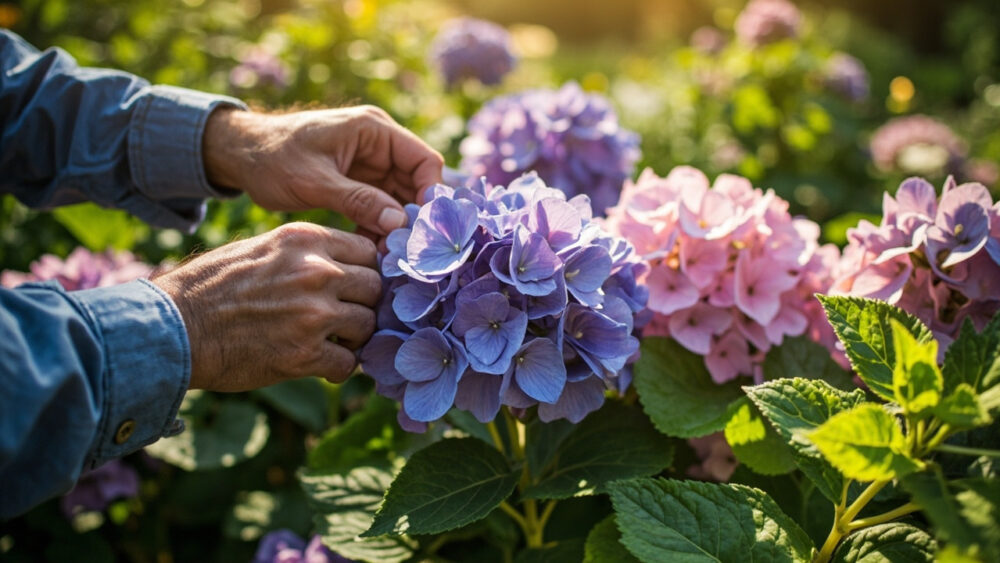
Here’s the color myth: people assume you can turn any Endless Summer pink or blue with a product, but the truth is your soil pH is the real lever, not the fertilizer. Aluminum sulfate added to acidic soil (pH below 6) pushes blooms toward blue, while garden lime raises pH toward 6.5 or higher for pink. If your water is naturally alkaline or your soil is heavy clay with a high pH, holding true blue is a constant, years-long fight, not a one-time fix.
White varieties in this line, like the Blushing Bride type, don’t shift color at all regardless of pH, so don’t waste product on those.
Once the color question is settled, the next thing people get wrong is when and how hard to cut this plant back.
Pruning, Repotting, and Cleanup
If you assumed you need to prune Endless Summer hard every spring like an old-fashioned mophead, that habit is exactly what costs people their first flush of blooms. Because it flowers on both old and new wood, the only pruning it truly needs is removing dead, damaged, or weak stemswhich you can do anytime you spot them.
If you want to shape it or remove spent flower heads, do that right after the first bloom flush fades in summer, cutting just below the spent bloom, not deep into the woody stems. Avoid any hard cutback in fall or early spring. That’s exactly when you’d remove the old wood that’s about to flower first.
Deadheading spent blooms isn’t required for rebloom, but it tidies the plant and can encourage a stronger second flush later in the season.
Repot container plants every two to three years, moving up one pot size, in early spring before new growth really takes off. In the ground, this hydrangea can stay put for decades if the spot suits it.
Cleanup is simple: pull fallen leaves away from the base in fall to reduce fungal spores overwintering near the crown.
Even with perfect pruning, this plant still runs into a short list of predictable problems.
Common Problems and Honest Fixes
Most Endless Summer trouble traces back to one of these:
- No blooms: usually a late hard frost killed the current season’s buds, or the plant is too young, too shaded, or was pruned at the wrong time. Give it another season. Established plants recover.
- Wilting despite wet soil: often heat stress in full afternoon sun, not a watering problem. Move containers to more shade if you can.
- Yellowing leaves with green veins: a sign of iron deficiency, common in high-pH soil. An iron supplement or acidifying the soil slightly usually corrects it.
- Powdery mildew or leaf spot: improve airflow, water at the soil line instead of overhead, and use a fungicide labeled for hydrangeas if it spreads, following the label exactly.
- Aphids or Japanese beetles: hand-pick or hose off light infestations. For heavier pressure, an insecticidal soap labeled for the pest works, applied per the label.
None of these are usually fatal to an established plant, but a hydrangea that drops most of its leaves mid-summer and doesn’t recover by fall is telling you something is wrong at the roots, usually drainage.
Now for the good news, what it looks like when everything’s actually going right.
Signs Your Hydrangea Is Genuinely Thriving
A healthy Endless Summer has leaves that are glossy, deep green, and hold their shape through the afternoon rather than collapsing flat. New growth from the base in spring, thick and multiplying each year, tells you the root system is expanding well.
Expect the first bloom flush in late spring to early summer on old wood, followed by a second, often lighter flush in late summer on new growth, this is the “endless” part of the name and the main reason people choose this variety over older ones. Blooms that start green, deepen into full color, then age toward a papery antique shade before fall are completely normal, not a sign of decline.
A plant putting out that two-flush bloom pattern year after year, with sturdy stems that don’t flop under the flower weight, is a hydrangea that’s settled in and happy.
Here’s everything from above condensed into the numbers worth saving.
Endless Summer Hydrangeas at a Glance
- Light: morning sun, afternoon shade, four to six hours of direct light, more shade in hot climates.
- Hardiness: USDA zones 4 through 9, blooms on old and new wood so winter damage doesn’t erase the whole season.
- Watering: check soil an inch or two down, water deeply two to three times a week in heat, daily for containers if dry.
- Soil and feeding: rich, well-drained soil, feed once in early spring and optionally again in early summer, stop by midsummer.
- Bloom color: controlled by soil pH, not fertilizer, aluminum sulfate for blue in acidic soil, lime for pink in alkaline soil.
- Pruning: remove only dead or damaged wood anytime, shape lightly right after the first bloom flush, never a hard fall or early spring cutback.
- Bloom pattern: first flush late spring to early summer on old wood, second flush late summer on new wood.
If you remember one thing, remember this: leave the pruners alone except for dead wood, and let the soil pH do the color work.
Everything else with this hydrangea is just consistent water and a little patience.