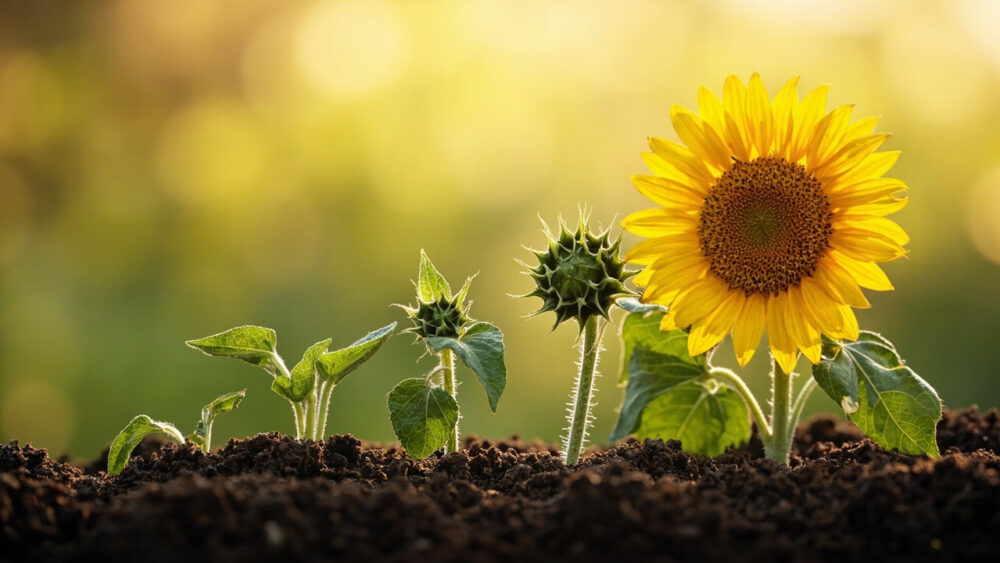
Sunflowers move through five distinct growing stages between seed and seed head: germination (5 to 10 days), seedling growth (2 to 3 weeks), rapid vegetative growth (4 to 6 weeks), budding and flowering (2 to 3 weeks), and seed maturation (4 to 6 weeks). Total time from planting to a fully mature seed head runs 80 to 120 days depending on the variety. If you’re standing over a pot or a garden bed right now trying to figure out where your plant sits in that timeline, the leaf count and stem behavior will tell you faster than the calendar will.
Here’s what trips people up: the stage where sunflowers look the most dramatic is not the stage where they’re doing the most work, and the stage that looks the most boring is where the plant is quietly deciding how tall it will get and how big that flower head will be. Miss that one and you can do everything right later and still end up with a stunted plant.
There’s also a sign almost everyone misreads, a droopy top that looks like wilting but is actually completely normal for one particular stage. And there’s the honest answer to the question you’re probably about to ask next: what does a stalled sunflower actually look like, and is it recoverable. Stick with me through each stage and I’ll flag exactly where things usually go sideways, then save the whole cheat sheet as a “Sunflowers at a Glance” card at the very bottom so you can pull it back up without rereading any of this.
Germination: Days 1 to 10
Nothing visible happens above ground for the first several days, which is exactly why people give up on seeds too early. Underground, the seed is splitting its coat and sending down a taproot. Soil temperature matters more than air temperature here: sunflower seeds germinate fastest between 70 and 85°F soil temp, and they stall hard below 55°F. Plant seeds 1 to 1.5 inches deep, keep the soil evenly moist but not soggy, and expect the first loop-shaped shoot (the cotyledon pushing up) within 5 to 10 days in warm soil, longer in cool spring ground.
The one mistake that kills more sunflower attempts than anything else happens right here: planting too early into cold, wet spring soil. The seed just sits there and rots before it ever gets a chance to sprout.
Once that first shoot breaks the surface, the plant shifts gears completely.
Seedling Stage: Weeks 1 to 3 After Sprouting
The seedling stage starts the moment two round cotyledon leaves unfold, followed within days by the first true leaves, which look rougher and more textured. By the end of this stage the plant should have 4 to 6 true leaves and stand 4 to 8 inches tall. This is a vulnerable window: slugs, birds, and damping-off fungus in soggy soil all target seedlings specifically.
Thin crowded seedlings now, not later. If you scatter-seeded or overplanted, cut (don’t pull, to avoid disturbing neighboring roots) extras so plants stand 6 inches apart for dwarf varieties or 18 to 24 inches apart for standard and giant types. Crowded sunflowers all compete for the same light and none of them get strong.
Get spacing right at this stage and the next one takes care of itself.
Rapid Vegetative Growth: Weeks 3 to 8
This is the stage everyone remembers because the growth is almost comical. A healthy sunflower can gain 3 to 6 inches of height per week during this window, and it’s when the thick, hairy main stem and the big lobed leaves really show up. Roots are also expanding hard underground, which is why this is the single most important stage to get watering and feeding right.
Water deeply and less often rather than a light daily sprinkle. Aim for about 1 inch of water per week, more in sandy soil or hot climates, delivered in one or two soakings so moisture reaches down 6 to 12 inches and pulls the roots deep with it. Shallow, frequent watering trains roots to stay near the surface, and shallow-rooted sunflowers are the ones that topple in the first strong summer wind.
If you’re growing a tall variety, this is also when a stake driven in early (not later, once roots are established and staking would mean spearing them) pays off.
This is the stage that quietly determines your final height and head size, more than any stage after it.
Budding: Weeks 6 to 9
Growth slows noticeably and the plant seems to pause, which is the moment a lot of people assume something’s wrong. It isn’t. The plant is redirecting its energy from getting taller to building the flower bud, which first appears as a small green, tightly closed knob at the top of the stem.
Here’s the sign everyone misreads: in the day or two before the bud opens, the whole top of the plant often droops and nods downward, looking exactly like heat stress or underwatering. In most cases it isn’t. It’s the stem preparing to support the weight of an opening flower head, and it usually straightens back up, or settles into the plant’s natural head angle, once the bloom opens.
Check soil moisture before you panic-water a drooping bud; if the soil an inch down is still moist, leave it alone.
Once that bud starts to crack open at the edges, you’re days away from full bloom.
Flowering: Weeks 8 to 11
The head opens fully, petals (technically ray florets) spread out, and the center disk begins its slow march of tiny individual flowers opening from the outer ring inward over 1 to 2 weeks. This is also when young plants do their well-known heliotropism, tracking the sun across the sky; that tracking largely stops once the head matures and the neck stiffens.
Pollinators show up heavily now, and this stage is where pollination actually happens, seed by seed, across the whole face of the disk. Avoid any pesticide use during open bloom. It’s the single easiest way to wreck your own seed set.
Bloom itself can last anywhere from 1 to 3 weeks depending on variety and weather, with cooler conditions stretching it longer.
Once the petals start browning and dropping, the plant is done flowering and starts the slow work of turning pollinated flowers into seed.
Seed Maturation: Weeks 10 to 16
The back of the flower head, the green part, is your best clue here. As seeds mature it fades from green to yellow to brown, and the head itself tips downward under its own weight. This stage takes 4 to 6 weeks and there’s no rushing it.
Harvest is ready when the back of the head is fully brown and dry, petals have dropped, and seeds look plump with visible black and white or gray striping (color varies by variety) rather than pale and hollow. If birds are stripping the head faster than seeds are finishing, cover it loosely with cheesecloth or a paper bag, never plastic, which traps moisture and rots the head.
That slow color change on the back of the head is more reliable than any calendar date you could go by.
Stalled Growth vs. Normal Pause: How to Tell the Difference
A normal pause, like the slowdown at budding, comes with otherwise healthy dark green leaves and a plant that’s still firm and upright. A true stall shows up as pale or yellowing lower leaves, a stem that stays thin and doesn’t thicken week over week, or a plant that’s been at the same height for more than two weeks during what should be the rapid growth stage.
The honest answer to whether a stalled sunflower recovers: often yes, if the cause is fixable, like underfeeding in poor soil (a balanced feeding once vegetative growth starts usually restarts things within a week or two) or root crowding from planting too close. If the cause is a damaged taproot, severe transplant shock, or the plant was simply planted too late in the season to finish its cycle before frost, no amount of feeding brings back lost time.
Know which one you’re dealing with before you spend another month waiting.
Sunflowers at a Glance
- When to plant: after your last frost date, once soil temperature holds above 55 to 60°F.
- Planting depth and spacing: 1 to 1.5 inches deep, thinned to 6 inches apart for dwarf types or 18 to 24 inches for standard and giant types.
- Germination time: 5 to 10 days in warm soil.
- Time to bloom: 60 to 90 days from planting, depending on variety.
- Total time to mature seed: 80 to 120 days from seed to harvest-ready head.
- Watering rule: about 1 inch per week, deep and infrequent, more in sandy soil or hot weather.
- Harvest sign: the back of the flower head turns from green to brown and the head droops downward.
Every sunflower stage has its own look and its own job, and most problems trace back to rushing one of them.
Get the timing and spacing right early, and the plant genuinely does most of the rest of the work itself.