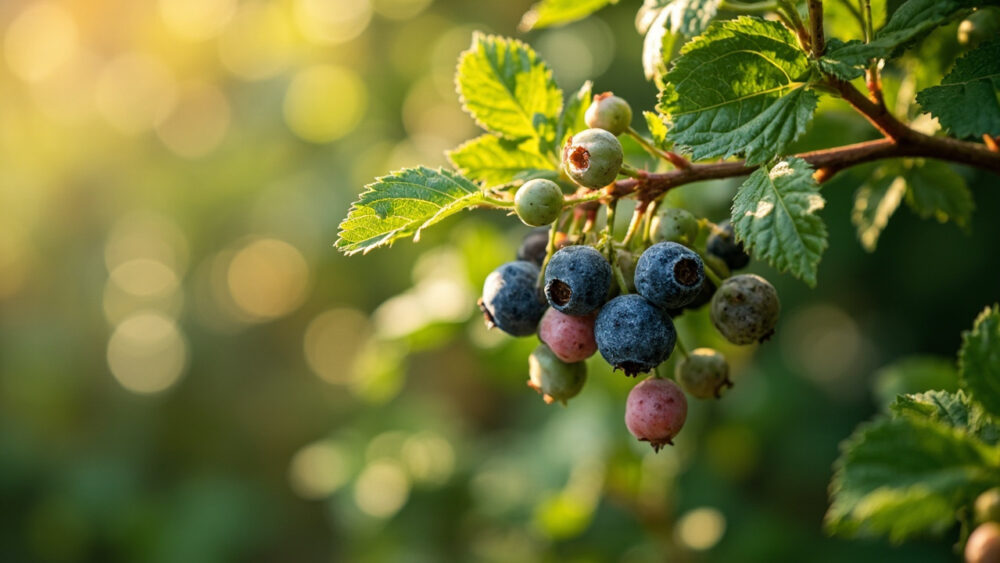
A blueberry bush moves through five distinct stages every year: dormancy, bud swell, bloom, green fruit, and ripening, then back to dormancy after fall color. From dormancy break to first ripe berries usually takes 10 to 16 weeks, depending on your climate and variety, and a newly planted bush needs two to three full growing seasons before it fruits heavily. If you clicked this looking at a bush right now trying to figure out what stage it’s in and whether that’s normal, you’re in the right place.
There’s one stage almost everyone misreads as a disaster when it’s actually the plant working exactly as designed, and one stage where impatience costs an entire season of fruit. There’s also a quieter problem: a bush that looks fine but just sits there, putting out no new growth and no fruit, for reasons that have nothing to do with water.
Stick with me through each stage and I’ll tell you what’s normal, what’s a warning sign, and what to actually do about it. The saveable Blueberries at a Glance card is at the bottom, with every timing and spacing number in one place for your phone.
Dormancy: The Stage Everyone Panics About
From late fall through late winter, a healthy blueberry bush looks completely dead. No leaves, gray-brown bark, bare stems. This is correct and necessary.
Blueberries require a real winter chill to set fruit buds properly, typically 800 to 1,200 hours below 45°F depending on variety. Southern highbush types need less, northern highbush and half-high types need more.
During dormancy, your only job is pruning, done while the plant is leafless so you can see its structure. Remove dead, crossing, and low branches on mature bushes, but leave young bushes (under 3 years) mostly alone to build size.
A dormant bush is not a stalled bush, it’s a resting one.
Bud Swell: The First Real Sign of Life
As soil warms and days lengthen, usually 2 to 6 weeks before your last frost date, the flower buds at branch tips begin to swell and blush pink or reddish before opening. This is the true start of the growing season.
This is also when a hard late frost does the most damage, since swollen buds are far less cold-hardy than dormant ones. If a frost is forecast after bud swell has started, covering the bush overnight with a sheet or frost cloth can save the crop.
If you assumed spring frost only threatens seedlings and transplants, that assumption is what costs established blueberry growers their harvest most often. A mature bush loses no leaves to a light frost at this stage, it loses flowers, and flowers are the only thing that becomes berries.
Once buds swell, the clock on your entire season starts ticking.
Bloom: Small White Bells and a Pollination Window
Bloom arrives 1 to 3 weeks after bud swell, showing clusters of small white or pale pink bell-shaped flowers along last year’s growth. This typically lands anywhere from early to late spring depending on your zone.
Bees do almost all the pollination work here, particularly bumblebees, which fly in cooler temperatures than honeybees. A stretch of cold, wet, windy weather during bloom means fewer pollinator visits and a lighter fruit set, even though the bush looks perfectly healthy.
Planting two or more varieties that bloom at the same time noticeably improves fruit set and size compared to a single variety alone, even in types marketed as self-fruitful.
Once the petals brown and drop, you’re not looking at a problem, you’re looking at the next stage starting.
Green Fruit: The Slow, Boring, Necessary Middle
For 4 to 8 weeks after bloom, developing berries stay hard, green, and roughly pea-sized, swelling gradually with no obvious color change until near the very end. This is the stage that tests patience.
This is also where most people make their biggest mistake of the whole season: letting the bush dry out because “nothing seems to be happening.” Blueberries have shallow, fibrous roots that sit in the top 8 to 12 inches of soil, and green fruit swells almost entirely on consistent moisture.
Check soil moisture by feel, not by looking at the surface. An inch down, soil should feel like a damp sponge, never bone dry, never waterlogged. A 2 to 4 inch layer of mulch (pine bark or wood chips work well) does more to protect this stage than any amount of extra watering.
Berries that stay hard and green far longer than expected usually aren’t broken, they’re just waiting on heat and light, which brings us to the stage everyone actually clicked for.
Ripening: Color Change and the Sugar Timing Everyone Rushes
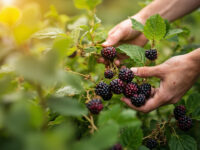
Ripening runs 1 to 2 weeks and starts with berries turning from green to a dull reddish-pink, then to full blue, then developing a light silvery-white bloom on the skin. Color change alone is not your harvest signal.
A berry that has just gone fully blue is often still tart and underripe. The real cue is a gentle tug: a ripe blueberry releases from the stem with almost no resistance, while an unripe one holds on tight even after it looks blue. Give color three to five extra days after it first turns fully blue before you rely on it as your main test.
Berries don’t all ripen at once on the same bush or even the same cluster, so plan on picking every 3 to 7 days over several weeks rather than one big harvest day.
Once picking season winds down, the bush isn’t finished working for the year, it’s setting up for the next one.
Post-Harvest and Fall Color: Building Next Year’s Crop Now
After the last berries are picked, the bush keeps growing new wood through late summer, and this new growth is exactly where next year’s flower buds will form. Fall color (yellow, orange, or deep red depending on variety) signals the plant shutting down for dormancy, not a problem.
Late-summer fertilizing or heavy pruning pushes soft new growth that won’t harden off before frost, which weakens the plant instead of helping it. Stop fertilizing by mid to late summer and save major pruning for dormancy.
This is also your honest answer to “why didn’t my bush fruit much this year”: light crops in year one and two after planting are completely normal, not a sign of a sick plant.
Which raises the real question worth answering directly: how do you tell a young, patient bush apart from one that’s actually stuck?
Healthy Progress vs. a Real Stall
A young or resting bush still pushes new leaf growth every spring, even in a light-fruit year, and stems stay flexible and green or reddish under the bark. That’s normal patience, not trouble.
A stalled bush shows no new leaf growth for a full season, brittle gray stems with no green underneath when you scratch the bark, or leaves that yellow between the veins while veins stay green (a sign of iron deficiency, usually from soil pH that’s too high). Blueberries need distinctly acidic soil, roughly pH 4.5 to 5.5, and in ordinary garden soil that’s often the real culprit behind a bush that just sits there.
Test soil pH before you assume a fertilizer or water problem. Amending soil to the right acidity (with elemental sulfur or an acidifying mulch) fixes more “stalled” blueberry bushes than any feeding schedule does.
A bush that’s slow is usually fine, a bush that’s stuck is almost always a soil chemistry problem, and now you have every stage in between mapped out.
Blueberries at a Glance
- When to plant: in early spring after soil is workable, or in fall in mild-winter climates, at least 4 to 6 weeks before your first hard freeze.
- Spacing and depth: 4 to 5 feet apart for highbush types, planted at the same depth they sat in the pot, with roots gently loosened before backfilling.
- Soil needs: acidic, pH 4.5 to 5.5, well-drained but never dry, amended with peat moss or acidic compost at planting.
- Time to first real harvest: light picking in year 2 to 3, full production by year 4 to 6.
- Stage most at risk: bud swell through bloom, when a late frost or poor pollination weather costs the whole season’s fruit.
- How to know it’s ripe: fully blue color plus 3 to 5 more days, confirmed by a gentle tug that releases the berry with no resistance.
- Water needs: consistently moist top 8 to 12 inches of soil, especially during green fruit swell, maintained with 2 to 4 inches of mulch.
Get the soil acidity right and respect the frost window at bud swell, and every other stage mostly takes care of itself.
Everything else on this list is just patience with a calendar attached.