The window for planting blueberries is early spring, right after the soil thaws and becomes workable, up until about four to six weeks before your last hard frost, or in fall after the heat of summer breaks and roots have six to eight weeks to settle before the ground freezes. Container-grown plants stretch that window wider than bare-root ones do. Get the timing wrong and the plant does not die outright, it just sulks for a year or two while you wonder what you did.
Most people planting blueberries make one mistake that costs them an entire season, and it has nothing to do with the calendar date. It is planting into soil that was never fixed to be acidic enough, so the roots sit there half-starved no matter how perfect the week was.
There is also a sign of “ready to plant” that almost everyone misreads, and a fall-versus-spring question that nobody answers honestly. Stick around, because the Blueberries at a Glance card at the bottom has the exact numbers, spacing, depth, and soil pH saved in one place so you can pull it up while you are standing at the nursery or in your own dirt.
The Real Planting Window, Anchored to Frost and Soil
Blueberries go in the ground at one of two times: early spring or early fall, and the choice depends more on your summers than your winters. Spring planting works everywhere and is the safer default, done as soon as the soil can be worked and danger of a hard, damaging freeze has passed, typically four to six weeks before your last frost date through about two weeks after it.
Soil temperature matters more than the date on the calendar. You want soil that has warmed past roughly 45 to 50°F at root depth, not just thawed on the surface.
Fall planting works well in regions with mild winters and hot summers, since it lets roots establish before summer stress hits. Give the plant six to eight weeks before your ground typically freezes hard.
Get the season right and the rest is just details.
How to Read Your Own Yard, Not the Calendar
Forget the printed frost date for a minute and look at your actual ground. Squeeze a handful of soil from where you intend to plant.
If it forms a slick, sticky ball, it is still too wet and too cold. You want it to crumble, holding shape loosely without turning to mud.
The sign everyone misreads is new growth on the blueberry plant itself. People see swelling leaf buds at the garden center and assume that means “plant me now.”
Actually, visible bud swell just means the plant broke dormancy in a greenhouse, not that your ground is ready. Trust the soil in your yard over the plant in the pot.
Once your soil crumbles instead of clumps, you are looking at the true start of your window.
Plant Too Early or Too Late, and Here Is What Actually Happens
Plant too early, into cold, waterlogged soil, and the fine feeder roots simply rot before they can take hold. The plant may leaf out weakly, then stall all summer, never dying cleanly enough for you to notice the actual cause.
Plant too late in spring, after the plant has already pushed heavy leaf growth in its container, and it suffers transplant shock in summer heat it is not ready for. Fall planting too late is the more forgiving mistake, but done too close to a hard freeze, roots never anchor and frost heaving can pop a shallow-rooted plant right out of the ground over winter.
None of these mistakes are usually fatal in one shot. But a blueberry bush that limps through its first year rarely catches up for two or three more, and that delay is the real cost.
The honest fix for both problems is the same: get the prep done before the window opens, not during it.
The Prep That Actually Determines Success
Here is the honest answer to the question you were about to ask next: soil pH matters more than planting date. Blueberries need acidic soil, roughly 4.5 to 5.5 pH, which is far more acidic than almost anything else in a home garden.
Test your soil the season before you plant, not the week of. If your native soil runs neutral to alkaline, which most vegetable garden soil does, you need to amend with elemental sulfur or a acidic planting mix worked in weeks ahead, since pH shifts slowly.
Pick a site with full sun, at least six hours daily, and soil that drains well. Blueberries hate wet feet almost as much as they hate alkaline soil, so raised beds or mounded rows solve two problems at once in heavy clay.
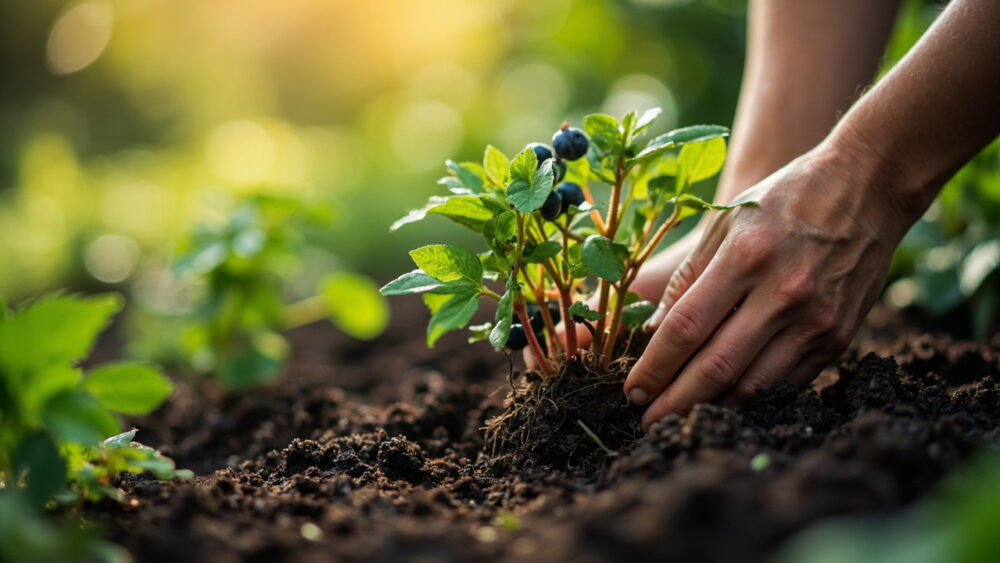
Dig planting holes twice as wide as the root ball and no deeper, setting the plant at the same depth it sat in its container. Space highbush varieties 4 to 5 feet apart, lowbush and half-high types 2 to 3 feet apart, with rows 8 to 10 feet apart if you are planting more than a couple.
Do the soil work now, and the actual planting day becomes the easy part.
Zone and Region Notes Worth Knowing
In cold-winter regions, USDA zones 3 through 5, spring planting is the safer bet almost every time, since young roots need a full growing season before facing a hard freeze. Northern highbush varieties are bred for these zones and need that winter chill to fruit well anyway.
In milder zones 7 through 9, fall planting often outperforms spring, because summer heat stresses new transplants hard, and rabbiteye or southern highbush types establish nicely in the cooler months. Zone 6 sits in the middle, and either season works if you watch the soil rather than the date.
Gulf Coast and desert Southwest gardeners face a narrower window still, since summer heat arrives fast and hard; fall through very early spring is the play there. If you are gardening somewhere with mild, wet winters and dry summers, fall planting lets roots take advantage of natural rainfall before you are stuck hand-watering a new transplant through a dry season.
Know your zone, but let the soil in your own yard have the final word.
Blueberries at a Glance
- When to plant: early spring once soil crumbles and is workable, four to six weeks before last frost through two weeks after, or early fall six to eight weeks before your ground typically freezes hard.
- Soil pH needed: 4.5 to 5.5, tested and amended the season before planting whenever possible.
- Site requirements: full sun, at least six hours daily, well-drained soil, raised beds if you have clay.
- Spacing: 4 to 5 feet apart for highbush types, 2 to 3 feet for lowbush and half-high, rows 8 to 10 feet apart.
- Planting depth: same depth the plant sat at in its container, hole twice as wide as the root ball.
- Zone notes: cold-winter zones 3 to 5 favor spring, mild zones 7 to 9 favor fall, zone 6 and hot Southern or desert climates go by soil condition over calendar date.
- Biggest mistake to avoid: planting into soil that was never acidified, which stalls growth for a year or more regardless of perfect timing.
Get the soil acidic and workable, and the exact week you plant matters far less than people think. The plant will forgive a lot once its roots are in ground it actually likes.