You prune dahlias in two very different ways depending on why you’re doing it, and mixing them up is the mistake that costs most people their best blooms. Early in the season, when plants are 12 to 18 inches tall, you pinch out the growing tip to force branching. All season after that, you deadhead spent flowers and cut back to a strong side shoot, never straight down to bare stem.
There’s a third kind of cutting nobody warns you about, the fall cutback before the tubers go into storage, and getting that one wrong can rot a whole clump over winter. There’s also a sign most gardeners misread completely: a dahlia that stops flowering in high summer isn’t done for the year, it’s usually crying out to be cut, not left alone.
Stick with me and I’ll walk through the exact timing, the tools, the step-by-step cuts, and the mistakes that quietly rob you of flowers all summer. At the bottom there’s a save-able Dahlias at a Glance card with the numbers you’ll actually want on your phone next time you’re standing in front of the plant with pruners in hand.
When to Prune, and When to Leave the Plant Alone
Dahlias need three separate rounds of attention, not one big pruning session. The first happens when young plants hit 12 to 18 inches tall, usually 3 to 4 weeks after you planted tubers or transplants once soil has warmed past 60°F. That’s when you pinch the central growing tip.
Do not touch a dahlia shorter than about 12 inches or with fewer than four sets of true leaves. Pinching too early stalls a plant that hasn’t built enough root and leaf mass yet, and it just sulks instead of branching.
The second round is ongoing deadheading, from first bloom until frost threatens. The third is the fall cutback, done after the first light frost blackens the foliage, not before.
Each round has its own job, and confusing them is where most seasons go sideways.
Tools and the One Prep Step That Actually Matters
You need sharp bypass pruners or garden snips for stems, and your thumb and forefinger for pinching young tips. That’s the whole tool list. Dahlia stems are hollow and fibrous, so dull blades crush rather than cut, and a crushed stem is an open invitation to rot and fungal disease.
Wipe your blades with rubbing alcohol between plants, especially if any dahlia in the bed has shown virus symptoms like mottled or streaked leaves. This is the prep step everyone skips, and it’s the one that actually matters.
Dahlia viruses spread easily on pruner blades and have no cure, only removal of the infected plant. A ten-second wipe is cheap insurance against losing an entire tuber collection to something you can’t fix later.
Clean tools, then let’s talk about where exactly to cut.
How to Pinch and Prune a Dahlia, Step by Step
Step 1: The Early Pinch for Branching
Once the plant has 3 to 4 sets of leaves and stands 12 to 18 inches tall, pinch out the topmost 2 to 4 inches of the central stem, right above the third or fourth leaf set. Use your fingers or snips just above a leaf node.
This feels wrong the first time you do it, since you’re removing the plant’s tallest, healthiest growth on purpose. That’s exactly the point.
Within a week or two, two or more side shoots will push out from the leaf nodes just below your cut, and each of those becomes a flowering stem instead of one lonely spike at the top.
Skip this step and you’ll still get flowers, just far fewer of them, on a taller, floppier plant.
Step 2: Deadheading Through the Season
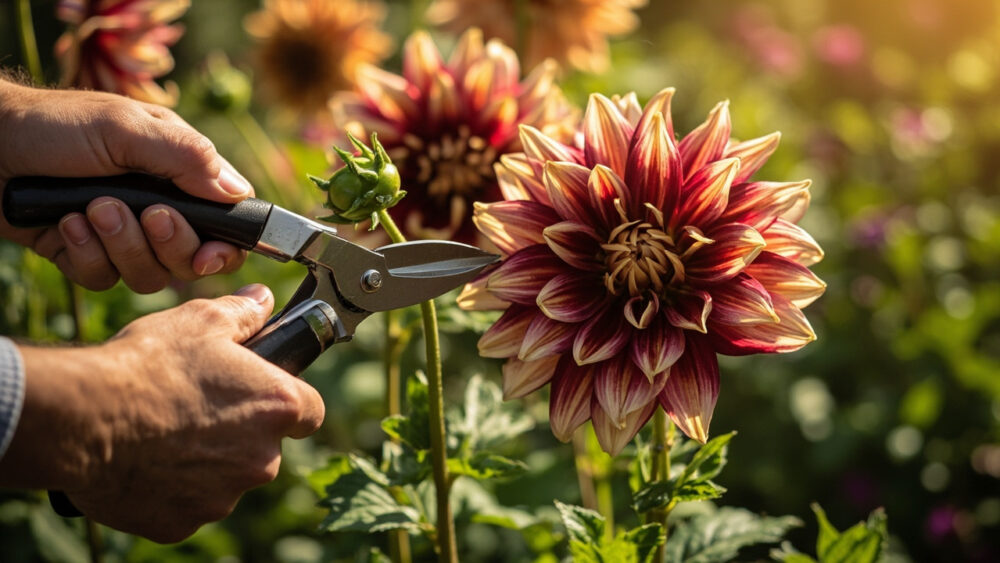
Once flowering starts, cut spent blooms down to the first set of full leaves or the next side branch, not just snapping off the dead flower head. Follow the stem down until you find a junction with healthy leaves, and cut there.
The sign everyone misreads is a dahlia that seems to quit blooming in the thick of summer heat. Most of the time that’s not heat stress or a nutrient problem, it’s a plant loaded with old seed heads that never got cut back, signaling the plant to stop investing in new flowers.
Cut hard and consistently and most dahlias will rebloom within 2 to 3 weeks.
Deadheading is the pruning that keeps the flowers coming, but knowing how to tell a spent bloom from a bud that’s about to open matters just as much.
Step 3: Telling Buds From Spent Blooms
Dahlia buds are round and tight. Spent blooms go papery, faded, and often start curling or dropping petals from the center outward.
When in doubt, wait 2 to 3 days. A true bud will visibly swell and start showing color; a spent bloom will only get worse.
Cutting a live bud by mistake costs you one flower. Leaving spent blooms on the plant costs you the whole rest of the season’s production.
Step 4: The Fall Cutback Before Storage
After the first light frost blackens the foliage, cut the main stem down to about 4 to 6 inches above the soil. Leave the tubers in the ground for another 1 to 2 weeks after that cut if your soil isn’t waterlogged, since this lets the eyes on the tuber crown mature and toughen skin against rot.
Cutting the whole plant to ground level immediately at first frost, before that curing window, is a common shortcut that leads to soft, rot-prone tubers in storage.
Get the fall cut right and you’ve set yourself up for a much easier spring.
What to Expect After Each Cut
After the early pinch, expect a visibly stalled-looking plant for 5 to 10 days before branching kicks in. That lag is normal and not a sign of transplant shock or disease.
After deadheading, expect new buds within 2 to 3 weeks on vigorous varieties, sometimes a bit longer on giant dinner-plate types, which naturally flower on a slower cycle than smaller pompon or ball varieties.
After the fall cutback, expect the remaining stem stub to look dead and dry, which is correct. You’re not looking for green regrowth at this point, you’re just protecting the tuber below.
Next, the mistakes that quietly undo all of this good work.
The Mistakes That Cost You Flowers
- Pinching too late: waiting until the plant is already 2 feet tall and budding means you’re removing flowers instead of encouraging branching, which sets bloom time back weeks.
- Deadheading with a snap instead of a cut: tearing off spent blooms by hand leaves a jagged wound that invites stem rot, especially in humid weather.
- Cutting straight across a hollow stem’s open top: water collects in the hollow stem and rots downward toward the tuber. Always cut at a slight angle, or right above a node, never leaving a flat open hollow facing the sky.
- Removing too much foliage at once: taking more than about a third of the plant’s leaf area in one session shocks it and slows both branching and rebloom.
- Cutting back hard before frost: a plant cut to the ground in September, before frost, wastes weeks of remaining bloom time the plant still had in it.
Every one of these is fixable next season once you know what to look for.
Dahlias at a Glance
- When to pinch: at 12 to 18 inches tall with 3 to 4 leaf sets, remove the top 2 to 4 inches of the central stem.
- When to deadhead: continuously from first bloom until frost, cutting down to the first healthy leaf set or side branch.
- When to cut back for winter: after the first light frost blackens foliage, leave tubers in the ground 1 to 2 weeks more before digging.
- Tools: clean, sharp bypass pruners, wiped with rubbing alcohol between plants.
- Cut angle: slightly angled or just above a node, never a flat cut leaving an open hollow stem.
- Rebloom timing: expect new buds 2 to 3 weeks after a good deadheading pass.
- Never remove: more than about a third of the plant’s total foliage in a single pruning session.
Get the timing right on these three cuts and a dahlia will reward you with flowers from midsummer clear to frost.
When in doubt, cut less, watch for a week, and let the plant tell you what it needs next.