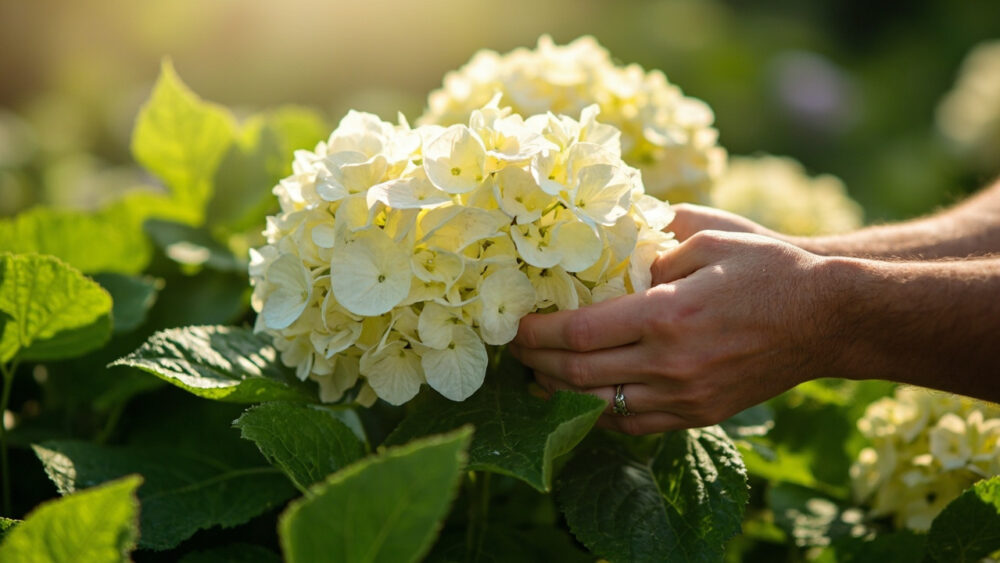
Annabelle hydrangeas care boils down to four things: part shade with morning sun, steady moisture, a hard prune to about 6 to 12 inches each late winter, and patience while those huge white blooms flop around on new growth until the stems catch up. Get those right and Annabelle forgives almost everything else. She is one of the toughest hydrangeas you can plant, hardy down to zone 3, and she blooms on new wood so a bad winter never costs you flowers.
Here is where most people go wrong, though. They see the famous floppy blooms and assume the plant is dying of thirst or needs staking forever, when the real fix is a pruning habit almost nobody uses correctly.
There is also a color question everyone asks eventually, and the honest answer surprises people who bought this plant expecting the pink-and-blue trick. Stick around, because the save-able Annabelle Hydrangeas at a Glance card is waiting at the bottom with every number in one place.
Light, Placement, and Temperature
Annabelle wants morning sun and afternoon shade, roughly 4 to 6 hours of direct light total. Full sun works in cooler climates, zones 3 to 5, where heat never really punishes the leaves. In zones 6 and warmer, full afternoon sun will scorch the leaf edges and wilt the blooms by 2 p.m. even when the soil is damp.
Give her room. Annabelle spreads 3 to 5 feet wide and grows just as tall, so space plants 3 to 5 feet apart if you are planting more than one. She does fine near black walnut trees, unlike some shrubs, and she tolerates urban pollution and clay soil better than most hydrangeas.
Placement against a house wall that reflects heat is the single most common site mistake.
Watering: How Much, How Often, and How to Tell
Water deeply once or twice a week, enough to soak the root zone 8 to 10 inches down, rather than a light daily sprinkle. In the first growing season, check the soil 2 inches down with your finger; if it is dry, water. Established plants, two years or older, usually need water only during dry stretches of a week or more without rain.
Wilting midday leaves are not always a thirst signal. Annabelle’s big leaves and heavy blooms droop in strong afternoon heat even with wet soil, then perk back up by evening. Check the soil before you reach for the hose. If it is still moist and the plant recovers by dusk, that is heat stress, not drought, and extra water just invites root rot.
Mulch 2 to 3 inches deep out to the drip line to hold moisture and keep roots cool.
Getting the moisture right matters less, though, if the soil underneath is working against you.
Soil, Potting Mix, and Feeding
Annabelle wants rich, well-drained soil with consistent moisture, a pH anywhere from slightly acidic to slightly alkaline. Unlike bigleaf hydrangeas, her white blooms do not change color with soil pH, so skip the aluminum sulfate and lime tricks entirely.
Work 2 to 3 inches of compost into the planting hole and the surrounding bed at planting time. In containers, use a quality potting mix with added compost or perlite for drainage, and expect to size up pots every 2 to 3 years as the root ball fills in.
Feed lightly, once in early spring as new growth starts, with a balanced slow-release fertilizer or an inch of fresh compost worked into the soil surface. Too much nitrogen produces huge leafy growth and weak stems that cannot hold the flower heads up, which makes the flopping problem worse, not better.
That flopping problem, and the color question right behind it, both trace back to what happens with the pruning shears.
Pruning, Cleaning, and the Repotting Schedule
Prune Annabelle hard in late winter or very early spring, while she is still dormant and before new growth breaks, cutting the whole plant back to 6 to 12 inches from the ground. Because she blooms entirely on new wood grown that same season, this hard cut does not cost you a single flower and actually produces a sturdier, less floppy plant than leaving old wood in place.
If you skip pruning for a few years, stems get taller, thinner, and progressively worse at holding up the blooms, which is the real cause behind most of that famous flopping everyone blames on watering.
Deadhead spent blooms through summer if you want a tidier look, though it is optional since they dry attractively on the stem into fall. Container plants need repotting every 2 to 3 years in early spring, moving up one pot size and refreshing the mix.
Get the late-winter cut right and most of the season’s problems solve themselves before they start.
Problems Most Likely to Strike
Powdery mildew shows up as a white, dusty coating on leaves during humid, still weather. Improve air circulation by thinning crowded stems and avoid overhead watering late in the day; if it persists, a fungicide labeled for powdery mildew on ornamentals works, applied exactly per the label.
Leaf spot and botrytis blight both appear as brown or gray spotting, usually after a wet spring, and respond to the same fix: better airflow, water at the soil line instead of the leaves, and remove badly affected foliage.
Aphids and Japanese beetles are the most common pests, aphids clustering on new growth and beetles chewing ragged holes in leaves through midsummer. Insecticidal soap handles aphids. Hand-picking beetles into a bucket of soapy water in early morning, when they are sluggish, controls light infestations without spraying.
Annabelle hydrangea is considered mildly toxic to dogs, cats, and horses if leaves, flowers, or bark are eaten in quantity, and can cause digestive upset. If you suspect a pet has eaten a meaningful amount, call your veterinarian rather than waiting to see what happens.
Most of these issues are cosmetic and survivable, which brings up the real question: how do you know the plant is actually doing well?
Signs Annabelle Is Genuinely Thriving
A thriving Annabelle pushes multiple strong new canes from the base each spring, thick as a pencil or better, with leaves that stay a deep green rather than pale yellow-green. Blooms should reach 6 to 8 inches across on a well-established, properly pruned plant, sometimes larger.
Sparse, spindly canes and small blooms usually point to too much shade, too much nitrogen, or a plant that has gone several years without its hard late-winter prune. Yellowing leaves with green veins usually mean iron deficiency in alkaline soil, fixable with a chelated iron treatment, not more water.
If your plant checks those boxes, you are doing it right, and the rest is just maintenance.
Annabelle Hydrangeas at a Glance
- When to plant: spring after your last frost or early fall, giving roots 6 weeks before hard frost hits.
- Light: morning sun with afternoon shade, full sun tolerated only in zones 3 to 5.
- Water: deep soak once or twice weekly, more during heat, check soil 2 inches down before watering established plants.
- Soil: rich, well-drained, amended with compost, pH does not affect bloom color on this variety.
- Spacing and size: 3 to 5 feet apart, matures to 3 to 5 feet tall and wide.
- Pruning: cut back hard to 6 to 12 inches in late winter or very early spring, before new growth starts.
- Hardiness: zones 3 through 9, blooms on new wood so winter damage never costs you flowers.
Get the late-winter prune and the moisture check right, and Annabelle takes care of the rest herself.
Everything else in this guide is just cleanup around those two habits.