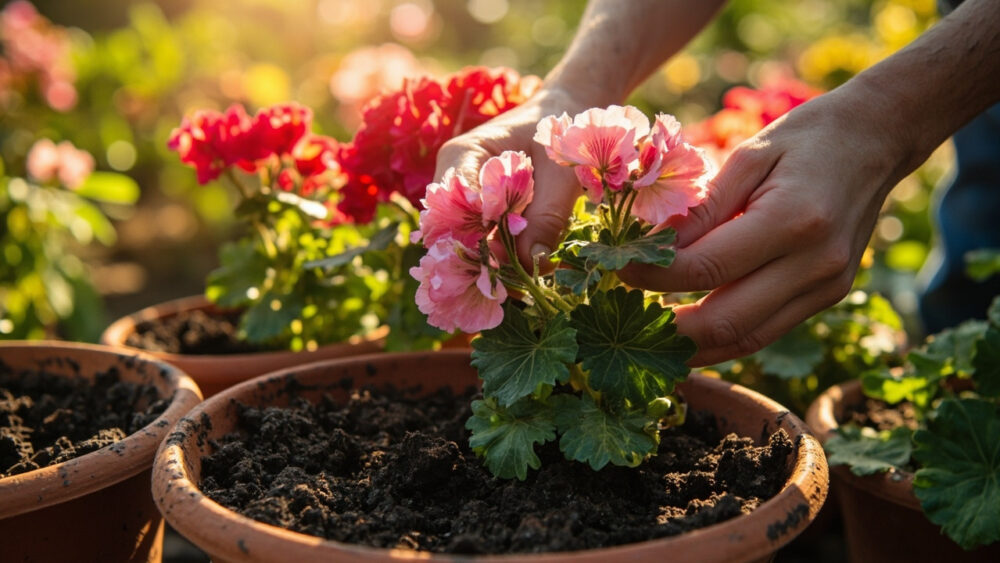
Learning how to grow geraniums comes down to four things: plant them after your last frost once nights stay above 50°F, give them at least six hours of direct sun, water only when the top inch of soil goes dry, and deadhead spent blooms constantly. Do that and you get a plant that flowers non-stop from late spring until frost, sometimes longer if you bring it indoors. Miss any one of those four and you get a leggy, sulking plant that looks nothing like the ones on the plant tag.
Most people who struggle with geraniums make the same mistake, and it is not underwatering like everyone assumes. It is the opposite, and it is quietly rotting roots for weeks before a single leaf shows it.
There is also a sign on the leaves that gets misread constantly, a feeding habit that backfires, and an honest answer about whether that leggy old geranium from last year is worth saving. All of it is coming up, and the Geraniums at a Glance card at the very bottom has every number on one screen so you can save it before you walk back out to the garden.
When to Plant Geraniums
Wait until night temperatures hold above 50°F before putting geraniums outside, whether in the ground or in containers. That is typically two to three weeks after your last spring frost date. Soil temperature matters more than the calendar here: geraniums stall and sulk if the soil is still cold and wet, even if the air feels warm during the day.
If you started seed indoors, count back 12 to 14 weeks from your last frost date to sow. Most gardeners skip that and buy started plants instead, which is the easier route and perfectly respectable.
In zones 8 through 11, geraniums often behave as short-lived perennials or overwinter outdoors with minimal protection. In zones below that, treat them as annuals or plan to bring them inside before the first frost.
Timing gets the plant in the ground safely, but the spot you choose decides whether it thrives or just survives.
Choosing the Spot and Prepping the Soil
Geraniums want six or more hours of direct sun a day. In hot climates, zone 9 and up, a little afternoon shade actually helps blooms last longer and keeps leaves from scorching. In cooler regions, full sun all day is fine and usually produces the most flowers.
Soil drainage is the part people underestimate. Geraniums do not tolerate wet feet. If you squeeze a handful of moist soil and it holds together in a dense ball that doesn’t crumble, work in compost or coarse grit before planting.
In containers, always use a potting mix, never garden soil straight from the yard. Garden soil compacts in pots and holds water exactly where you don’t want it.
Good soil sets up everything that comes next, starting with how deep and how far apart you actually plant.
Planting Geraniums Step by Step
1. Dig the hole to match the root ball
Dig each hole the same depth as the nursery pot and about twice as wide. Planting too deep, burying any part of the main stem, invites rot at the crown.
2. Space them properly
Give upright zonal geraniums 10 to 12 inches between plants. Trailing ivy geraniums need 12 to 18 inches since they spread wide. Crowded plants compete for airflow, and poor airflow is where fungal problems start.
3. Set the plant and firm the soil
Loosen the root ball gently with your fingers if it’s tightly wound, then set it so the crown sits level with the surrounding soil, not below it. Firm the soil around the base, don’t pack it hard.
4. Water in immediately
Give a thorough soak right after planting to settle soil around the roots and eliminate air pockets. Skip fertilizer for the first two weeks and let roots establish first.
Once they’re in the ground, watering habits decide whether they take off or stall out completely.
Watering and Feeding Through the Season
Here’s the mistake that ruins most attempts, and it’s not what you’d guess: it is not too little water, it’s too much, too often. Geraniums actually prefer to dry out somewhat between waterings. Check the top inch of soil with your finger, and only water when it feels dry, not just cool.
Overwatered geraniums show yellowing lower leaves that people almost always read as “needs more water.” That guess kills more geraniums than drought ever does. Yellow, soft, or translucent lower leaves paired with damp soil mean cut back watering immediately, not increase it.
For feeding, use a balanced liquid fertilizer at half strength every three to four weeks during active growth. Skip high-nitrogen formulas. They push leafy growth at the expense of blooms, which is the opposite of what you’re growing these for.
Feeding and water get the plant growing, but a few predictable troublemakers will still show up uninvited.
Problems That Actually Show Up
Botrytis blight, a gray fuzzy mold, appears on flowers and leaves during cool, damp, crowded conditions. Improve airflow, remove affected parts promptly, and avoid overhead watering that wets the foliage.
Bacterial leaf spot and stem rot show up as dark, water-soaked patches, usually from soil that stays too wet for too long. There’s no cure once stem rot sets in deep, so pull and discard badly affected plants rather than nursing them along.
Aphids and whiteflies cluster on new growth and the undersides of leaves. A strong spray of water knocks most of them off, and insecticidal soap applied per the label handles the rest.
Geranium budworm (a caterpillar) chews holes straight through unopened flower buds. Check buds regularly and remove any with small entry holes before they open.
Most of these problems trace back to one root cause: too much moisture sitting where it shouldn’t. Fix drainage and airflow first, always.
Handle pests and disease early, and the reward is the part everyone actually clicked for: the blooms.
When Geraniums Bloom, and How to Keep Them Going
Geraniums typically start blooming 8 to 10 weeks after planting and continue non-stop through summer into fall if you stay on top of deadheading. There’s no single “harvest” moment like a vegetable, the payoff is continuous flowering, which makes maintenance the real skill here.
Snap or cut spent flower stalks at the base where they meet the main stem, not just the flower head. Leaving stubs invites rot and slows the next flush of blooms.
If plants get leggy and sparse by midsummer, cut them back by about a third. This looks brutal for a week and feels wrong, but it triggers a fuller, more compact flush of new growth and blooms within two to three weeks.
As for that leggy geranium from last year: if the stems are still green and firm and roots are healthy, it’s worth cutting back hard and reviving rather than tossing. If stems are woody, hollow, or the crown is soft, start fresh instead.
Keep deadheading through the season and you’ll get flowers until frost finally shuts things down, at which point the card below has everything worth remembering for next year.
Geraniums at a Glance
- When to plant: after last frost, once nights hold above 50°F, roughly two to three weeks past frost date.
- Sun needs: six or more hours of direct sun, with light afternoon shade in zones 9 and up.
- Spacing: 10 to 12 inches for upright zonal types, 12 to 18 inches for trailing ivy geraniums.
- Planting depth: same depth as the nursery pot, crown level with the soil surface, never buried.
- Watering: only when the top inch of soil is dry, never on a fixed schedule.
- Feeding: balanced liquid fertilizer at half strength every three to four weeks, skip high-nitrogen blends.
- Bloom time: starts 8 to 10 weeks after planting, continues until frost with regular deadheading.
If you remember one thing, remember this: geraniums fail from too much water far more often than too little.
Check the soil with your finger before you reach for the hose, and you’ll skip the problem that takes down most first attempts.