You harvest chamomile when the white petals start to droop backward and lie flat against the stem, leaving the yellow center raised and full. This usually happens 2 to 3 days after a flower opens, and once you see it, pick that same day or the next morning. That’s the whole answer, but knowing how to harvest chamomile well, without wrecking next week’s flush, takes a little more than that.
Most people either pick too early, when the flowers still look tight and cheerful, or wait until the whole patch has gone to seed and wonder why their tea tastes like grass clippings. There’s also a timing mistake that costs people the entire back half of the season without them ever realizing it was their fault.
And there’s one detail about the smell that most guides skip entirely, the one that actually tells you more than the petals do. Stick around, because the save-and-screenshot “Chamomile at a Glance” card is waiting at the bottom once you’ve got the full picture.
The Ready Signs: What to Actually Look For
Chamomile doesn’t ripen the way a tomato does, all at once and obvious. It tells you flower by flower, and you’ll be harvesting the same plant every 2 to 4 days for weeks.
The petal droop
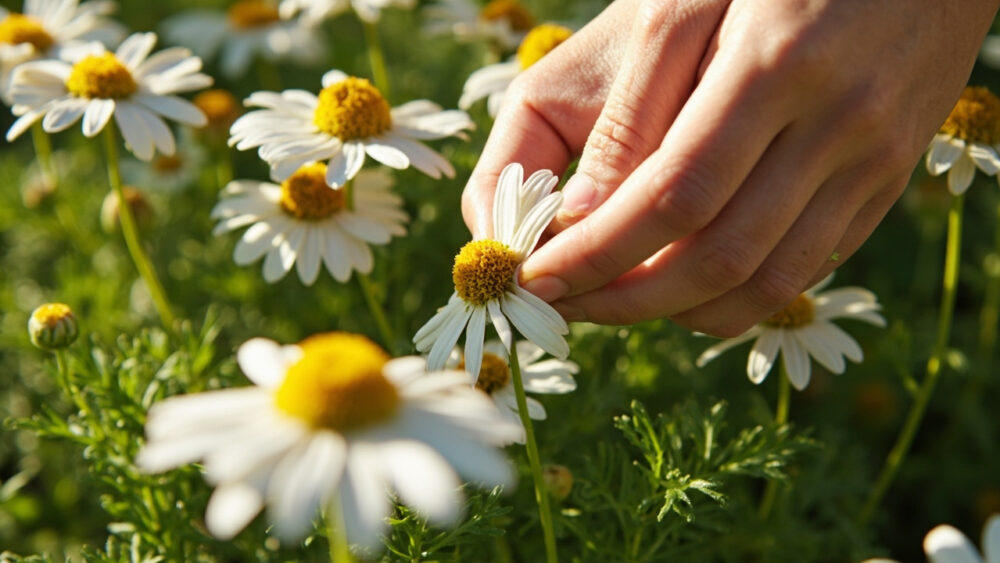
Watch the white petals around the yellow disc. When they’re standing straight out, flat like a little sunburst, the flower is a day or two away. Once those petals bend downward and hang loose against the stem, the flower is at peak and ready right now.
The center dome
The yellow center should look rounded and slightly domed, not flat. A flat, sunken center that’s gone from bright yellow to dull or brownish means you waited too long and the flower has already started setting seed.
Petal droop is your green light, but there’s a smell test that catches what your eyes miss.
The Timing Window, and Why Going Early or Late Both Cost You
Chamomile blooms in flushes starting about 60 to 65 days after you sow, and once it starts, it keeps flowering for 6 to 8 weeks or more if you stay on top of picking. The window per flower is narrow. Miss it by a week and that flower is done contributing to your harvest.
If you pick too early, before the petals droop, you get flowers with less aroma and a weaker, thinner flavor once dried. The essential oils that give chamomile its apple-like scent are still developing in that tight, upright stage.
If you pick too late, after the center flattens and browns, you’re harvesting flowers that have already dropped most of their oil into seed production. Worse, a plant left to go to seed slows down on producing new flowers, because it thinks its job is finished.
That’s the mistake that quietly ends a season early: let too many flowers go to seed at once, and the plant stops trying nearly as hard.
Here’s the part almost nobody mentions: crush a petal-drooped flower gently between your fingers. It should smell distinctly like fresh apple with a grassy edge. If it smells faint or mostly green, give it another day. That smell test is more reliable than the petals alone, especially on cloudy days when the droop is harder to judge.
Get the timing right and the next question is simply how to get the flower off the plant without damage.
How to Harvest Chamomile Step by Step
Chamomile plants are wiry and a little delicate at the stem, so ripping handfuls off is how people snap branches they didn’t mean to lose.
- Harvest in the morning, after the dew has dried but before the heat of the day, when essential oil content is highest.
- Pinch or snip each flower head individually, right where the flower meets the thin stem, leaving an inch or so of stem attached if you plan to dry them on the stalk.
- Use two fingers and a thumbnail, or small snips, rather than pulling. Pulling drags on the whole branch and can uproot shallow-rooted plants.
- Collect into a shallow basket or bowl, not a plastic bag. Piled-up flowers in a bag sweat and start to mold within hours.
- Work through the whole patch, since flowers ripen unevenly and you’ll likely only get a third to half of the blooms ready on any given pass.
Once the basket’s full, the clock starts, and what you do in the next hour matters as much as the picking did.
What to Do With the Harvest Right Away
Fresh chamomile flowers are mostly water and they mat down fast. Spread them out in a single layer on a screen, a baking sheet, or a clean towel within an hour of picking. Piled flowers left in a bowl overnight will brown and lose fragrance by morning.
Don’t wash them unless they’re visibly dirty or you spot pests. Water on the flowers just adds drying time and invites mold. If you must rinse, pat completely dry before spreading them out.
Check for tiny insects hiding in the petals, chamomile flowers are an easy hideout for them, and shake the flowers gently over a light-colored surface to dislodge anything unwanted before you set them to dry.
Getting them spread out fast protects the harvest, but keeping the plant productive is a separate job entirely.
How to Keep the Flowers Coming
Chamomile rewards frequent picking the same way basil does. The more you harvest, the more flower buds the plant pushes out to replace them.
Pick every 2 to 4 days during peak bloom rather than waiting for a big harvest day. A plant checked twice a week will outproduce one checked once every two weeks, because you’re catching flowers at their peak instead of losing them to seed.
If you fall behind and a section goes to seed, snip those spent heads off anyway even though you won’t use them. It signals the plant to keep flowering rather than wind down.
Once you’ve got a rhythm of picking and drying, the last piece is knowing how to hold onto that harvest.
Curing and Storing What You’ve Picked
Dry the spread flowers somewhere warm, dark, and airy, a spot with good air circulation matters more than heat. It typically takes 1 to 2 weeks for flowers to dry fully depending on humidity.
You’ll know they’re done when the petals feel papery and crumble slightly rather than bending. The center should feel dry all the way through, not just on the surface.
Store dried chamomile in an airtight jar, away from light and heat, and it’ll hold good flavor and aroma for about a year. Label the jar with the date, since chamomile past a year isn’t unsafe, it’s just weak and grassy tasting.
That routine, pick, spread, dry, jar, is the whole cycle, and it repeats every few days for most of the summer.
Chamomile at a Glance
- Ready to pick: petals drooped downward and flat against the stem, yellow center domed and bright, smells strongly of apple when crushed.
- Timing window: harvest 2 to 3 days after a flower opens, and revisit the whole patch every 2 to 4 days during peak bloom.
- Best time of day: mid to late morning, after dew dries but before the heat sets in.
- How to cut: pinch or snip individual flower heads, never pull handfuls, to avoid snapping the thin stems.
- After picking: spread flowers in a single layer within an hour, check for insects, avoid washing unless necessary.
- Drying time: 1 to 2 weeks in a warm, dark, airy spot, done when petals feel papery and crumble.
- Storage: airtight jar, dark and cool, labeled with the date, good for about a year.
Chamomile forgives a lot, but timing each flower by feel and smell, not just by looking pretty, is what separates a fragrant harvest from a flat one.
Pick often, dry fast, and the plant will keep giving you more all season.