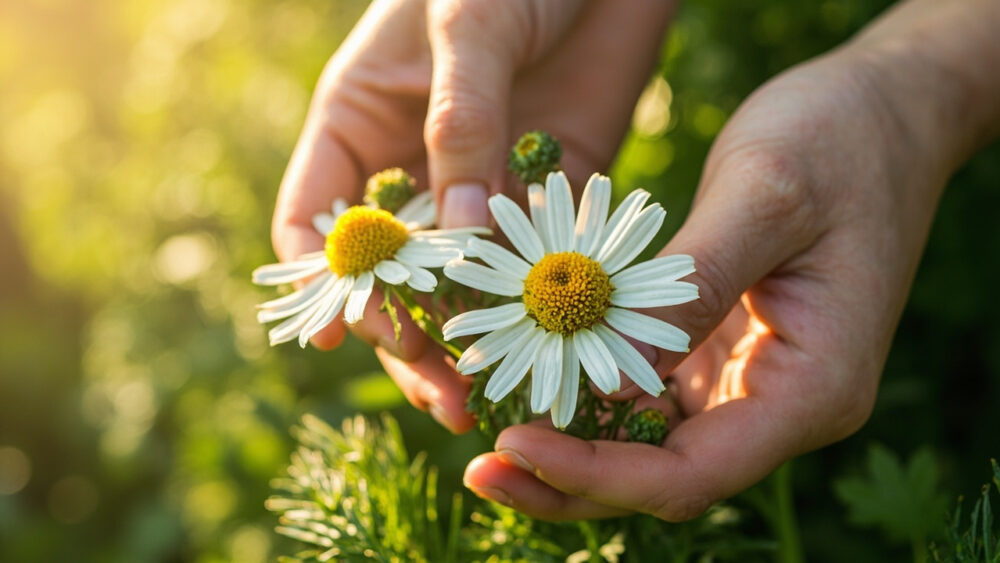
You dry chamomile by pulling the flowers the moment the white petals start folding down flat against the stem, then spreading them in a single layer somewhere dark, dry, and airy for one to two weeks until the centers feel crumbly instead of spongy. That’s the whole job. Get the harvest timing right and the drying takes care of itself.
Most people blow it before the drying even starts, though. They pick flowers too young, or they pile them in a jar still damp, and three weeks later they’re wondering why their homegrown chamomile tea tastes like grass clippings and smells faintly of mildew.
There’s also a sign almost everyone misreads, a stage that looks perfect but is actually two days too early. I’ll show you exactly what to check with your fingers, not just your eyes, and how to keep a chamomile patch producing pickable flowers for six to eight weeks straight instead of one big flush that’s gone by July. Save-able specifics, including the exact dry-time and storage window, are waiting in the Chamomile at a Glance card at the bottom.
The Ready Signs: What a Pickable Chamomile Flower Actually Looks Like
German chamomile flowers have a yellow center cone surrounded by white petals, and that cone is your real clock. Early on, the cone sits flat and the petals stand straight out, almost like a tiny daisy at attention.
As the flower matures, the petals start drooping downward toward the stem and the yellow center domes upward, getting rounder and more pronounced. That drooping-petal, domed-center look is your green light. It usually shows up three to five days after the flower first opens.
The Feel Test
Look isn’t quite enough on its own. Press the yellow center gently between two fingers.
A ready flower feels slightly hollow and a little cottony inside, not tight and solid. If it still feels dense and rubbery, give it another day or two.
The center is honestly a better guide than your eyes, and once you’ve felt the difference once you’ll never mispick again.
The Mistake That Ruins Most First Attempts
If you assumed the flower looks best right when it fully opens flat, that’s the guess that costs most beginners their batch. A flat, fresh-looking flower with petals standing straight out is actually still a day or two green, and picking at that stage gets you chamomile with almost no aroma and a thin, weedy flavor once dried.
The opposite mistake is worse and harder to notice: waiting until the petals have started curling under and the center has gone from domed to nearly spherical. At that point the flower is dropping seed, the essential oils that carry the flavor and scent have already peaked and started fading, and drying won’t bring any of it back.
The honest window is narrow, roughly a three to four day stretch per flower between too-young and too-old. That’s why chamomile is a little-and-often crop rather than a one-day harvest.
Knowing the window matters less than knowing how to move through a whole patch without wrecking next week’s flowers, which is the next problem.
Timing Across the Season, Not Just the Day
German chamomile blooms roughly six to eight weeks after direct-sowing into soil that’s warmed past 55°F, and it keeps producing new flowers in flushes for two months or more if you stay on top of picking. Bloom typically runs from late spring through mid summer in most zones, tapering hard once daytime temperatures push consistently past 85°F.
Pick every two to three days once flowering starts. Chamomile plants respond to regular harvesting by pushing out more buds, so a patch that’s picked often will out-produce one left alone by a wide margin over the season.
Go too early on the season overall, before the plant has built real branching, and you get a handful of flowers off a single stalk. Go too late, letting the first flush go to seed while you wait for a “big enough” harvest, and the plant shifts energy into seed production instead of new blooms, shortening your whole season.
The timing is forgiving day to day but unforgiving if you ignore the patch for two weeks straight.
Harvesting Without Damaging the Plant
Chamomile is delicate, and rough handling at harvest is a quieter yield-killer than most people realize.
- Pick in the morning after dew has dried but before the heat of the day, when essential oil content in the flowers is highest.
- Pinch or snip just below the flower head, leaving a short stub of stem rather than yanking, which can uproot shallow-rooted plants.
- Use two fingers or small scissors, not a fist grab, since German chamomile stems are thin and branching stalks snap easily if you grip a whole cluster.
- Collect into a wide, shallow basket or bowl, not a bag, so flowers don’t crush and start sweating before you even get inside.
Work through the patch flower by flower rather than stripping whole stems, and expect the picking itself to take longer than you think for the volume you get.
What you do in the next thirty minutes matters almost as much as the pick itself.
Right After Picking: Don’t Let Them Sit
Chamomile flowers start losing quality the minute they’re off the plant, especially if they’re damp or piled deep. Spread them out immediately, in a single layer, on a screen, a clean towel, or a paper-lined tray.
If you picked in dew or after rain, do not skip this: a damp pile of chamomile flowers left even overnight can mold before it ever gets a chance to dry, and moldy chamomile gets thrown out, full stop.
Rinsing is generally unnecessary if the plants were grown clean and away from road dust or soil splash, and rinsing also adds moisture you now have to remove anyway. If you must rinse for dirt, pat completely dry on towels before laying out to cure.
Once they’re spread thin and dry to the touch, the actual drying process is mostly a waiting game.
Drying: Low, Slow, and Out of the Light
Chamomile dries best out of direct sun, which bleaches color and burns off the volatile oils that give it flavor and scent. A dark, warm, airy spot works better than a sunny windowsill, despite what feels intuitive.
Air-drying on screens takes roughly one to two weeks depending on humidity, and you’ll know it’s done when the centers crumble between your fingers instead of squishing, and the petals feel papery and brittle rather than leathery.
A food dehydrator on its lowest setting, around 95 to 100°F, speeds this to four to eight hours and is a solid option in humid climates where air-drying risks mold. Avoid higher heat settings; chamomile’s fragrance is fragile and cooks off fast above about 110°F.
Fully dry flowers should feel light as paper and rattle slightly if you shake the tray.
Storing and Keeping the Harvest Coming
Store fully dried chamomile whole (don’t crush the flowers until you’re ready to use them) in an airtight jar, away from light and heat. Kept this way it holds good flavor and aroma for about six to twelve months, though the color and scent will slowly fade after that rather than spoil outright.
Check jars after the first week for any condensation on the glass, a sure sign some flowers weren’t fully dry; if you see it, tip them back onto a tray for a few more days before they mold in storage.
To keep the plant producing, stay on that two to three day picking rhythm and deadhead any flowers you missed once they’ve gone to seed, which frees the plant to keep pushing new buds instead of ripening seed heads.
Everything above compresses down into the quick-reference card below.
Chamomile at a Glance
- Ready to pick: petals drooping down, yellow center domed and feeling slightly hollow when pressed, usually three to five days after the flower opens.
- Picking frequency: every two to three days through the six to eight week bloom season for the best total yield.
- Best time of day: mid-morning, after dew dries but before peak heat.
- Right after picking: spread flowers in a single layer immediately, never pile them damp.
- Air-drying time: one to two weeks in a dark, warm, airy spot, out of direct sun.
- Dehydrator option: four to eight hours at 95 to 100°F, never above about 110°F.
- Storage: airtight jar, dark and cool, whole flowers keep good flavor six to twelve months.
Chamomile drying isn’t finicky, it’s just unforgiving of shortcuts: pick at the drooping-petal stage, spread flowers thin right away, and keep them out of the sun.
Get those three things right and every batch after your first will be easy.