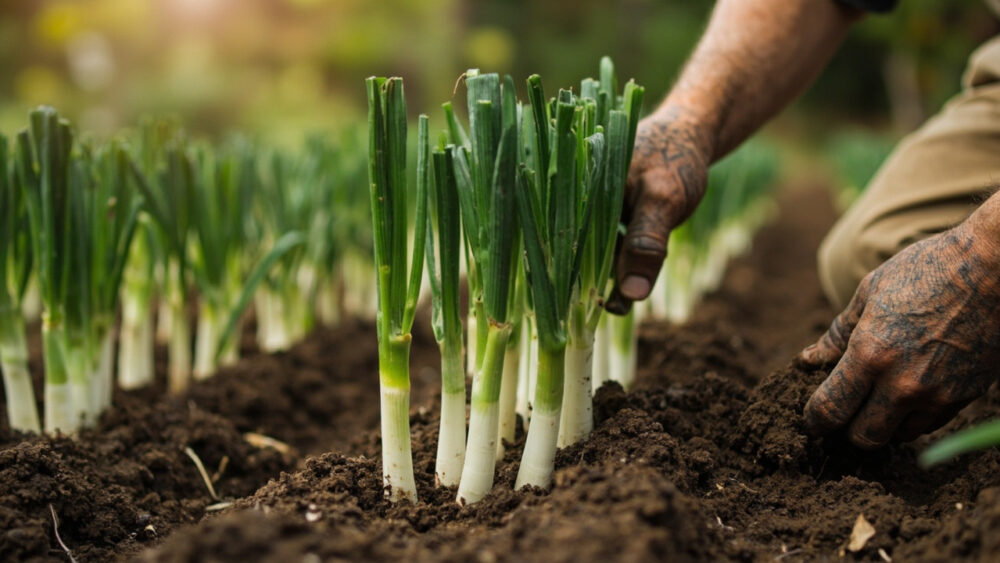
Leeks want 6 inches between plants and 12 to 18 inches between rows, set into holes 4 to 6 inches deep. That is the number to work from whether you are transplanting seedlings or thinning direct-seeded rows. Get that spacing right and you will pull fat, straight leeks in fall; get it wrong and you will pull a bundle of scallion-thin disappointments that never had room to bulk up.
But the spacing number is the easy part. The part almost everyone gets wrong is the depth, because leeks do not grow the way you think they grow.
There is also the question you have not asked yet but will, the minute your leeks are six weeks in the ground: what do you do when you already planted them too close together. That fix exists, and it is not “rip them all out.” Stick with me through the sections below and I will get you there, plus a save-able spacing card at the bottom you can pull up from your phone while you are standing in the garden.
The Exact Spacing and Depth, and Why Leeks Are Different
Space leek plants 6 inches apart within the row. That gives each one enough root room and enough soil volume to swell into a decent shaft, usually 1 to 1.5 inches in diameter by harvest for standard varieties. Go tighter than 4 inches and you get pencil leeks. That is not necessarily a failure, thin leeks are tender and fine for the pan, but it is not what most people picture when they plant leeks.
Depth is where leeks break the normal transplanting rule. Most seedlings go in at the same depth they were growing at. Leeks go in deeper, 4 to 6 inches down a dibbled hole, with the seedling dropped in and the hole left mostly unfilled rather than firmed in tight.
That depth is not about anchoring the roots. It is about growing the white part.
Why the Planting Hole Stays Open
The white shaft on a leek is stem tissue that never saw sunlight. Depth and later hilling are what create that blanched length, the same principle as blanching celery or hilling potatoes.
When you drop a seedling into a 5-inch hole and leave it loose rather than backfilling completely, soil trickles in naturally with watering and rain over the following weeks. As the plant grows, you also draw soil or mulch up around the base every few weeks. Both steps keep light off the lower stem.
Skip this and you still get a leek, just a short-shanked one, mostly green, with only an inch or two of usable white. The plant did not fail. You just harvested the visual payoff of the wrong technique.
Now that the hole makes sense, the next question is how to lay out more than one row of them.
Row Layout and Bed Spacing Options
In traditional rows, keep 12 to 18 inches between rows so you have room to hoe, hill soil, and walk without compacting the bed. Eighteen inches also gives you room to under-sow a quick crop like lettuce or radish between rows early in the season, before the leeks bulk up.
In raised beds or intensive plots, growers often tighten this to a grid: 6 inches between plants in every direction, staggered slightly. That works, but only if your soil is loose and rich enough to feed that many roots in a small footprint.
Wide-row planting is another option: three or four rows spaced 8 to 10 inches apart within one wide bed, with paths only between beds. This is the most efficient layout for small gardens, since you skip the wasted space of a full 18-inch walking row between every single line of leeks.
Whichever layout you choose, the spacing decision you make now is the one that determines shaft diameter later.
What Actually Goes Wrong When Leeks Are Too Close
If you assumed crowding just means “smaller leeks,” that guess is half right and misses the real damage. Crowded leeks compete for both light and root space, and the result is not just thin shafts, it is uneven bulbing, more bolting-prone plants under stress, and a bed where half the leeks are usable and half are barely worth cleaning.
Crowding also traps moisture around the base, and leeks packed tight with poor airflow are more prone to fungal leaf issues in humid weather. Rust, showing up as small orange-red pustules on the leaves, spreads faster in tight, damp plantings.
Too far apart has its own cost, just a gentler one: wasted space and more weeding, since exposed soil between distant plants grows weeds instead of leeks. Neither extreme ruins the crop the way overcrowding does.
The good news is that overcrowding, unlike a lot of garden mistakes, is fixable mid-season.
How to Fix an Overcrowded Planting
Catch it early, within the first month after transplanting, and the fix is simple: thin the row. Pull every other plant while they are still small, use the thinnings as scallions or baby leeks in a soup that week, and let the remaining plants take over the freed-up space.
Catch it later, once leeks are 8 to 12 inches tall and clearly jammed together, and thinning still works, it just costs you some of the crowded ones as harvest rather than transplant material. You can also carefully transplant crowded seedlings to a new spot if you catch it before the roots tangle badly, though leeks sulk for a week or two after a move and resume growing once resettled.
What you cannot do is leave it and hope. Leeks do not sort out spacing problems on their own, they just all stay small together.
One more layout question before the card: does any of this change in a pot.
Container Spacing for Leeks
Leeks grow fine in containers, but the pot needs real depth, at least 12 inches, to give roots room and to let you hill soil up around the stems as they grow. Space plants 4 to 6 inches apart in a wide container, same logic as the ground: less than 4 inches and you are growing scallions whether you meant to or not.
A container roughly 16 to 18 inches across can comfortably hold six to eight leeks on that spacing. Anything smaller and you are better off growing fewer plants well than cramming more in and getting nothing but green tops.
Feed container leeks a bit more than in-ground ones, since potting mix runs out of nutrients faster, and never let the pot dry out completely, since leeks in containers dry out faster than leeks in open ground.
With the spacing, depth, and layout settled, here is everything worth saving before you head back out to the bed.
Leeks at a Glance
- Spacing between plants: 6 inches apart, tighter down to 4 inches only if you want thin, scallion-style leeks.
- Spacing between rows: 12 to 18 inches for traditional rows, 8 to 10 inches for wide-row or intensive bed layouts.
- Planting depth: 4 to 6 inch dibbled holes, seedling dropped in and left mostly unfilled, not firmed in tight.
- Why the hole stays open: soil trickling in over time plus later hilling is what blanches the white shaft.
- Container minimum: at least 12 inches deep, 4 to 6 inches between plants, roughly six to eight leeks in a 16 to 18 inch pot.
- Sign of overcrowding: thin shafts, uneven sizes, and more rust or leaf disease in humid weather.
- Fix for overcrowding: thin early and eat the thinnings, or transplant crowded seedlings before the roots tangle.
Spacing decides shaft diameter, and depth decides how much of that shaft is actually white.
Get both right at planting and the rest of the season is just watering, hilling, and waiting.