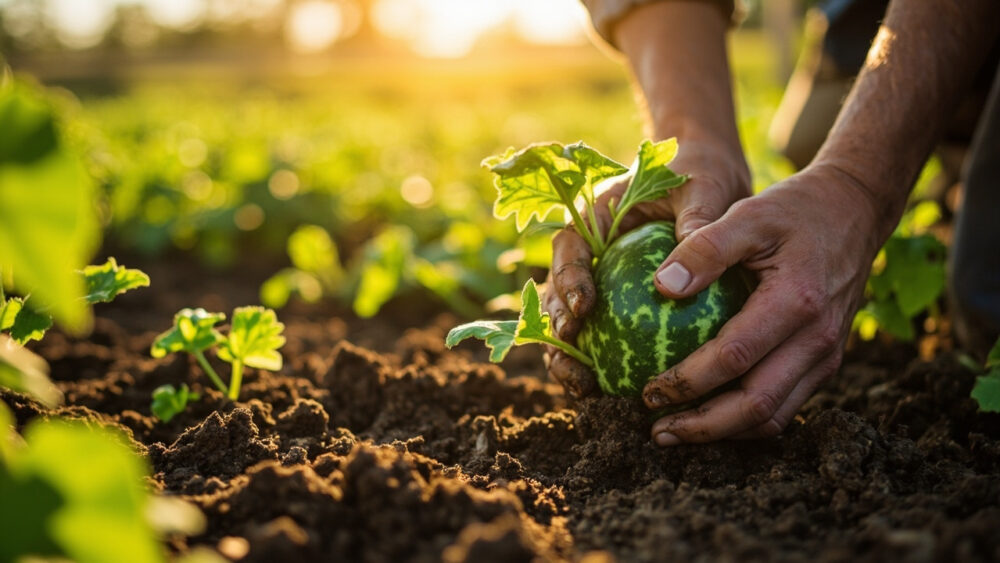
The short answer: plant watermelon in Texas once soil temperature holds at 65 to 70°F and all frost danger has passed, which lands roughly mid-March in the Rio Grande Valley and South Texas, early to mid-April across Central Texas and the Gulf Coast, and late April into early May in the Panhandle and High Plains. Texas is big enough that “when to plant watermelon in Texas” doesn’t have one date, it has a soil temperature and a frost date, and you need to know yours, not your cousin’s in Amarillo.
Most failed watermelon patches in this state trace back to one of two mistakes, and they’re opposites: jumping in during a warm February spell that fools everybody, or waiting so long the melons are still setting fruit when July heat shuts pollination down. There’s also a sign a lot of gardeners misread completely, and it costs them their whole first flush of fruit without them ever knowing why.
Stick with me through the details below and you’ll know exactly how to read your own yard instead of a calendar. At the bottom is a save-able Watermelon at a Glance card with every number in one place for your phone.
The Real Planting Window, Region by Region
Watermelon needs warm soil to germinate well and warm nights to set fruit. Soil temperature matters more than the date on your calendar. You want at least 65°F at a two-inch depth, sustained for several days, and 70 to 75°F is better if you can get it.
In the Rio Grande Valley and Deep South Texas (zones 9b to 10a), that often arrives by mid-March, sometimes late February in a warm year. Central Texas, the Hill Country, and the Gulf Coast (zones 8b to 9a) usually hit that mark late March into mid-April. North Texas and the Panhandle (zones 7a to 8a) trail behind, often not reliable until late April or even early May.
Last frost dates back this up: early to mid-March in the Valley, mid-March to early April around Austin and Houston, and mid-April in the Panhandle. Watermelon is not frost-tolerant at all, a single freeze on young seedlings ends the attempt.
Knowing your region’s average window is step one, but your actual yard runs on its own clock.
How to Find YOUR Window, Not the Almanac’s
Averages lie to individual gardens all the time. Check your own soil with a simple soil thermometer pushed two inches down, read it in the morning before the sun heats the surface, and do this for three or four days in a row rather than trusting one warm afternoon.
A south-facing raised bed against a wall can run 10 degrees warmer than an open row in the same zip code. Heavy clay holds cold longer than sandy loam. If your soil sits at 58°F while your neighbor’s sandy bed reads 68°F, you are not in the same window even though you’re ten miles apart.
The mistake almost everyone makes here is trusting the air temperature instead of the soil. A string of 75°F days can feel like planting weather while the ground underneath is still in the 50s from a cold snap two weeks back, and watermelon seed sitting in cold, wet soil doesn’t sprout, it rots.
Once your soil consistently clears 65°F and nighttime lows stay above 50°F, you’re clear to plant.
Plant Too Early, and This Is What Actually Goes Wrong
If you assumed an early planting just means a slower start, that guess is too generous. Cold soil doesn’t stunt watermelon seed, it usually just kills it outright through rot before it ever sprouts, or produces a weak seedling that a single cool night finishes off.
Transplants fare a little better than direct seed but still stall hard below 60°F soil, sitting there sulking for two or three weeks while weeds and pests get a head start around them. A stalled transplant rarely catches back up to one planted on time.
The sign most people misread is a light frost that doesn’t visibly kill the plant. The leaves look fine the next day, so gardeners assume they dodged it. But cold injury to the growing tip often doesn’t show for a week, and by then the plant has lost its best early vigor for good, even though it technically survives.
Planting late carries its own separate cost, and it’s arguably the more common Texas mistake.
Plant Too Late, and Texas Heat Becomes the Real Enemy
Watermelon needs 70 to 90 days from transplant to harvest depending on variety, and it needs to be flowering and setting fruit before the worst summer heat arrives. Sustained daytime temps above roughly 95°F combined with hot nights can cause poor pollen viability and blossom drop, meaning flowers form but never turn into fruit.
Push planting into late May or June across most of Texas and you’re racing the thermometer. Your vines may look lush and green all summer while setting little to no fruit, which is a frustrating, honest problem with no quick fix once it’s underway.
The honest answer to the question you’re probably about to ask: no, you generally cannot rescue a too-late planting by just watering more or feeding more. Heat-driven blossom drop is a temperature problem, not a nutrition problem, and it resolves only when nights cool back down, which in most of Texas means your fruiting window has already closed for the year.
This is exactly why prep work before the window opens matters so much.
What to Do Before Your Window Opens
Watermelon roots hate disturbance and hate competition, so the bed needs to be ready before seed or transplant goes in, not after. Work compost into the bed two to three weeks ahead, aiming for loose, well-drained soil at least a foot deep since watermelon roots run wide and deep.
- Warm the soil early with black plastic mulch laid down 10 to 14 days before planting, which can add several degrees and buy you a real head start in cooler regions.
- Space hills 3 to 4 feet apart in rows 6 to 8 feet apart for standard vining types, since these plants sprawl 10 feet or more.
- Plant seed about 1 inch deep, or set transplants at the same depth they were growing in the pot, never deeper.
- Have row cover on hand for a surprise cool night early on, since a light frost can still sneak in near the edges of your window.
Skipping this prep doesn’t stop watermelon from growing, it just means the plant spends its first few weeks fighting the soil instead of building roots.
Where you sit on the map still shifts a few of these details, so let’s break it down by region one more time.
Zone Notes That Actually Change Your Plan
South Texas and the Valley (roughly zone 9b to 10a) can often manage a second planting in July or early August for a fall crop, since the growing season runs long enough to fit two rounds if the first melons come off by early summer.
Central and East Texas (zone 8a to 9a) generally get one solid window, planted as early as soil allows in spring, because summer heat and humidity make a true second planting risky for disease pressure late in the year.
The Panhandle and West Texas (zone 6b to 7b in the coldest pockets) have the shortest season of anyone in the state and the latest last frost, so choosing a shorter-season variety, 70 to 75 days rather than 85 to 90, matters more here than anywhere else.
Get the regional timing right and the rest of the season is mostly about consistent water and patience, which is exactly what the card below is for.
Watermelon at a Glance
- When to plant: mid-March in South Texas and the Valley, late March to mid-April in Central Texas and the Gulf Coast, late April to early May in North Texas and the Panhandle.
- Soil temperature target: at least 65°F at two inches deep, sustained for several days, 70 to 75°F is ideal.
- Frost rule: no frost tolerance at all, wait until all frost danger has passed in your specific area.
- Spacing: hills 3 to 4 feet apart, rows 6 to 8 feet apart for standard vining varieties.
- Planting depth: about 1 inch for seed, transplants set at the same depth as their pot.
- Days to maturity: 70 to 90 days depending on variety, choose the shorter end in the Panhandle and West Texas.
- Fruiting risk window: sustained heat above roughly 95°F with hot nights can cause blossom drop, aim to have plants flowering before that heat locks in.
Get the soil temperature right and the calendar mostly takes care of itself.
Everything else, the water, the feeding, the waiting, is easy by comparison.