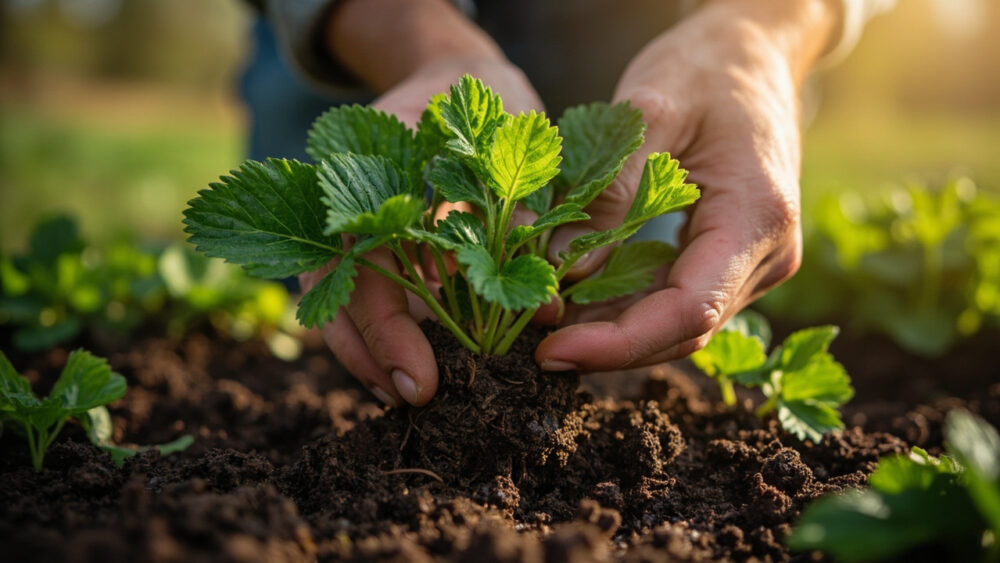
The window for planting strawberries in Michigan runs from mid-April through early May in the southern Lower Peninsula, and roughly late April into mid-May farther north. The trigger isn’t the calendar, it’s soil you can work with a trowel and no hard freeze forecast in the next week or two. Get bare-root plants in during that stretch and they’ll have a full season to build the root system that produces next year’s berries.
Here’s what trips people up: most of the damage to a Michigan strawberry patch happens weeks before anyone notices a problem, and it’s rarely the frost everyone worries about. It’s usually the planting depth, or waiting too long and losing the whole first growing season without realizing it. There’s also a sign on the plant itself that tells you exactly when your particular yard is ready, and it has nothing to do with the date on your phone.
Stick with this and you’ll get the full breakdown, plus a save-able Strawberries at a Glance card at the bottom with every number worth writing down.
The Real Planting Window for Michigan
Michigan sits mostly in USDA zones 5 and 6, with a narrow strip of zone 7 near the Lake Michigan shoreline in the southwest. Last frost dates run from around late April in the far south to late May up in the U.P. and northern Lower Peninsula.
Strawberries want soil temperature around 40 to 50°F and workable ground, not a frost-free guarantee. Established plants tolerate a light frost fine once they’re rooted. What they can’t tolerate is sitting in cold, waterlogged clay while they try to establish roots.
That gives most of the state a window from mid-April to mid-May, shifting later the farther north and inland you go.
Soil temperature decides the start date more than the frost date does.
How to Read Your Own Yard’s Window
Forget the general date range for a second. Push a finger two inches into your bed. If it’s still cold, sticky, and clumps into a ball, wait. If it crumbles and feels cool but workable, that’s your green light.
South-facing beds and raised beds warm up a week or two ahead of low, shaded, or heavy-clay ground, even in the same zip code. Two Michigan gardeners ten miles apart can have legitimately different windows.
If you assumed the last frost date is the day to plant, that guess is close but not quite right. Frost date tells you when the cold snaps stop, not when the soil has actually warmed enough for roots to grow. Plants can survive in cold soil, they just won’t do anything useful in it, and stalled roots going into summer are a weak plant all year.
Your soil, not your calendar app, is the real signal.
Planting Too Early or Too Late: What Actually Happens
Plant too early into cold, wet soil and bare-root strawberries often just sit there. Roots that don’t get oxygen and warmth start to rot before they ever anchor. You won’t see wilting for a while, you’ll see plants that never seem to grow, and by June you’re replacing half the row.
Plant too late, say after Memorial Day in most of Michigan, and the plant spends its short first season just trying to survive summer heat instead of building the crown and root mass it needs. June-bearing varieties in particular need that early runway. A late-planted bed can look fine in August and still barely produce the following June, because it never built the reserves to do it.
Both mistakes cost you the same thing: a full season, not just a few weeks.
Timing errors don’t show up as dead plants, they show up as a disappointing harvest a year later.
Depth and Spacing: The Detail Almost Everyone Gets Wrong
Bare-root strawberry crowns get planted at exactly the right depth or they fail, and this is the single most common mistake in a Michigan strawberry bed. The crown, the woody knob where roots meet leaves, needs to sit right at soil level. Bury it and it rots. Plant it too high and the roots dry out and the plant never establishes.
Spread roots straight down in the hole, fan them out, and firm soil so the midpoint of the crown lines up with the surrounding soil surface.
Space plants 12 to 18 inches apart in rows 3 to 4 feet apart for matted-row systems, which is what most home gardeners in Michigan use. Tighter spacing means more competition and smaller berries down the line.
Get the crown depth right and everything else about establishment gets easier.
Prep Work Before the Window Opens
Do soil prep the fall before, if you can. Strawberries want well-drained soil with a pH around 5.5 to 6.8, and Michigan’s naturally heavy or sandy soils often need amendment either way. Work in 2 to 3 inches of compost the previous autumn so it has all winter to integrate.
If bare-root plants arrive before your soil is ready, keep them in the refrigerator, roots wrapped in damp paper towel inside a plastic bag, for up to a week or two. Do not let them dry out, and do not let them sit at room temperature.
Remove flowers that form in that first spring on June-bearing types. It feels wrong to pinch off the only fruit you’ll see all year, but letting a new plant fruit its first season steals energy the roots need. Everbearing and day-neutral types are more forgiving here and can be allowed a light first crop.
The work you do in fall and the discipline you show with those first flowers matter more than the exact planting date.
Regional Notes Across Michigan
Southern Lower Peninsula (zone 6, Detroit, Kalamazoo, Grand Rapids corridor): plant mid to late April most years, sometimes into early May in a cold spring.
Central Michigan (zone 5b to 6a, Lansing, Saginaw, Mount Pleasant): expect late April into mid-May.
Northern Lower Peninsula and the U.P. (zone 4b to 5a): mid-May is typical, sometimes pushing into early June in a slow spring or at higher elevations.
Lake Michigan shoreline counties often run a zone warmer than inland spots at the same latitude, thanks to lake effect moderating spring temperatures. If you garden within a few miles of the lake, you can often plant a bit earlier than inland neighbors at the same latitude.
Wherever you are in the state, the soil test still beats the map.
Strawberries at a Glance
- When to plant: mid-April through mid-May across most of Michigan, later toward the north and interior, once soil is workable and roughly 40 to 50°F.
- Frost tolerance: established plants handle light frost fine, the real limit is cold, wet soil that stalls or rots roots.
- Planting depth: crown sits exactly at soil level, not buried, not exposed.
- Spacing: 12 to 18 inches between plants, 3 to 4 feet between rows in a matted-row bed.
- Soil needs: well-drained, pH 5.5 to 6.8, amended with compost the fall before if possible.
- First-season flowers: pinch off on June-bearing types so roots establish instead of fruiting.
- Zone context: most of Michigan is USDA zone 5 to 6, with a warmer pocket near the Lake Michigan shoreline.
Get the crown depth and the soil-feel test right, and the exact date stops mattering much.
Everything else about a good Michigan strawberry patch follows from those two things.