Plant strawberries in Florida between late September and early November, not in spring like most of the country. Florida runs its strawberry season backward: you set transplants in fall while soil temperatures are still warm, and you harvest all winter into early spring before summer heat and humidity shut the plants down. Get the month right and you will be picking berries by the holidays.
Here is where most transplants from up north go wrong the first time. They plant strawberries the way their neighbor in Ohio does, in spring, and end up with a plant that sulks through the summer and never fruits. There is also a specific soil and moisture mistake that rots more Florida strawberry crowns than any pest does, and a “wait for it to warm up” instinct that is exactly backward here.
Stick with me and you will know your own planting window, the fix for the two ways people blow it, and exactly what to do the week before you plant. There is a save-able Strawberries at a Glance card at the bottom with every number in one place.
Florida’s Planting Window Runs Opposite the Rest of the Country
Most of the U.S. plants strawberries in spring because they need to build roots before winter dormancy and fruit in early summer. Florida’s summers are the problem, not the winters. Heat above the mid 80s and constant humidity stall flowering and invite disease, so growers plant in fall instead and let the plants fruit during the mild, dry winter months.
The practical window is late September through early November, with early to mid October the sweet spot for most of the peninsula. Soil temperature matters more than the calendar: you want soil in the upper 60s to mid 70s Fahrenheit at planting, which fall in Florida delivers reliably even when the air still feels like summer.
Central Florida, especially the Plant City and Dover area around Hillsborough County, is the state’s commercial strawberry belt and plants right in that same early to mid October window.
Your exact date depends on where on the map you’re standing, and that’s worth working out precisely.
Finding Your Actual Window, Not Just a Date on a Bag
Florida spans USDA zones roughly 8b in the panhandle to 11 in the Keys, and that range changes your calendar more than people expect. North Florida gardeners (zones 8b to 9a, think Tallahassee and Jacksonville) should aim for late September to mid October, since a real frost risk returns by December and plants need time to establish first.
Central Florida (zone 9b to 10a, the Orlando to Tampa corridor) has the most flexibility, planting anywhere from late September through early November.
South Florida (zone 10b and warmer, Miami and the coasts) can push into November since frost is rarely a real concern, but summer heat lingers longer too, so waiting for soil to cool slightly still helps.
Do not go by feel alone. A four-inch soil thermometer pushed into the bed at midday is the only honest read, and if you don’t have one, the back of your hand pressed into moist soil should feel warm but not hot, like a sun-warmed countertop, not a sidewalk.
Nail the window and the next question is what happens if you miss it in either direction.
Plant Too Early or Too Late and Here’s What Actually Happens
If you assumed planting earlier just gets you a head start, that guess is what stalls most Florida strawberry beds. Plant in late August or early September while soil is still near 85 degrees and heat stress alone can kill new transplants before roots ever take hold, disease pressure spikes, and any fruit that does set will be small and sparse.
Plant too late, past mid to late November, and the plant does not get enough cool-season growing time to build the root and crown structure it needs before its winter fruiting push. You will still get berries, just fewer of them, later, and for a shorter stretch before spring heat ends the season early.
The honest tradeoff: a few weeks early costs you plants outright, a few weeks late costs you yield. Neither is fatal, but only one of them is recoverable, and it’s the late one.
None of this works, though, if the bed itself isn’t ready when the window opens.
What to Do Before the Window Opens
Start bed prep three to four weeks ahead, meaning early September for most of the state. Strawberries want full sun, at least six to eight hours, and soil that drains fast, since Florida’s sandy soil drains well on its own but usually needs organic matter worked in to hold moisture and nutrients long enough for roots to use them.
Raised rows or mounded beds 6 to 8 inches high are standard practice here for a reason: they keep crowns out of standing water after Florida’s fall rain events, which is the rot risk that catches new growers who assume more water is always better.
Test or at least estimate soil pH; strawberries want 5.5 to 6.5, and Florida’s naturally alkaline soil in some regions may need sulfur worked in weeks ahead, since it takes time to shift pH.
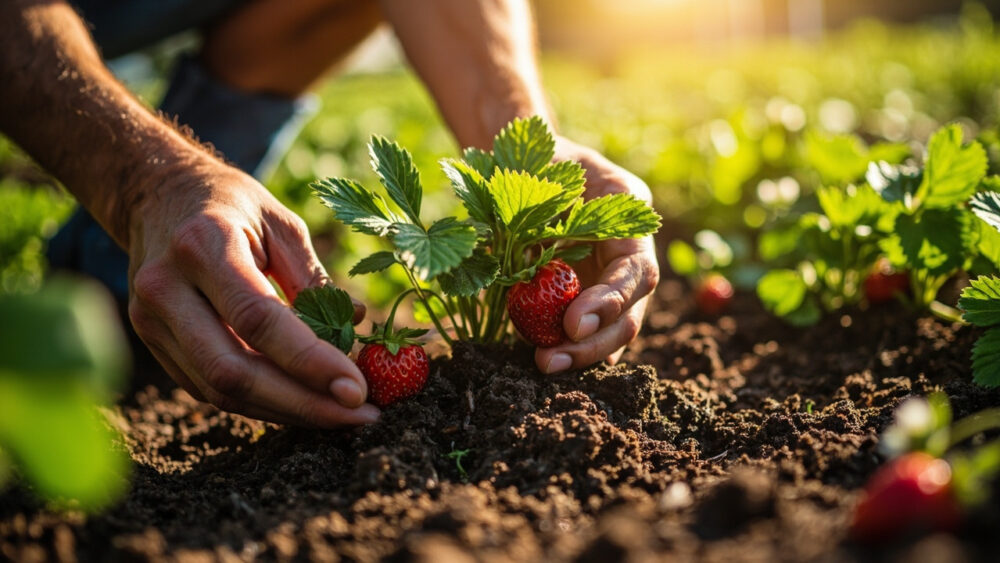
Space transplants 12 to 18 inches apart in rows spaced 10 to 12 inches apart, with the crown, the point where leaves meet roots, sitting exactly at soil level. Bury the crown and it rots; leave roots exposed above soil and the plant dries out and dies. Set it right at the soil line, roots straight down, and water in immediately.
Get the bed and the crown depth right and the timing you picked earlier finally has something to work with.
Bare-Root vs. Plug Transplants Change Your Exact Timing
Florida strawberry growers mostly use two kinds of starts, and they are not interchangeable on the calendar. Bare-root transplants are dormant-looking crowns with trimmed roots and need to go in the ground as soon as you get them, ideally right at the start of your window, since they have no soil around the roots to buffer a delay.
Plug transplants come already rooted in a small soil plug and are more forgiving, tolerating a week or two of pot-bound waiting if weather or bed prep runs behind.
If you’re buying from a local nursery in the Plant City or Tampa area, ask which type you’re getting, because a bare-root crown planted a week late in warm soil struggles far more than a plug does.
Whichever type you plant, the first two weeks after transplanting decide whether the season gets off to a real start.
Strawberries at a Glance
- When to plant: late September through early November in Florida, with early to mid October the sweet spot for most of the state.
- Soil temperature target: upper 60s to mid 70s Fahrenheit at a four-inch depth, checked at midday.
- Zone notes: north Florida (8b to 9a) plant late September to mid October, central Florida (9b to 10a) late September to early November, south Florida (10b and up) can extend into November.
- Spacing and depth: 12 to 18 inches between plants, 10 to 12 inches between rows, crown planted level with the soil surface, never buried or exposed.
- Soil prep: full sun, six to eight hours minimum, well-drained raised beds 6 to 8 inches high, pH 5.5 to 6.5, organic matter worked in three to four weeks before planting.
- Too early risk: heat stress and disease from planting while soil is still near 85 degrees.
- Too late risk: weak root and crown development, leading to lower yield and a shorter harvest window before spring heat ends the season.
If you remember one thing, remember this: Florida strawberries are a fall crop, not a spring one, and the plant, not the calendar, tells you it’s ready through soil temperature.
Get the crown depth right and the timing you chose will actually pay off in berries by winter.