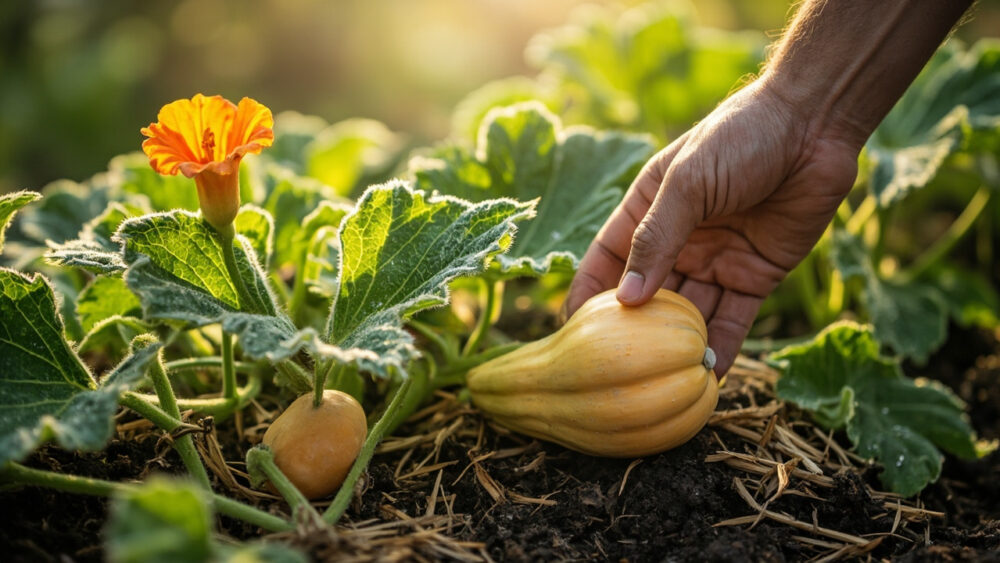
Butternut squash moves through five distinct stages between the seed and the harvest bin: germination (5 to 10 days), the seedling stage (2 to 3 weeks), vining and vegetative growth (4 to 6 weeks), flowering and fruit set (roughly weeks 6 through 10), and fruit maturation (another 6 to 8 weeks after that). Total time from seed to a ripe, storable squash runs 85 to 100 days depending on the variety and your weather. That timeline only holds if the plant gets warm soil, steady water early, and enough room to actually vine.
Here is what most people get wrong without realizing it: the stage where things quietly fail is not fruiting, it’s flowering. You’ll see plenty of blossoms and assume squash are coming. Half the time nothing sets, and the reason is not disease, it’s biology, and I’ll walk you through the actual fix further down.
There’s also a sign almost everyone misreads as a problem when it’s actually normal, and a stall that looks like patience but is really trouble. Save the at-a-glance card at the very bottom of this page to your phone before you head out to the garden, it has the numbers you’ll want mid-season when you don’t want to scroll through all this again.
Germination: Days 1 to 10
Butternut seeds want soil at 65 to 75°F to germinate reliably. Below 60°F they’ll sit and often rot before sprouting. Direct-sow 1 inch deep, 2 to 3 seeds per hole, after your last frost has passed and soil has genuinely warmed, not just the air.
You’ll see the seed leaves (cotyledons) push up first, thin and pointed, nothing like the true leaves that follow. Keep soil consistently moist but not soggy during this window, a dried-out seed bed is the single most common reason for spotty germination.
Thin to the strongest one seedling per hole once true leaves appear.
Seedling Stage: Weeks 2 to 4
The plant now grows its first true leaves, rounded and slightly fuzzy, noticeably bigger than the seed leaves. Growth feels slow here and that’s normal, the plant is building roots before it builds top growth.
This is the stage where cold nights do lasting damage even without a frost. Nights consistently below 50°F stunt young squash plants for weeks, so if you jumped the gun on planting, don’t be surprised if growth seems stalled through this phase.
Watch for cutworm damage (clean cuts near the soil line) and flea beetle pinholes in the leaves, both are common at this tender stage and manageable with row cover if you catch it early.
Once the plant puts out a runner instead of just leaves, it’s moved on.
Vining and Vegetative Growth: Weeks 4 to 10
This is the stage that surprises new growers with how much room it eats. Butternut vines can run 6 to 12 feet, so give each plant 3 to 4 feet of spacing in rows 6 feet apart, or train vines vertically on a sturdy trellis if space is tight.
Leaves get large, deeply lobed, and the plant starts throwing out tendrils that grab anything nearby. Feed with a balanced fertilizer or compost side-dressing now, this is peak nitrogen demand before flowering shifts the plant’s needs.
Water deeply once or twice a week rather than a little every day, aiming for about 1 inch total per week including rain. Shallow, frequent watering builds shallow roots that struggle once fruit starts loading the vine.
Once you start seeing bright yellow-orange flowers open in the morning, you’ve entered the stage most people misunderstand.
Flowering and Fruit Set: Weeks 6 to 10
Here’s the part that trips up almost everyone. The plant produces male flowers first, sometimes for two full weeks, before any female flowers show up. If you’re staring at dozens of blossoms and zero squash, you likely just have males, and that’s completely normal, not a failure.
Female flowers are easy to tell apart once you know the trick: they have a small bulge at the base of the flower, a baby squash in miniature, right where the stem meets the bloom. Males have a plain thin stem.
The real reason fruit set fails is usually poor pollination, not plant health. Butternut relies on bees, and cool, rainy, or windy stretches during the female bloom window keep bees home and flowers unfertilized.
You’ll know pollination worked if the tiny fruit swells within 3 to 5 days instead of yellowing and dropping off.
If you’re losing fruit at this stage, hand pollination with a small brush, moving pollen from a male flower’s center to a female flower’s center in the morning, fixes it fast.
Once a fruit is holding and growing steadily, you’ve cleared the hardest part of the whole process.
Fruit Development and Maturation: Weeks 10 to 18
Fruit sizes up over several weeks, starting pale green-yellow and gradually turning the deep tan-beige color butternut is known for. This color change is your main ripeness cue, along with a skin that resists a fingernail press instead of denting easily.
Stems also matter: a ripening squash develops a hard, corky, dried-looking stem. A green, flexible stem means it’s not ready no matter how tan the skin looks.
Stop watering as heavily in these final weeks. Too much moisture late delays curing and can dilute flavor, while a slight dry-down actually concentrates sugars.
Most fruit finishes 45 to 55 days after fruit set, right around the first light frost in many regions, which is a useful natural deadline.
Knowing when it’s truly done matters more than most people think, and that’s the next thing to get right.
Healthy Progress Versus a Real Stall
Slow growth in cool weather or during heavy fruit-loading is normal and temporary. A true stall looks different: wilting leaves at midday even after watering, yellowing that spreads from older to newer leaves, or a fruit that stops swelling for over a week while still small.
The sign everyone misreads is large lower leaves yellowing and dying back once fruit is sizing up. That’s the plant reallocating energy to the squash, not a nutrient problem, and pulling those spent leaves off is fine.
What genuinely signals trouble is powdery mildew (white dusty patches on leaves), squash vine borer damage (sudden wilting of one runner, sawdust-like frass at the base), or blossom end rot on the fruit itself. Cultural fixes like improving airflow, watering at the soil line instead of overhead, and removing infected leaves promptly handle most of it, but a heavy vine borer infestation late in the season sometimes means cutting your losses on that plant.
With the stages, the pollination fix, and the stall test all covered, here’s everything condensed for the field.
Butternut Squash at a Glance
- When to plant: direct-sow or transplant after last frost, once soil hits 65 to 75°F.
- Spacing: 3 to 4 feet between plants, 6 feet between rows, or trellis vertically in small gardens.
- Days to maturity: 85 to 100 days from seed, 45 to 55 days from fruit set to harvest.
- Water needs: about 1 inch per week, deep and infrequent, tapering off as fruit nears maturity.
- Pollination window: male flowers appear first for up to two weeks, female flowers follow and need bee activity or hand pollination to set fruit.
- Ripeness signs: deep tan skin, resistance to a fingernail press, hard corky stem.
- Biggest failure point: poor pollination during cool or rainy bloom periods, fixable by hand pollinating in the morning.
Trust the stem, not just the color, when deciding it’s ready to cut.
Get pollination right in that middle stretch and the rest of the season mostly takes care of itself.