The best companion plants for cucumbers are bush beans, dill, radishes, corn, and nasturtiums, and the one to keep well away is any aromatic herb or brassica planted right at the base of the vine, especially sage and most strong-scented herbs, which stunt cucumber growth more often than they help it. Get the layout right and you get better pollination, fewer cucumber beetles, and vines that stay productive for weeks longer.
Get it wrong and you will not see an explosion or a dead plant, just a slow, quiet underperformance that most people blame on the weather. That is the mistake that costs a whole season and nobody notices until harvest is thin.
There is also a pairing almost every companion-planting list repeats that does not actually hold up once you look at how these plants really compete underground. I will tell you which one, and I will save the full at-a-glance card, the one worth screenshotting before you head out to the garden, for the very bottom.
Why Companion Planting Actually Matters for Cucumbers
Cucumbers have shallow, wide-spreading roots and big, thirsty leaves. That combination makes them sensitive to two things: competition for water in the top 6 to 8 inches of soil, and pest pressure from cucumber beetles and squash bugs, which is where good companions earn their keep.
Good companions either pull pests away, draw in pollinators, or use a different root depth so they are not fighting your cucumbers for the same moisture.
Bad neighbors do the opposite quietly, and that quiet part is what trips people up.
Bush Beans: Nitrogen Without the Shade
Bush beans fix nitrogen in the soil through bacteria on their roots, and cucumbers are heavy nitrogen feeders once they start setting fruit. Plant beans 4 to 6 inches from a cucumber row and they feed the soil without shading the vines the way pole beans eventually would.
Skip pole beans near cucumbers if you are growing cukes on the ground rather than a trellis. Pole beans climbing structures next to sprawling cucumber vines just tangle everything into a mess by midsummer.
Beans solve the nitrogen problem, but the beetle problem needs a different fix entirely.
Dill and Nasturtiums: The Pest-Pressure Release Valve
Dill attracts predatory wasps and hoverflies that hunt aphids and cucumber beetle larvae, and it draws in pollinators when it flowers, which matters because cucumbers need consistent pollination to avoid misshapen, bitter fruit. Nasturtiums work as a trap crop, pulling aphids and squash bugs onto themselves and away from your vines.
Plant dill 12 to 18 inches from the cucumber row so it does not get swallowed by cucumber foliage before it flowers. Let nasturtiums sprawl at the bed’s edge, not tucked directly under the vines.
The visual cue that this pairing is working: aphid clusters showing up on the nasturtium leaves instead of your cucumber leaves. That is the plan succeeding, not a problem to spray.
That trap-crop logic is exactly why some plants people assume are helpful actually backfire.
Radishes: The Underrated Beetle Deterrent
Radishes are fast, cheap insurance. Their sharp scent confuses cucumber beetles hunting by smell, and because radishes mature in 25 to 30 days, you can tuck them right into the same hole area at planting and pull them before the cucumber vines need the space.
Sow radish seed about 1 inch from where you plant cucumber seeds, at a depth of half an inch. By the time cucumbers are vining out, the radishes are already in your kitchen.
That fast turnaround is also the key to solving cucumbers’ biggest layout problem: space.
Corn and Sunflowers: Living Trellises
If you are short on trellis material, corn stalks and sunflower stems give cucumber vines something sturdy to climb, keeping fruit off damp soil where it rots and slugs find it easily. This only works if you plant the corn or sunflowers 2 to 3 weeks ahead so they have height before the cucumber vines start reaching.
The mistake here is planting them the same week. Cucumbers grow fast once soil hits 70°F, and they will outrun a corn stalk that has not established yet, ending up as a tangled mat on the ground instead of climbing.
Get the timing right on the climbers and the rest of the layout falls into place.
What to Never Plant Near Cucumbers
Aromatic herbs like sage, and most strongly scented perennial herbs in general, release compounds through their roots and leaves that measurably slow cucumber growth in close quarters. This is the opposite of the dill and nasturtium effect, and it is exactly the mix-up that ruins people’s plans, because “herbs help cucumbers” is only half true.
Potatoes are the other one to avoid. Both are heavy feeders competing for the same nutrients and moisture in the same root zone, and potatoes also host some of the same fungal blights that hit cucumbers, so planting them close raises disease risk for both crops.
Skip melons and squash in the same tight bed too, not because they harm cucumbers directly, but because all three are vining, space-hungry, and prone to the same pests and mildew, so crowding them together concentrates every problem in one spot.
- Sage and most strong culinary herbs, root competition and growth suppression
- Potatoes, shared blight risk and nutrient competition
- Melons and squash in the same bed, shared pests and overcrowding
Knowing what to avoid only helps if you also know how to arrange what is left.
Laying Out the Bed So None of This Fights Itself
Give cucumbers 12 to 18 inches between plants if trellised, or 24 to 36 inches if left to sprawl on the ground. Plant seeds about 1 inch deep once soil has warmed to at least 65°F, usually 1 to 2 weeks after your last frost date.
Run companions along the edges, not underneath. Dill and nasturtiums at the bed border, radishes tucked at the base during the first month, beans in their own short row nearby. This keeps root competition low and still puts every companion close enough to do its job.
A trellis running north to south lets morning sun reach both sides evenly, which matters more for fruit set than most people realize.
Even a well-planned bed can still fall for one bad piece of advice, so let’s clear that up next.
The Companion Planting Myth That Does Not Hold Up
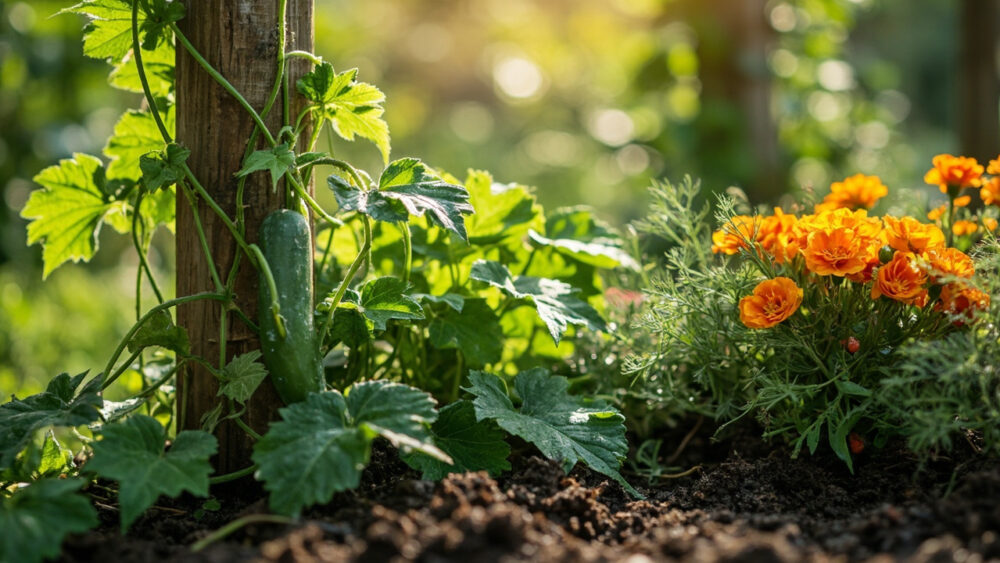
You have probably seen marigolds listed as a universal cucumber companion. Marigolds do repel some nematodes in soil over time, but that effect takes a full growing season of buildup and works best as a rotational cover crop, not a same-season neighbor.
Planted this year next to this year’s cucumbers, marigolds mostly just take up space and compete for water without delivering the pest protection people expect. It is not a harmful pairing, just an overrated one.
The other myth worth killing: that companion planting alone will fix a cucumber bed with poor drainage or inconsistent watering. It will not. Companions help around the edges of a problem, they do not replace even watering and soil that drains within a few hours of a heavy rain.
With the real pairings sorted from the overhyped ones, here is everything worth keeping on hand.
Cucumbers at a Glance
- When to plant: 1 to 2 weeks after your last frost, once soil is at least 65°F.
- Spacing: 12 to 18 inches apart trellised, 24 to 36 inches apart if sprawling on the ground.
- Planting depth: about 1 inch for seed.
- Best companions: bush beans, dill, radishes, nasturtiums, corn or sunflowers as living trellises.
- Never plant nearby: sage and most strong herbs, potatoes, or melons and squash in the same tight bed.
- Watch for: aphids collecting on nasturtiums instead of cucumber leaves, a sign your trap crop is working.
- Skip the hype: marigolds help nematodes over a full season of buildup, not as a same-year cucumber neighbor.
Get the spacing and the neighbors right, and cucumbers mostly take care of themselves from there.
Everything else, the fertilizer schedule, the watering, is easier to fix than a bed planted too close to the wrong roots.