Plant asparagus crowns two to four weeks after your last spring frost date, once the soil has warmed to at least 50°F and is dry enough to work without clumping in your hand. That window usually lands in early to mid spring across most of the country, though gardeners in mild-winter regions can go as early as late winter. Get the timing for when to plant asparagus wrong in either direction and you are not just risking a rough start, you can set the whole bed back a full year before it ever produces a spear worth eating.
Here is the part almost nobody tells you: the calendar date matters far less than what the soil is doing underfoot, and most first-time growers plant on the “right” weekend by the calendar while the ground is still too cold and wet to give the crowns a fair shot. There is also a timing mistake that costs people an entire harvest three years down the road, not this season, which is exactly why they never connect the dots.
Stick with me through the sections below and you will know exactly how to read your own yard instead of a generic date, what early or late planting actually does to a crown, and how to prep the bed so the window works in your favor. There’s an at-a-glance card at the very bottom you can screenshot before you head out to the garden center.
The Real Planting Window, Anchored to Soil and Frost
Asparagus crowns go in the ground when soil temperature at planting depth sits between 50°F and 65°F, which typically falls two to four weeks after your last average frost date. In the Upper Midwest and Northeast, that often means late April into May. In the Mid-Atlantic and much of the Midwest, expect a window from early to late April. Southern and Pacific Coast gardeners can often plant in February or March, since their soil warms earlier and hard frosts are less of a threat to dormant crowns.
Asparagus crowns are dormant roots, not tender seedlings, so a light frost after planting will not kill them the way it would a pepper transplant. What actually matters is the soil being workable and warm enough to wake the roots up without rotting them in cold, soggy ground.
A soil thermometer pushed 4 to 6 inches down gives you a real answer in thirty seconds.
How to Tell Your Personal Window, Not the Calendar’s
If you assumed the safe move is just to wait for the exact date your extension office lists, that guess is what leaves crowns sitting in cold mud for weeks doing nothing. The real test is tactile, not calendar-based.
Grab a handful of soil from where you plan to plant. It should crumble apart, not compress into a wet ball or dust through your fingers like powder. If you can form a ribbon of mud between your fingers, it is still too wet, and asparagus crowns set into that kind of ground are prone to rot before they ever root in.
Check drainage too: dig a 12-inch hole, fill it with water, and see how long it takes to disappear. Anything beyond a few hours signals a spot that stays too wet for asparagus, which hates wet feet more than almost any perennial vegetable you’ll grow.
Once your soil crumbles right and drains within a reasonable stretch, your personal window is open, regardless of what the calendar says.
What Actually Happens If You Plant Too Early or Too Late
Here is the mistake that ruins most first attempts, and it is not the one people expect. Planting too early in cold, wet soil does not usually kill the crown outright. Instead it sits dormant and rots slowly at the crown’s growing point, so you do not find out anything went wrong until the following spring when nothing comes up at all.
Planting too late is the quieter problem. Crowns set into soil that is already hot and dry struggle to establish roots before summer stress hits, and the fernlike top growth that feeds the root system for next year’s harvest never gets fully built. You will not see a failure this year. You will see a weak, thin harvest two years from now, which is exactly the delayed consequence nobody connects to planting date.
Asparagus takes two to three years after planting before you harvest a full crop, so an early mistake does not show its bill until much later.
That delay is exactly why the prep work before planting matters more than people assume.
The Bed Prep That Has to Happen Before the Window Opens
Asparagus occupies the same bed for 15 to 20 years, so prep is not optional busywork, it is the difference between a productive bed and a mediocre one for the entire life of the planting.
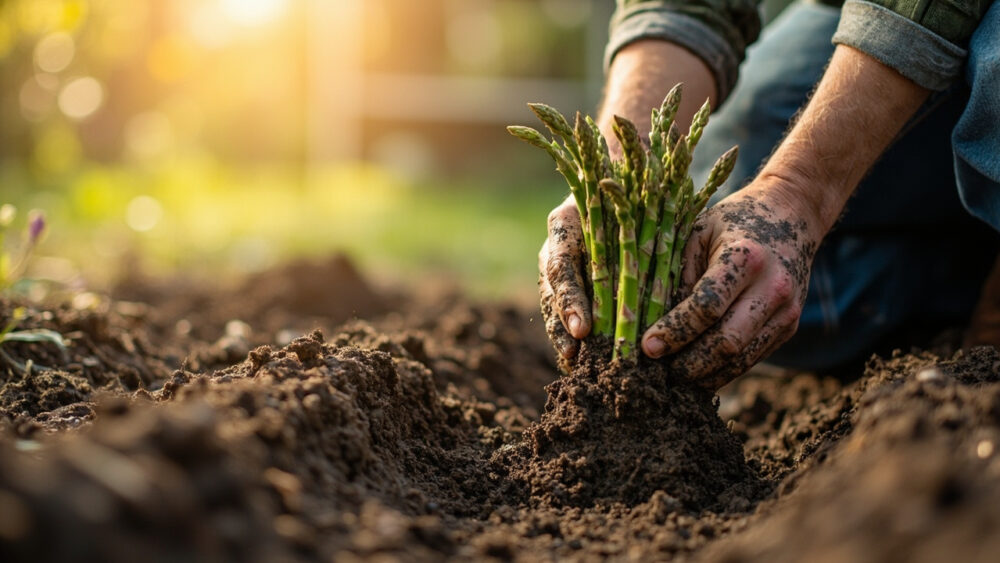
Dig trenches 12 to 18 inches wide and 6 to 8 inches deep, spaced 3 feet apart if you are running multiple rows. Work several inches of compost or aged manure into the trench bottom before crowns ever go in, since you will not get a second chance to amend that deep once roots are established.
Check your soil pH ahead of time too. Asparagus wants a pH between 6.5 and 7.5, and soil much more acidic than that will visibly stunt growth over the following seasons even though the bed looks fine at planting.
Set crowns on a small mound at the trench bottom, spider the roots outward, and cover with just 2 inches of soil at first, not the full trench depth, backfilling gradually as shoots emerge over the following weeks.
Get this part right before the window opens and the actual planting day takes fifteen minutes.
Region and Zone Notes Worth Knowing
USDA zones 3 through 8 are asparagus’s comfort range, and most named regions fall somewhere in that band with a shifted calendar rather than a different method.
Cold-winter zones (3 to 5) should expect a planting window from mid to late spring, often not until the soil finally shakes off winter wet in May. Rushing this in the North costs more failed crowns than any other single mistake in the region.
Warm-winter zones (7 to 9) get the opposite risk: soil can be workable in February, but asparagus still needs a real winter chill to go properly dormant and produce well, which is why the Deep South and low desert Southwest are genuinely harder places to grow it long-term, not impossible, just harder.
Wherever you garden, the crumble-and-drain test from earlier overrides any general zone guideline.
With timing and prep sorted, here is everything worth saving before you head outside.
Asparagus at a Glance
- When to plant: two to four weeks after your last frost date, once soil hits 50 to 65°F at root depth.
- Soil check: it should crumble in your hand, not clump into mud or drain slower than a few hours in a test hole.
- Depth and spacing: trenches 6 to 8 inches deep, crowns spaced 12 to 18 inches apart, rows 3 feet apart.
- pH target: 6.5 to 7.5, tested and corrected before planting, not after.
- Biggest mistake: planting into cold, wet soil, which rots crowns silently and shows up as a bare bed the following spring.
- Time to harvest: two to three years before a full harvest, so early mistakes do not show their cost right away.
- Zone range: USDA zones 3 through 8 are the reliable comfort zone, with warmer zones needing enough winter chill to keep dormancy on schedule.
Get the soil test right and the rest of this is just digging.
Patience with the first two years is what actually pays for the next fifteen.