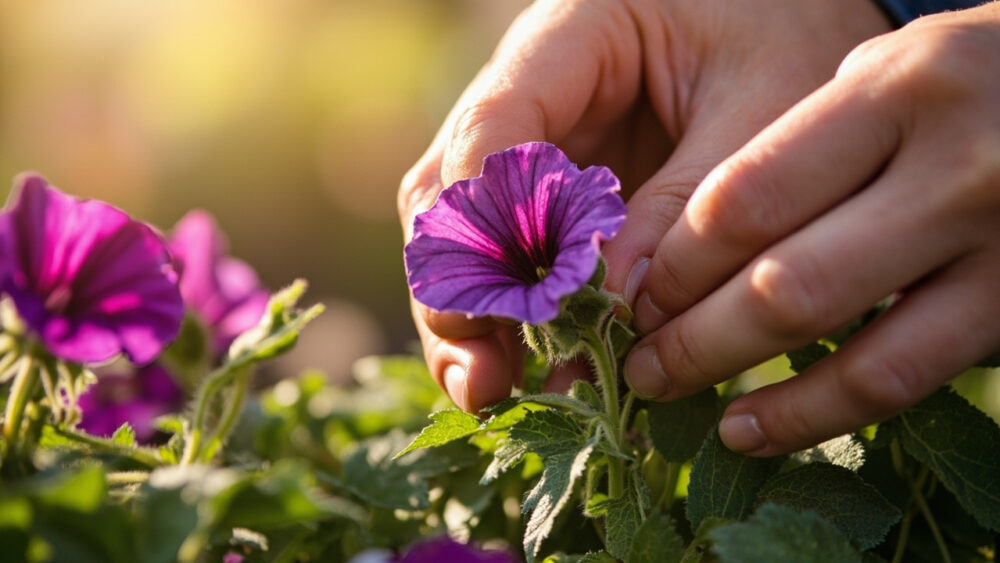
The single fastest way to make petunias bushy is to cut them back hard, by about a third to a half of their length, starting once they hit 6 to 8 inches of leggy growth, then feed them every one to two weeks after. Do that on a repeat cycle through the season and you get a mounded, thick plant instead of a handful of long bare vines with flowers only at the tips. Most people skip the hard part, the actual cutting, because it feels like destroying a plant that’s finally blooming.
That hesitation is the mistake that costs most gardeners their best petunia display. There’s also a sign almost everyone misreads as a fertilizer problem when it’s actually a haircut problem, and an honest answer about how long you have to wait before the plant looks good again, which is longer than the garden center will tell you.
Stick around for all of it, plus the save-able Petunias at a Glance card at the very bottom with the numbers you’ll want pulled up on your phone the next time you’re standing in front of a leggy pot.
When to Cut Petunias Back (and When to Leave Them Alone)
Start pinching or trimming young, right at planting or within the first couple weeks, once transplants have three or four sets of true leaves. This early pinch, removing just the growing tip, forces side branching before the plant ever gets tall and thin.
The bigger cutback comes later, usually mid-season, once stems have stretched past 8 inches and flowering has thinned out toward the tips only. That’s your cue, not a date on the calendar.
Skip the hard cutback in the first two or three weeks after transplanting while roots are still establishing, and hold off in the depths of a heat wave. Cutting a stressed, wilting plant just adds insult to injury.
Timing the cut right is only half of it, the other half is what you cut with and how you prep the plant first.
The One Prep Step That Actually Matters
You don’t need special tools. Sharp bypass pruners or even clean kitchen scissors work fine on petunia stems, they’re soft and fleshy, not woody.
The prep step people skip is watering the plant well the day before you cut. A well-hydrated petunia recovers from a hard trim in days. A drought-stressed one sulks for a week or two, sometimes longer, and you’ll blame the cutback instead of the dry soil.
Check the soil an inch down before you do anything. If it’s dry and crumbly, water first, wait a day, then cut.
Wipe your blades with rubbing alcohol between plants if you’re working on more than one pot, especially if any of them look diseased.
Once the plant is hydrated and your tools are ready, the actual cutting is the easy part.
How to Cut Petunias Back for Bushiness, Step by Step
Step 1: Find the leggy stems
Look for stems that are mostly bare toward the base with flowers clustered only at the very tip. Those are the ones stealing energy without giving you much bloom coverage.
Step 2: Cut a third to a half off each stem
Cut back to just above a set of leaves or a leaf node, the small bump where new growth will emerge. For a stem that’s 12 inches long, that means removing 4 to 6 inches.
Step 3: Stagger the cuts if the plant is in a hanging basket
Don’t shear the whole basket to one uniform length in a single pass. Cut a third of the stems this week, another third in a week or two, so you’re never left with a completely flowerless ball for weeks at once.
Step 4: Remove spent flowers as you go
While you’re in there, snap or snip off any faded blooms and the seed pods forming behind them. Seed production pulls energy away from new flower and branch growth.
That’s the whole mechanical process, the real skill is what you do in the two weeks after.
What to Expect After the Cutback
If you assumed the plant would look better within a few days, that guess is what makes people give up on the technique. A hard cutback usually looks worse before it looks better. Expect a rough, twiggy, half-bare plant for 7 to 14 days.
New shoots emerge from the leaf nodes you cut above, and this is where the branching actually happens. One stem becomes two or three.
Feed within a few days of cutting, using a balanced liquid fertilizer at half to full label strength, and repeat every one to two weeks through the rest of the growing season. Petunias are heavy feeders and a cutback without follow-up food just gives you a smaller, still-leggy plant.
Full rebloom typically shows up around 3 weeks out, sooner in warm, sunny conditions, slower in cool or shady spots.
Knowing what’s normal recovery keeps you from making the mistakes that undo all this work.
The Mistakes That Cost You Flowers
- Only pinching the tips and never cutting hard: light pinching alone slows legginess but won’t rebuild a plant that’s already sprawled out and thin at the base.
- Cutting once and never feeding: the plant needs nutrients to push out all that new branching, not just water and sun.
- Skipping the deadheading in between big cutbacks: letting seed pods form is one of the most common reasons blooming slows down even on a plant you trimmed correctly weeks ago.
- Cutting a drought-stressed plant: this is the fertilizer problem people misread, wilting and slow regrowth after a trim is usually dry soil, not a lack of food.
- Waiting until the plant is a foot of bare stem with three flowers on top: the longer you wait, the harder the cutback and the longer the ugly recovery phase.
- Cutting every stem to the same short length at once: staggering keeps some color in the pot while the rest recovers.
Get those six things right and the rest is just repeating the cycle every few weeks through summer.
Petunias at a Glance
- When to pinch young plants: within the first two weeks after transplanting, once they have three or four sets of true leaves.
- When to do a hard cutback: once stems reach 8 inches or more and flowers cluster only at the tips, usually mid-season.
- How much to remove: a third to a half of each stem’s length, cutting just above a leaf node.
- Watering before cutting: water the day before if soil is dry an inch down, never cut a wilting plant.
- Feeding after cutting: balanced liquid fertilizer within a few days, then every one to two weeks through the season.
- Recovery time: 7 to 14 days looking rough, full rebloom by around 3 weeks in good sun and warmth.
- Ongoing upkeep: deadhead spent blooms weekly and stagger cutbacks so the plant isn’t ever fully bare at once.
The plant will look worse before it looks better, that’s the deal, not a sign you did it wrong.
Cut hard, water first, feed after, and repeat every few weeks and the bushy, mounded petunias you’re picturing are a few cycles away, not a different variety.