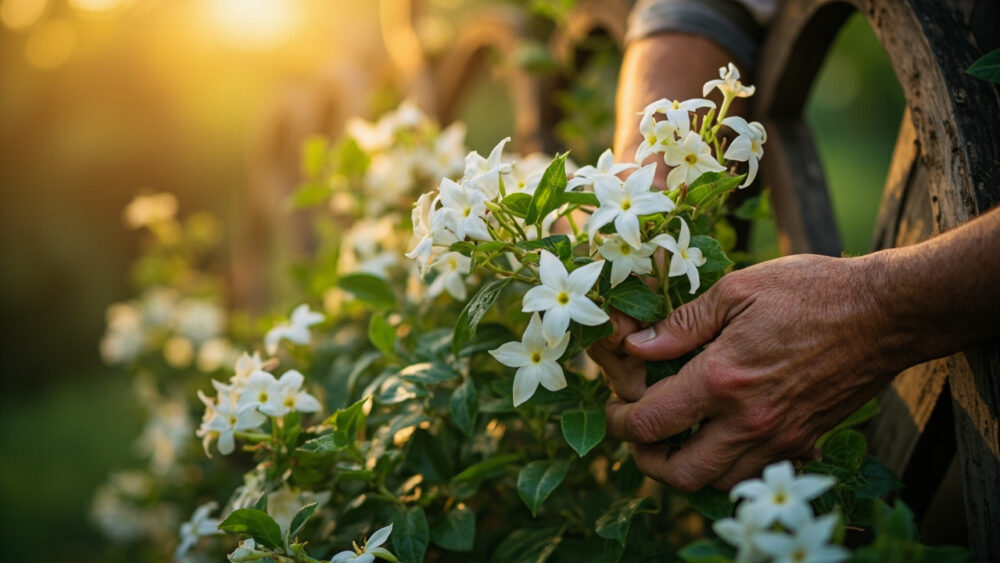
Learning how to grow star jasmine comes down to three things: give it heat, give it something to climb, and be patient for the first year while roots establish. Plant it in spring or early fall once nighttime temperatures stay above 40°F, in full to part sun, in soil that drains well, and it will reward you with glossy evergreen vines and that unmistakable sweet fragrance every summer. It is not actually a jasmine at all, which matters more than you’d think once problems show up.
Most people who kill their first star jasmine make the same mistake, and it has nothing to do with watering. There’s also a bloom sign almost everyone misreads as a fungus problem when it’s actually normal. And if you’re wondering when this thing actually starts smelling like something, the honest answer will either relieve you or annoy you depending on how much patience you’ve got.
Stick around for the Star Jasmine at a Glance card at the bottom. It’s the save-to-your-phone version of everything below, for the days you’re standing in front of the plant with dirt on your hands and no time to scroll.
When to Plant Star Jasmine
Spring, after your last frost, is the safest window in most climates. Soil temperature matters more than the calendar: wait until it’s reliably above 55°F a few inches down, which usually lines up with a couple weeks past your last frost date. Early fall works too, giving roots a head start before winter, as long as you’re at least six weeks out from your first hard freeze.
Star jasmine is reliably hardy in USDA zones 8 through 10. In zone 7, it survives most winters against a warm south-facing wall but can get burned back hard in a cold one. Anywhere colder, grow it in a pot you can move indoors or into a garage for winter.
The mistake that trips up most first-timers happens right here, before the plant is even in the ground.
Choosing the Spot and Prepping the Soil
Star jasmine wants at least four to six hours of direct sun for the best bloom, though it tolerates part shade and will still grow, just with fewer flowers. It needs a structure nearby: trellis, fence, arbor, or mailbox post, because this is a twining vine that climbs by wrapping stems around whatever’s closest, not by clinging with tendrils.
Drainage is the real make-or-break factor. This plant tolerates drought far better than it tolerates wet feet. If your soil is heavy clay, work in a few inches of compost before planting, or better yet, build a raised mound or bed. Aim for a soil pH in the slightly acidic to neutral range, roughly 6.0 to 7.0.
Here’s the mistake that ruins most attempts: planting star jasmine somewhere with no support and assuming it’ll figure itself out as a shrub. It won’t stay tidy on its own, and by year two you’ll have a tangled mat instead of a climbing vine.
Once the spot and soil are sorted, the actual planting takes ten minutes.
Planting Step by Step
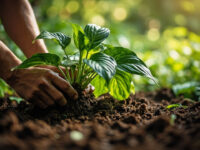
- Dig the hole: twice as wide as the nursery pot and just as deep, so the top of the root ball sits level with the surrounding soil.
- Loosen the roots: if the plant is rootbound (circling roots at the bottom of the pot), tease them apart gently or make a few vertical slices with a clean knife.
- Set and backfill: place the plant, backfill halfway, water to settle the soil, then finish filling and water again.
- Space plants: 3 to 5 feet apart if you’re growing a hedge or dense screen along a fence.
- Mulch: 2 to 3 inches of mulch around the base, kept a few inches clear of the stem itself.
- Tie in the first growth: loosely secure the main stems to your support with soft twine so the plant starts climbing in the right direction instead of sprawling.
Getting it in the ground is the easy part; keeping it alive through its first summer is where attention actually pays off.
Watering and Feeding Through the Season
For the first two to three months, water whenever the top 2 inches of soil dry out, which in warm weather often means twice a week. Once established, star jasmine is genuinely drought-tolerant and only needs supplemental water during long dry stretches.
Overwatering is the quieter killer here, more common than people expect from a plant marketed as low-maintenance. Yellowing leaves and a musty smell at the base point to soggy roots, not thirst, so resist the urge to water more when the plant looks unhappy.
Feed lightly in spring as new growth starts, using a balanced, slow-release fertilizer, and again in early summer if growth looks weak. Skip feeding in fall so you don’t push tender new growth right before cooler weather.
Feeding and watering keep the vine alive, but a few specific problems show up no matter how well you’ve done everything else.
Problems That Actually Show Up
Scale insects and aphids are the most common visitors, showing up as sticky residue on leaves or small bumps along stems. A strong spray of water knocks most of them off, and insecticidal soap handles the rest if you follow the label directions.
Root rot is the serious one, caused almost entirely by poor drainage or overwatering rather than any pest. Blackened, mushy stems near the soil line mean the damage is likely done, and at that point your best move is often taking a healthy cutting and starting over rather than nursing the original plant back.
Here’s the sign almost everyone misreads: brown, dropped flowers after a bloom cycle look like disease to a lot of new growers, but it’s completely normal. Star jasmine blooms in flushes, and spent flowers drop on their own to make room for the next round.
Cold damage after a hard freeze looks alarming too, blackened leaves and dieback along exposed stems, but established plants usually push new growth back out from the base once temperatures warm.
Once you know what’s normal and what’s not, the only real question left is when you get to enjoy the payoff.
When Star Jasmine Blooms and How to “Harvest” It
Star jasmine doesn’t get harvested the way a vegetable does, but if you clicked here wanting flowers or cuttings, here’s the timeline. A newly planted vine typically won’t bloom heavily until its second or sometimes third year, once the root system is established.
The honest answer to the patience question: a one-gallon nursery plant put in the ground this spring probably gives you a light scattering of flowers this year and a real show the year after. That’s normal, not a sign you did something wrong.
Once established, expect flushes of small, star-shaped white flowers in late spring into summer, each flush lasting several weeks. The fragrance is strongest in the evening and on warm, humid nights.
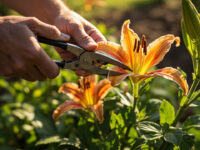
If you want cut stems for indoor fragrance, snip 6 to 8 inch pieces in the morning while flowers are freshly open, and they’ll hold their scent for a day or two in water. For propagation, take 4 to 6 inch semi-hardwood cuttings in summer, strip the lower leaves, and root them in moist potting mix.
One more honest note: star jasmine is considered toxic to dogs and cats, so if you have pets that chew on vines, keep it out of reach or watch for drooling, vomiting, or lethargy, and call your veterinarian if you see any of those signs.
Everything above boils down to a handful of numbers worth keeping on hand.
Star Jasmine at a Glance
- When to plant: spring after last frost once soil hits about 55°F, or early fall at least six weeks before first hard freeze.
- Where it grows outdoors year-round: USDA zones 8 through 10, with zone 7 possible against a warm wall.
- Sun and soil: full to part sun, well-draining soil, pH roughly 6.0 to 7.0.
- Spacing and depth: 3 to 5 feet apart for a screen, planted at the same depth it sat in the nursery pot.
- Water: regularly for the first two to three months, then drought-tolerant with occasional deep watering once established.
- Feeding: light, balanced, slow-release fertilizer in spring and early summer, none in fall.
- Bloom timeline: light flowering in year one to two, full flushes of fragrant white flowers by year two to three, mainly late spring into summer.
Give it sun, drainage, and something to climb, and the rest mostly takes care of itself.
The only real risk is impatience, since this is a plant that rewards the second and third year far more than the first.