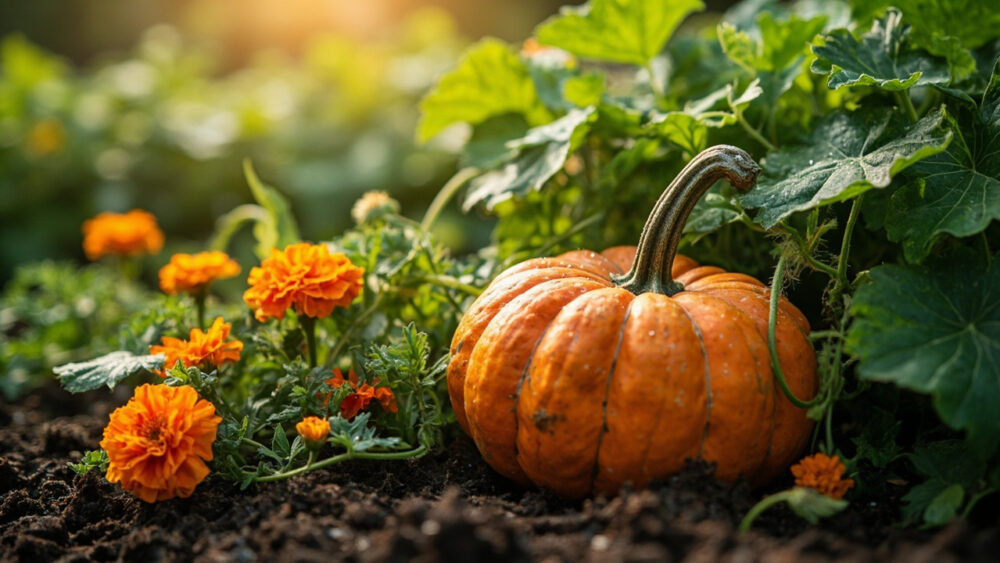
The best companion plants for pumpkins are bush beans, corn, radishes, nasturtiums, marigolds, and dill. They fix nitrogen, confuse squash bugs and cucumber beetles, lure pollinators to those big pumpkin flowers, and put idle ground to work while your vines are still small. Skip anything in the squash family, and go easy on potatoes and most brassicas nearby, for reasons that trip up a lot of otherwise careful gardeners.
Here is the part almost nobody tells you: the classic “plant marigolds around everything” advice is mostly folklore, and it is not even the biggest mistake people make with pumpkin companions. The real mistake is spacing, not species. You can pick the perfect neighbor and still lose the bed if you crowd it.
Stick with me through the layout section and the myth-busting near the end, because that is where the expensive mistakes actually happen. And save the “Pumpkins at a Glance” card at the very bottom, it has the planting depth, spacing, and timing numbers you’ll want pulled up on your phone while you’re standing in the dirt.
Companions That Actually Earn Their Spot
Bush Beans
Bush beans fix nitrogen in the soil through bacteria on their roots, and pumpkins are heavy nitrogen feeders that will take that free meal gladly. Plant them at the base of pumpkin mounds once vines start running, about 3 to 4 weeks after the pumpkins go in. Keep them bush type, not pole beans, or you will end up fighting a tangle of two vining crops for the same real estate.
That nitrogen boost only helps if the beans get enough light to thrive themselves.
Corn
Corn gives pumpkin vines something to sprawl toward instead of just outward, and its tall stalks provide light shade that pumpkin leaves tolerate fine in hot climates. This is half of the traditional “Three Sisters” planting, and it still works because the two crops use the garden in different dimensions, corn going up, pumpkins going sideways. Plant corn first, then tuck pumpkins in 2 to 3 weeks later once the corn has a head start on height.
Get that timing backward and the pumpkins will swallow young corn before it has a chance.
Radishes
Radishes, especially icicle types, are the sacrificial decoy against squash vine borers and cucumber beetles. The theory is that the pungent root confuses egg-laying insects looking for squash-family scent cues, and in practice gardeners see fewer beetles on pumpkin stems when radishes ring the base. They mature in 25 to 30 days, so plant a fresh round every few weeks through early summer to keep the deterrent active.
Radishes buy you time, but the real air support comes from the flowers.
Nasturtiums and Marigolds
Nasturtiums are a genuine trap crop, aphids and squash bugs prefer them over pumpkin leaves and will colonize the nasturtiums first, giving you an early warning and a sacrificial buffer. Marigolds pull more weight for their scent than any chemical magic, the strong smell disrupts how cucumber beetles find pumpkin plants by scent trail. Both also draw in bees and hoverflies right when your pumpkins need heavy pollinator traffic for those short-lived female flowers.
Attracting pollinators only matters if you have not accidentally repelled them with the wrong neighbor.
Dill and Other Umbellifers
Dill, along with fennel and cilantro left to flower, brings in predatory wasps and hoverflies that eat aphids and squash bug eggs. Let a few plants bolt and flower instead of harvesting everything young. The flat flower clusters are landing pads for these beneficial insects in a way solid pumpkin foliage never is.
Good bug allies are only half the plan, the other half is knowing who to keep far away.
What to Never Plant Near Pumpkins
Other squash-family crops top the list: zucchini, cucumbers, melons, and other squash varieties. They share every major pest, from squash vine borers to cucumber beetles to powdery mildew, so planting them close together just concentrates the problem instead of spreading it out. Worse, many pumpkins and squash cross-pollinate freely, and while that will not ruin this year’s pumpkins to eat, it will wreck seed-saving if that is your plan.
Potatoes are a quieter conflict. Both crops are heavy feeders competing for the same soil nutrients, and potato foliage sprawling at ground level fights pumpkin vines for the same low light and airflow, which invites fungal issues in both.
Brassicas like cabbage, broccoli, and kale are not toxic neighbors, but they are thirsty, heavy feeders too, and pumpkin vines will physically overrun and shade out low-growing brassica heads by midsummer. It is less a chemical clash and more a real estate problem nobody plans for until the vines start running 6 to 8 feet in every direction.
That vine sprawl is exactly why layout matters more than any single companion choice.
Laying Out the Bed So Nothing Fights for Space
Pumpkins need serious room: 4 to 6 feet between plants in rows spaced 8 to 10 feet apart for standard varieties, more for giant types. Plant companions at the edges, not the center, where vines will reach them last and where you can still access them for harvest. Radishes and nasturtiums go right at the base of young pumpkin mounds since they finish or get overrun early anyway.
Corn belongs upwind and on the north side in most northern hemisphere gardens, so it does not shade the pumpkins during their peak growing months. Beans go in after the pumpkins are established, tucked at the mound base where their roots can share the nitrogen fix without vining competition. Marigolds and dill work best as a border ring around the whole patch rather than mixed in.
Even a well-planned layout falls apart if you believe the wrong companion myth.
The Companion Myths That Do Not Hold Up
If you assumed marigolds are some kind of pest force field that protects everything around them, that guess is too generous. Marigolds reduce some pest pressure through scent confusion, but they do nothing against squash vine borers, which tunnel into stems and are largely a cultural and physical-barrier problem, not a companion-planting one.
The “Three Sisters” combo of corn, beans, and squash gets repeated as universally perfect, but it only works with enough space and the right timing sequence. Cram all three into a small raised bed and you get stunted corn, smothered beans, and pumpkins that never fruit well, because none of them had room to do their job.
And sunflowers, often recommended as pumpkin companions, mostly compete for the same root zone and light rather than helping much. They look good in photos, but the growing science behind them as a pumpkin ally is thin at best.
Skip the myths, keep the proven pairings, and the numbers below will get you through planting day without second-guessing yourself.
Pumpkins at a Glance
- When to plant: after all frost danger has passed and soil has warmed to at least 65 to 70°F, usually 2 to 4 weeks after your last frost date.
- Spacing: 4 to 6 feet between plants for standard varieties, 8 to 10 feet between rows, more room for giant pumpkin cultivars.
- Planting depth: sow seeds about 1 inch deep in mounds, 4 to 5 seeds per mound, thinned to the 2 or 3 strongest seedlings.
- Best companions: bush beans, corn, radishes, nasturtiums, marigolds, dill and other flowering umbellifers.
- Never plant nearby: zucchini, cucumbers, melons, other squash, and go light on potatoes and brassicas.
- Water needs: 1 to 2 inches per week, deep and infrequent rather than daily light watering, soil should feel moist an inch down but not soggy.
- Days to maturity: 90 to 120 days depending on variety, so time planting to finish well before your first fall frost.
Get the spacing right first, then let the companions do their quieter work in the margins.
Everything else in this guide only matters once that foundation is in place.