Nine times out of ten, squash leaves turning yellow means either uneven watering or the plant simply aging out its oldest leaves, and the fix is usually as boring as adjusting your watering schedule and leaving those old bottom leaves alone once you confirm that’s all it is. But yellowing squash leaves have several genuinely different causes, and they don’t all get the same fix.
The cause everyone blames first, nitrogen deficiency, is actually one of the less common culprits in a home garden, especially if you fed the bed at all this season. What actually tells you which cause you’re dealing with is one specific detail: where on the plant the yellow started, and whether it’s spreading in a pattern or showing up randomly.
I’ll walk through every plausible cause ordered by how often it’s actually the one, tell you the exact test to confirm each, and give you an honest recovery outlook, because some of these your plant bounces back from in days and others mean the plant is done. Save-able diagnosis checklist is at the very bottom, run it at the plant in about two minutes.
Most Likely Causes, Ranked
1. Natural Aging of Lower Leaves
Confirm it: only the oldest leaves at the base of the plant are yellowing, the newer growth at the crown is deep green, and the plant is otherwise vigorous with flowers and new leaves forming.
Squash plants shed their oldest leaves as the season goes on, it’s normal turnover, not a problem. Fix: snip the yellowed leaves off at the base once they’re mostly yellow, this improves airflow and does the plant a favor.
If this is all you’re seeing, you can stop worrying and skip straight to prevention.
2. Inconsistent Watering
Confirm it: check soil an inch or two down, if it’s bone dry or waterlogged and mucky, that’s your answer. Yellowing tends to show up on leaves scattered across the plant, often with slightly crispy or curled edges if it’s drought, and soft yellow with a wilted look if it’s overwatering.
Fix: squash wants about 1 to 1.5 inches of water a week, delivered consistently rather than a flood-then-drought cycle. Water at the base, deeply, once or twice a week rather than a light daily sprinkle, and mulch to even out soil moisture swings.
Water is the easy fix, but it’s also the one most likely to get confused with a nutrient problem.
3. Nitrogen Deficiency
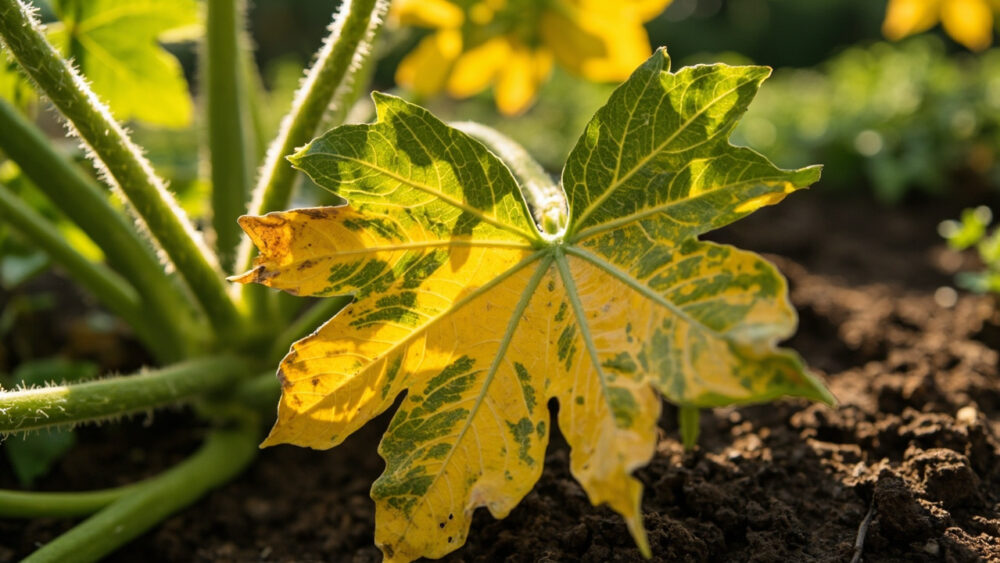
Confirm it: older, lower leaves yellow first in a fairly uniform pale green to yellow wash, the leaf veins may stay slightly greener than the tissue between them, and growth overall looks slow or stunted.
This shows up most in unfed soil or a long-productive bed that’s run out of steam. Fix: side-dress with a balanced or slightly nitrogen-forward vegetable fertilizer, or work in some compost, following the product label rate. You should see improvement in new growth within a week or two, though the yellowed leaves themselves won’t turn green again.
If the yellowing has a distinct mottled or speckled pattern instead of a uniform wash, keep reading, because that points somewhere else entirely.
4. Squash Bugs or Squash Vine Borer Damage
Confirm it: flip the leaves over and check for clusters of small bronze or brown eggs, or flat gray-brown adult bugs at the base of the plant. For vine borers, look for a small hole near the base of the stem with a sawdust-like frass around it, and a stem that’s wilting despite good soil moisture.
Squash bugs suck sap from leaves, causing yellow speckling that spreads into large dead brown patches, usually starting on a few leaves rather than uniformly across the plant. Fix: hand-pick bugs and eggs, remove and destroy badly infested leaves, and if the infestation is heavy, use an insecticide labeled for squash bugs, following the label exactly. Vine borer damage at the stem is much harder to reverse, more on that below.
Insects cause damage that looks patchy and localized, which is the biggest tell against a watering or nutrient problem.
5. Powdery Mildew or Downy Mildew
Confirm it: look for a white, powdery dusting on leaf surfaces (powdery mildew) or angular yellow patches on the top of leaves with a fuzzy gray-purple growth on the underside (downy mildew). These diseases tend to show up in mid to late season, especially in humid weather or when leaves stay wet overnight.
Fix: remove and discard the worst-affected leaves, improve airflow by thinning nearby foliage, water at the base instead of overhead, and apply a fungicide labeled for the specific mildew, following label directions. These diseases spread, so the earlier you catch it the better your odds.
Mildew has a texture you can see and often feel, which separates it from every cause above.
6. Squash Vine Borer or Bacterial Wilt Killing the Stem
Confirm it: the whole plant, or one entire vine, wilts and yellows fast, over a few days, even though soil moisture is fine. Cut into the base of the stem near soil level, a borer larva or a hollowed, frass-filled tunnel confirms vine borer, while a milky white ooze when you cut and squeeze a stem points to bacterial wilt (often spread by cucumber beetles).
Fix: for vine borers, you can sometimes slit the stem lengthwise, remove the larva, and mound soil over the wound to encourage new roots, but success is inconsistent. Bacterial wilt has no cure, infected plants should be pulled and discarded to protect neighboring plants.
This is the one cause where speed matters more than technique, so let’s talk about telling all of these apart fast.
How to Tell the Causes Apart
Where it starts matters most. Bottom-up, uniform, whole-plant-is-fine-otherwise usually means aging leaves, watering, or nitrogen. Scattered or speckled patches point to insects. A sudden, fast, whole-vine collapse points to a stem problem.
Old leaves only, new growth green: aging or nitrogen. New and old leaves both affected: watering. Surface texture like powder or fuzz: disease, not a nutrient or water issue.
Once you know the pattern, the next question is whether the plant is actually going to make it.
Will It Recover?
Aging leaves: nothing to recover from, the plant is fine. Watering issues: new growth improves within a week of consistent watering, though damaged leaves stay damaged. Nitrogen deficiency: new leaves come in greener within one to two weeks of feeding, old yellow leaves don’t reverse.
Insect damage: the plant usually recovers if you catch it early and the population is small, but heavy infestations that have hit the main stem are a tougher call. Mildew: manageable if caught early, but it rarely fully clears and will likely return in humid stretches.
Vine borer and bacterial wilt are the honest bad news. A vine borer that’s already tunneled deep into the main stem often kills that vine regardless of what you do, and bacterial wilt is not recoverable at all. If a whole vine has collapsed and you find a hollow stem or milky ooze, cut your losses on that vine, pull it, and protect the rest of the bed.
Knowing which ones are fixable changes how you garden next season too.
How to Keep It From Happening Again
Water consistently, aim for that 1 to 1.5 inch weekly target with deep, infrequent watering rather than daily light sprinkles, and mulch around the base to hold moisture steady.
Feed the bed before symptoms show up, working compost or a balanced fertilizer into the soil at planting and again mid-season.
Give plants real spacing, 3 to 4 feet between squash plants depending on variety, so air moves through the leaves and mildew has a harder time taking hold.
Scout weekly for squash bug eggs on leaf undersides and cucumber beetles on flowers, catching them early is far easier than fighting an established population.
Rotate where you plant squash family crops each year, vine borers and bacterial wilt both linger in soil and old plant debris.
None of this is complicated, but skipping it is exactly how the same problem comes back next July.
Diagnosis Checklist
- Check which leaves are yellow: only the oldest, bottom leaves, or leaves scattered across the whole plant.
- Press a finger into the soil an inch or two down: bone dry or soggy points to watering, evenly moist rules it out.
- Look at new growth at the crown: healthy green growth means the plant is fine overall, pale or stunted new growth points to nitrogen.
- Flip several leaves over: look for eggs, bugs, or speckled stippling that signals insect feeding.
- Check leaf surfaces for white powder or fuzzy gray-purple patches, that confirms mildew.
- If a whole vine wilted fast, cut into the stem near the soil line: a hollow, frass-filled tunnel means vine borer, a milky ooze means bacterial wilt.
- Match your findings to the matching cause above, and apply that fix today, not next weekend.
Most yellow squash leaves are the plant telling you something small and fixable, not something fatal.
Confirm the pattern, apply the right fix, and check back in a week to see the new growth answer the question for you.