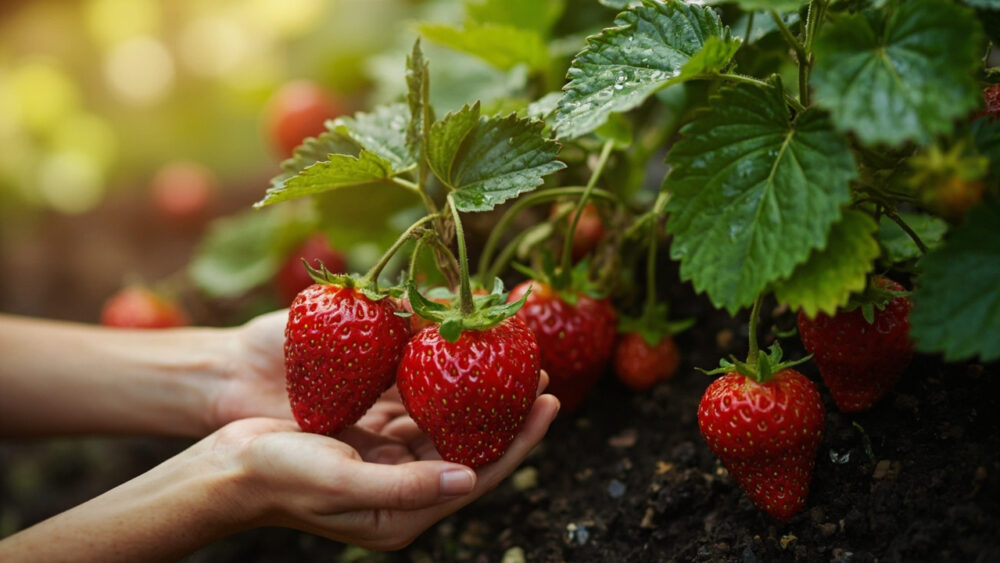
Strawberries want six to eight hours of direct sun, soil that drains fast but never dries out completely, and a feeding schedule that backs off nitrogen once flowers show up. Get those three right and the rest of caring for strawberries is just maintenance. Get them wrong and you will grow beautiful leaves and almost no fruit, which is the single most common outcome for first-time strawberry growers.
That leafy-but-fruitless plant is actually the biggest trap in this whole crop, and it is almost never a watering problem, even though watering is where most people point the blame first. There is also a pruning step nearly everyone skips because it feels wrong to do, and a sign of a thriving plant that has nothing to do with how many berries you can currently see.
Stick with this and you will hit the save-able Strawberries at a Glance card at the bottom, the version of this guide short enough to actually pull up on your phone next time you are standing in front of the plant wondering what it needs.
Light, Placement, and Temperature
Strawberries need six to eight hours of direct sun daily. Less than that and you get lush leaves with weak, sparse fruit, the exact trap mentioned above. Morning sun with light afternoon shade works in genuinely hot climates, but everywhere else, full sun all day is the goal.
They prefer daytime temperatures between 60 and 80 F. Growth stalls below 40 F and fruit quality drops hard above 85 F, with berries turning soft and dull-tasting.
In containers, move plants to catch more sun as the season shifts. In the ground, that is not an option, so site them right the first time.
Where you place the plant now decides more of the season’s harvest than anything you do to it later.
Watering: How Much, How Often, and How to Tell
Strawberries have shallow roots, mostly in the top 6 inches of soil, so they dry out fast and punish neglect quickly. Water when the top inch of soil feels dry to the touch, which in warm weather can mean every day for containers and every 2 to 3 days for in-ground beds.
Give about 1 to 1.5 inches of water per week, delivered slowly so it soaks down rather than running off. A soaker hose or drip line at the base beats overhead sprinklers, since wet leaves and wet fruit invite rot and fungal disease.
If you assumed limp, pale leaves mean the plant needs more water, that guess is often backwards. Strawberries wilt from both drought and from waterlogged, oxygen-starved roots, and soggy soil that never dries between waterings is the more common killer in home gardens.
Check the soil with your finger before you reach for the hose, every single time.
Soil, Potting Mix, and Feeding
Strawberries want loose, well-draining soil rich in organic matter, with a pH between 5.5 and 6.8. Heavy clay that holds water around the crown is a fast route to rot. In containers, use a quality potting mix, never garden soil straight from the yard, since it compacts and drains poorly in a pot.
Feed at planting with a balanced fertilizer, then back off nitrogen once flowering starts. A high-nitrogen feed at bloom time pushes leaf growth at the expense of fruit, which is the other half of that leafy-no-berries problem from the intro. Switch to a fertilizer higher in phosphorus and potassium once you see flowers.
A light topdressing of compost each spring covers most ongoing nutrition needs after that first year.
Feeding is half the fruit-set equation, and the other half is a pruning habit most people never do on purpose.
Pruning, Runners, and the Renovation Cut
Here is the step everyone gets wrong: pinch off the first round of flowers on newly planted strawberries, the ones that show up within the first few weeks. It feels like sabotage, but letting a brand-new plant fruit immediately steals energy the roots need to establish, and you get one weak flush of berries instead of a strong plant that produces for years.
Beyond that, remove dead or yellowing leaves anytime you see them, and trim off runners (the long stems reaching out to root new plants) unless you actually want more plants, since each runner you allow pulls energy from the mother plant’s fruit.
For June-bearing types, do a renovation cut right after harvest: mow or trim leaves down to about 1 inch above the crown, thin crowded plants, and let it regrow for next year. Everbearing and day-neutral types skip this hard cutback and just get regular cleanup instead.
Do this pruning on schedule and you buy yourself a plant that fruits reliably for three to four years before it needs replacing.
Problems That Actually Show Up
Grey, fuzzy mold on ripening fruit is botrytis fruit rot, driven by wet, crowded conditions. Improve airflow, water at the soil line, and pull affected berries immediately so it does not spread.
Slugs and birds take the ripe fruit right before you get to it. A layer of straw mulch under the berries keeps fruit off damp soil and cuts slug damage noticeably. Netting is the reliable fix for birds.
Small, misshapen, or seedy-tasting berries usually mean poor pollination, common in cool, wet spring weather when bees are not active. There is not much to do about a bad pollination week except wait for the next flush.
Yellowing between green leaf veins points to an iron or nutrient deficiency in soil that is too alkaline, fixable by lowering pH slightly and feeding as described above.
None of these problems are dramatic if you catch them early, which is exactly why the next section matters.
How to Tell the Plant Is Genuinely Thriving
The honest sign of a thriving strawberry plant is not berry count, it is new runner and leaf production alongside firm, deep-green older leaves. A plant putting out fresh growth all season, not just at the start, has roots that are happy and a crown that is healthy.
Firm, glossy fruit that fully colors before you pick it, rather than staying pale and hard or going soft and dull, tells you light and water are both dialed in.
Strawberry plants are mildly toxic to dogs and cats mainly due to the leaves and green unripe fruit, though serious poisoning is uncommon; if a pet eats a large amount and shows vomiting, drooling, or stomach upset, call your veterinarian rather than waiting it out.
Everything above adds up to one card worth keeping.
Strawberries at a Glance
- When to plant: 2 to 4 weeks before your last expected frost, once soil is workable and temperatures stay above about 40 F at night.
- Spacing: 12 to 18 inches apart, rows about 2 to 3 feet apart to leave room for runners.
- Light: 6 to 8 hours of direct sun daily.
- Water: about 1 to 1.5 inches per week, soil kept moist but never soggy, checked by feel at the top inch.
- Soil: loose, well-draining, rich in organic matter, pH 5.5 to 6.8.
- Feeding: balanced fertilizer at planting, then lower nitrogen once flowers appear.
- First-year care: pinch off the earliest flowers to build a stronger root system before letting it fruit.
If you remember one thing, remember this: strawberries fail from crowns sitting wet and from nitrogen fed at the wrong time, far more often than from neglect.
Fix the water and the timing of that feed, and the berries take care of themselves.