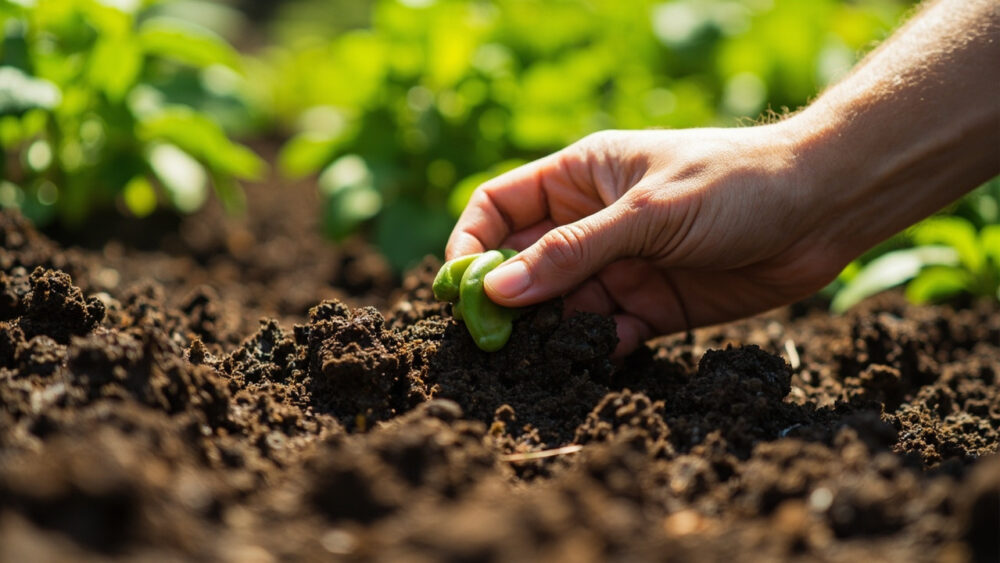
Plant green bean seeds 1 inch deep in heavy or clay soil, and up to 1.5 inches deep in sandy or loose soil. Space bush beans 2 to 4 inches apart in rows set 18 to 24 inches apart, and pole beans 4 to 6 inches apart at the base of a trellis or pole. Get the depth right and germination takes care of itself, but how deep to plant green beans is only half the answer nobody gives you straight.
The other half is spacing, and that is where most home gardens go wrong. Plant too tight and you get gorgeous foliage and almost no beans. Plant too far apart and you waste bed space and invite weeds to move into the gaps.
There is also a depth mistake that is nearly invisible until three weeks in, when half your row never comes up at all. Stick around, because the save-able Green Beans at a Glance card is at the bottom of this guide, and it has every number in one place for your phone.
The Exact Depth, and Why It Changes With Your Soil
Bean seeds want consistent moisture and enough soil contact to swell and crack open, but not so much soil weight that the sprout exhausts itself pushing up. In average garden loam, 1 inch deep is the standard. In sandy soil that dries fast and drains loose, go slightly deeper, up to 1.5 inches, so the seed does not dry out before it germinates.
In heavy clay, stay at 1 inch or even a touch shallower, because clay crusts hard when it dries and a bean sprout can genuinely fail to break through a compacted cap. This is the invisible mistake: gardeners in clay soil plant at 2 inches thinking deeper means safer, and end up with a spotty, gappy row for no visible reason.
If you assumed deeper is always safer for a bigger seed, that guess is exactly what stalls half a row underground.
Soil Temperature Matters More Than the Calendar
Bean seeds rot in cold, wet soil before they ever germinate. Wait until soil temperature is reliably at least 60°F, ideally 65 to 85°F, which usually lines up with one to two weeks after your last spring frost date, not the date itself.
Check by hand: soil that feels cool and damp like a refrigerated cloth is still too cold. Soil that feels like room-temperature potting mix, warmed by a few sunny days, is ready.
Planting early to beat the season is the second most common way to lose a bean planting entirely.
Bush Bean Spacing: Rows, Beds, and Why Crowding Costs You Beans
Space bush bean seeds 2 to 4 inches apart within the row, with rows 18 to 24 inches apart. In a wide raised bed, you can plant in bands 4 to 6 inches apart in all directions instead of strict rows, since you are not walking between them.
Here is the part that surprises people: bean plants set too close do not just compete for light, they trap humidity around the lower leaves. That damp, still air is exactly what fungal diseases like white mold and rust want. Airflow is doing real disease prevention, not just cosmetic tidying.
Crowded beans also simply set fewer pods per plant, because each plant is spending its energy competing for light rather than filling out flowers. You can plant beans close and still get a harvest, but you will get noticeably less per square foot than a properly spaced row.
Spacing is not the only thing crowding wrecks, and the next mistake is the one almost nobody names correctly.
The Sign Everyone Misreads: Lots of Leaves, No Beans
When a bean planting is too dense, gardeners almost always blame the variety, the weather, or lack of fertilizer. The plants look healthy and green, so the problem seems mysterious.
The real cause is usually light competition at the flower and pod level, not a nutrient problem. Bean flowers that get shaded by neighboring foliage abort at a much higher rate. The plant looks fine because leaves do not need as much light as flowers do to hold on.
If your beans are lush and green but pods are sparse, thin them before you reach for fertilizer. Overfeeding a crowded bed, especially with high-nitrogen fertilizer, makes this worse by pushing even more leaf growth at the expense of pods.
That fix is simple in theory and a little uncomfortable in practice, which is exactly the next thing to talk through.
Pole Beans Need Different Numbers Entirely
Pole beans climb, so they can be planted tighter at the base without the same airflow penalty, because the foliage spreads vertically instead of sideways across the bed. Space pole bean seeds 4 to 6 inches apart around each pole or every 4 to 6 inches along a trellis, planting 4 to 6 seeds per pole in a classic teepee setup.
Depth stays the same as bush beans, 1 to 1.5 inches depending on soil type. The trellis or pole should already be in place before you plant, since disturbing roots later to add support costs you time the plant does not have.
Rows of pole beans on a trellis fence need 30 to 36 inches between rows, more than bush beans, because a mature trellis casts real shade.
Vertical growing solves crowding at ground level, but it creates its own version of the same problem overhead.
Containers: Smaller Space, Same Rules Squeezed Down
Bush beans do well in containers at least 8 to 10 inches deep and at least 12 inches across, with 3 to 4 seeds spaced 3 to 4 inches apart around the pot’s edge. Depth of planting does not change in a container, still 1 to 1.5 inches.
Drainage matters more in containers than in ground soil, because a pot with poor drainage holds the exact cold, wet conditions that rot bean seeds before they sprout. Choose a container with real drainage holes, not a decorative pot with none.
Pole beans in containers need a genuinely stable trellis or tall stakes anchored well, since a loaded pole bean vine in a lightweight pot will tip in wind.
Containers forgive a lot of mistakes, but they do not forgive an overcrowded planting any more than the ground does.
How to Fix It If You Already Planted Too Thick
If your seedlings are up and clearly touching, thin them once they have their first true leaves, not at the tiny seed-leaf stage. Snip extras at the soil line with scissors instead of pulling, since pulling disturbs the roots of the seedlings you are keeping.
Thin bush beans down to that 2 to 4 inch spacing, and pole beans down to 4 to 6 inches per pole. It feels wasteful to cut healthy seedlings, but a thinned row consistently out-produces a crowded one by harvest time.
If the whole bed is uniformly too thick and thinning feels overwhelming, thin in stages over a week rather than all at once, so you can still adjust based on which seedlings look strongest.
Get the spacing right once and every later problem, disease, poor yield, and weak flowering, gets noticeably easier to manage.
Green Beans at a Glance
- When to plant: one to two weeks after your last frost, once soil is reliably 60 to 85°F.
- Depth: 1 inch in clay or heavy soil, up to 1.5 inches in sandy or loose soil.
- Bush bean spacing: 2 to 4 inches apart, rows 18 to 24 inches apart.
- Pole bean spacing: 4 to 6 inches apart at the base of each pole or trellis, rows 30 to 36 inches apart.
- Container size: at least 8 to 10 inches deep and 12 inches wide, 3 to 4 seeds per pot.
- Thinning cue: thin at first true leaves, snip at soil line, do not pull.
- Warning sign: lush leaves with few pods usually means overcrowding, not a feeding problem.
Depth gets the seed up. Spacing gets you the harvest.
Get both right and green beans are one of the most forgiving vegetables you will ever grow.