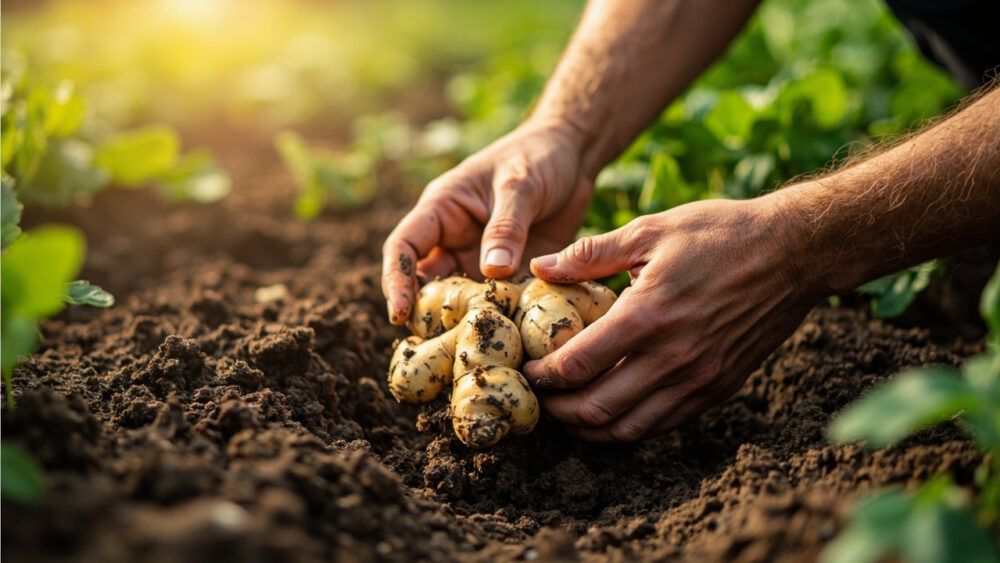
The window for planting ginger opens two to four weeks after your last frost date, once the soil has warmed to at least 65 F, and it stays open for roughly six to eight weeks after that. Miss the front end and the rhizome just sits in cold soil doing nothing. Miss the back end and you run out of the long, warm growing season ginger needs to size up before fall.
Here is the part almost nobody tells you when they answer when to plant ginger: the calendar date matters far less than what the soil is actually doing, and the piece of “seed” ginger you buy at the store is often not ready to plant the day you bring it home. There is also a common mistake with pre-sprouting that quietly costs people their whole season, and a soil test you can do with your bare hand in about ten seconds.
Stick with me through the sections below and you will know exactly how to read your own yard instead of guessing off a calendar. At the bottom is a save-able Ginger at a Glance card with every number in one place for your phone.
The Real Planting Window, Anchored to Frost and Soil
Ginger is tropical. It has zero frost tolerance and it barely tolerates cool soil either, so the frost date only tells you the earliest possible edge of the window, not the actual start.
The soil is the real gatekeeper. You want consistent soil temperatures of 65 to 75 F at planting, measured a couple inches down, not just warm afternoon air. Below 60 F the rhizome tends to rot before it sprouts instead of growing.
In practice that means most of the US mainland is planting ginger sometime in mid to late spring, often a solid month after the last frost, once nighttime lows have stopped dipping into the 40s.
Knowing the general rule is easy, reading it against your own patch of dirt is where people go wrong.
How to Find YOUR Window, Not the Textbook One
If you assumed you just count weeks from your last frost date and plant, that guess is what leaves half of ginger growers with mushy rhizomes and no explanation why. Frost date tells you air temperature history, not soil temperature today, and those two drift apart by weeks depending on your soil type, sun exposure, and whether you mulched last fall.
Do the hand test. Push your fingers two to three inches into the bed. It should feel warm, not just cool-to-neutral, and it should stay that way for a full week, not just one sunny afternoon.
A cheap soil thermometer removes the guesswork entirely and is worth owning if you grow anything heat-loving, since ginger, basil, and peppers all want roughly the same soil temperature to start.
Raised beds and containers warm up one to two weeks earlier than in-ground beds, which matters a lot if your season is already short.
If your ground stays cold late into spring, your real move is not to wait longer outdoors, it is to start indoors instead, and that is exactly what the prep section below covers.
What Happens If You Plant Too Early or Too Late
Too early costs you the rhizome, not just time. Plant into soil under 60 F and the piece typically sits wet and dormant until it softens and rots, especially in heavy clay that holds moisture. You do not get a delayed sprout, you get a dead planting and an empty spot in the bed for weeks before you realize it.
Too late is a quieter failure. Ginger needs a genuinely long season, commonly 8 to 10 months from planting to a full mature harvest, though you can dig “baby ginger” at 4 to 6 months for milder, thin-skinned rhizomes.
Plant in high summer instead of spring and you simply run out of warm days before the rhizome has bulked up, so you harvest small no matter how well you cared for it.
Neither mistake shows an obvious warning sign right away, which is exactly why so many first attempts end quietly disappointing rather than dramatically dead.
The Prep That Actually Determines Your Success
This is the step almost everyone skips, and it is the honest answer to the question you were about to ask next: no, you usually cannot just drop store-bought ginger straight into cold ground and expect much.
Pre-sprout indoors 3 to 4 weeks before your outdoor window opens. Break the rhizome into pieces with at least one visible growth bud (the small pointed nub, sometimes already green), let cut surfaces dry and callus for a day, then lay pieces on top of slightly moist potting mix in a warm spot, 70 to 80 F, out of direct sun.
You are waiting for pale green or pink shoots to emerge, which usually takes two to four weeks. That head start is what lets gardeners in shorter-season climates get a real harvest at all.
- Buy plump, firm rhizomes with visible buds, avoid shriveled or moldy pieces.
- Soak store-bought ginger in room-temperature water overnight if it looks dry, this can wake up dormant buds.
- Warm the bed ahead of time with black plastic or a cold frame if your spring soil runs cool.
Once you see those shoots, you are not guessing anymore, you are just waiting on the soil to catch up.
Depth, Spacing, and Site Once You’re In the Window
Plant rhizome pieces 1 to 2 inches deep, buds facing up, in loose, rich, well-draining soil high in organic matter. Ginger hates wet feet almost as much as it hates cold soil, so amend heavy clay before planting rather than fighting drainage all summer.
Space pieces 8 to 12 inches apart, or a bit tighter in large containers, in a spot with dappled shade to filtered sun, especially where summer afternoons run hot. Full sun in a mild coastal climate works fine, but blazing inland sun scorches the leaves.
Keep soil consistently moist but never soggy through the first few weeks while sprouts push through, since this is the most vulnerable stretch for rot.
Get this part right and the biggest risks are already behind you, which brings us to how your specific region changes the timeline.
Zone and Region Notes That Change the Math
USDA zones 9 through 12 can plant ginger directly in the ground in spring and count on a full 8 to 10 month season outdoors, sometimes leaving it in the ground over a mild winter in the warmest pockets.
Zones 7 and 8 need that indoor pre-sprout head start and should plan to dig before the first fall frost, since the growing season is right at the edge of what mature ginger needs.
Zones 3 through 6 are container or greenhouse territory for most growers. Start indoors 6 to 8 weeks before your last frost, move containers outside once nights stay reliably above 55 F, and bring them back in well before fall cold arrives.
Wherever you garden, all of it comes back to the same numbers, which is exactly what the card below is for.
Ginger at a Glance
- When to plant outdoors: two to four weeks after your last frost date, once soil holds steady at 65 to 75 F.
- When to pre-sprout indoors: three to four weeks before your outdoor planting window, longer in short-season zones.
- Planting depth: one to two inches deep, growth buds facing up.
- Spacing: eight to twelve inches apart in loose, well-draining, organically rich soil.
- Light: dappled shade to filtered sun, full sun only in mild coastal climates.
- Time to harvest: four to six months for baby ginger, eight to ten months for mature rhizomes.
- Zone notes: zones 9 to 12 plant direct in ground, zones 7 and 8 pre-sprout first, zones 3 to 6 grow in containers moved indoors before fall frost.
Get the soil temperature right and everything else about growing ginger gets easier. Plant by the calendar alone and you are just gambling with a rhizome that cannot afford the bet.