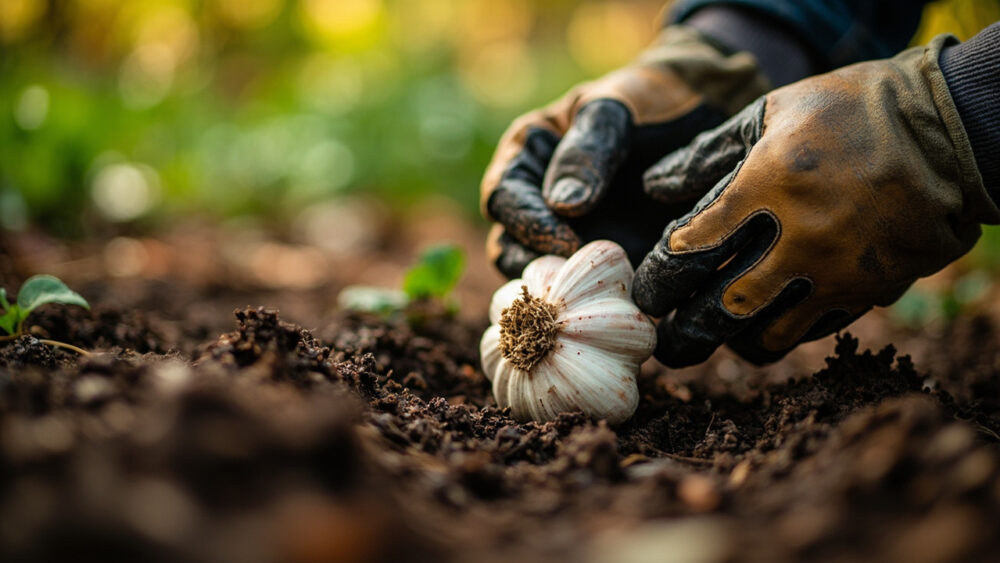
The answer for when to plant garlic is four to six weeks before your ground freezes solid, which for most of the country lands somewhere between mid September and early November. Soil temperature matters more than the calendar: you want it sitting around 50 to 60°F at planting depth. Garlic needs real cold to size up next summer, and it needs enough time to grow roots before that cold arrives, but not so much time it pushes up leafy green top growth that winter will just kill back.
That window sounds simple. It is not the part that trips people up.
The mistake that ruins more garlic crops than anything else has nothing to do with the date on the calendar. It is planting cloves that were never meant to be planted at all, and most people don’t find out until July when they pull up marble-sized bulbs. There’s also a sign a lot of gardeners misread every single spring, and an honest answer to the question you’re probably already forming: what happens if you miss the window entirely. All of it is below, and the exact save-able rundown, the Garlic at a Glance card with every number in one place, is waiting at the bottom.
The Real Planting Window, Anchored to Cold, Not the Calendar
Garlic goes in the ground in fall, not spring, because it needs a stretch of cold soil to trigger bulb division. Without that cold period, a clove will grow into something that looks like a single fat clove with no head structure at all, useless in the kitchen and useless for replanting.
Aim for four to six weeks before your ground typically freezes hard. In much of zones 5 through 7, that’s late September through October. In zone 8 and warmer, where hard freezes are rare or late, you can push into November or even early December.
In zone 3 and 4, don’t wait past late September. The ground locks up fast and cloves need those weeks to root before that happens.
The date matters less than what the soil is actually doing right now.
How to Read Your Own Yard Instead of a Chart
Forget the average frost date for your region for a second. Push a soil thermometer, or even just your finger, four inches down. You want that soil consistently in the 50s Fahrenheit, cooling but not cold.
If you assumed you should wait for the first frost to plant garlic, that guess costs a lot of gardeners their crop. Frost on the leaves has nothing to do with soil temperature four inches down, and by the time you get a hard frost the soil may already be too cold for good root establishment.
What you’re actually watching for is the soil settling into that cool-but-workable range, and a five to six week runway before it freezes solid. Microclimates matter here too. A south-facing bed against a house wall runs warmer than an open field twenty feet away, sometimes by a week or more of effective planting time.
Once you know your real window, the next question is what happens if you land outside it.
Too Early or Too Late: What Actually Goes Wrong
Plant too early, while soil is still warm, and cloves send up green shoots before winter. Those shoots get hammered by hard freezes, the plant spends its stored energy recovering instead of building roots, and bulbs come in undersized.
Plant too late, after the ground has already gone cold and hard, and cloves don’t get enough time to establish roots before freeze-up. They can survive, but weakly, and a weak root system going into winter usually means a smaller, less vigorous plant come spring.
If you miss the window completely, here’s the honest answer: you can still plant in very early spring, as soon as the ground thaws and can be worked, but expect smaller bulbs. Garlic wants that cold vernalization period, and a compressed spring cold spell is a poor substitute for a full winter. It’s not a wasted season, just a smaller one.
Getting the timing right only pays off if the cloves themselves were worth planting in the first place.
The Prep That Actually Determines Your Harvest
This is the mistake from the intro: most garlic failures trace back to seed stock, not timing. Grocery store garlic is often treated to prevent sprouting, and it’s frequently a variety not suited to your climate anyway. Buy seed garlic from a farm, nursery, or seed company specifically selling it for planting.
Break bulbs into individual cloves right before planting, not weeks ahead. Keep the papery skin on each clove intact. Plant only the largest, firmest cloves; small inner cloves grow into small bulbs, no exception.
Prep the bed with compost worked into loose, well-draining soil. Garlic sitting in heavy, wet clay all winter rots more often than it survives.
Plant cloves pointy end up, 2 inches deep in most regions, 3 to 4 inches deep where winters are severe, spaced 4 to 6 inches apart in rows 12 inches apart. Mulch with 4 to 6 inches of straw right after planting to buffer temperature swings and suppress weeds.
Get the stock and the prep right, and the calendar becomes a much smaller factor than most people think.
Regional Notes Worth Knowing
Hardneck garlic handles cold better and is the standard choice in zones 3 through 6, where winters are genuinely harsh. It also sends up a flower stalk, or scape, in early summer that should be cut for better bulb size.
Softneck garlic is the better call in zones 7 and warmer, where winters run mild. It’s also the type most often braided, and it generally stores longer after harvest.
In the Deep South and coastal zones 8 through 10, garlic sometimes needs a helping hand: refrigerate seed cloves for four to six weeks before planting if your winter doesn’t reliably get cold enough on its own. Plant in late fall, close to Thanksgiving in many of these areas.
Once it’s in the ground and mulched, garlic mostly takes care of itself until spring green-up.
Garlic at a Glance
- When to plant: four to six weeks before your ground typically freezes hard, usually mid September through early November depending on your zone.
- Soil temperature target: around 50 to 60°F at four inches deep, cooling but not yet frozen.
- Depth: 2 inches in milder climates, 3 to 4 inches where winters are severe.
- Spacing: 4 to 6 inches between cloves, 12 inches between rows.
- Seed stock: use certified seed garlic, not grocery store bulbs, and plant only the largest cloves.
- Mulch: 4 to 6 inches of straw immediately after planting.
- Type by region: hardneck for zones 3 to 6, softneck for zones 7 and warmer, and pre-chill cloves in zones 8 to 10 if winters run mild.
Get the soil temperature and the seed stock right, and the exact date stops mattering nearly as much as people assume.
Everything else about growing great garlic is just patience between now and next summer’s harvest.