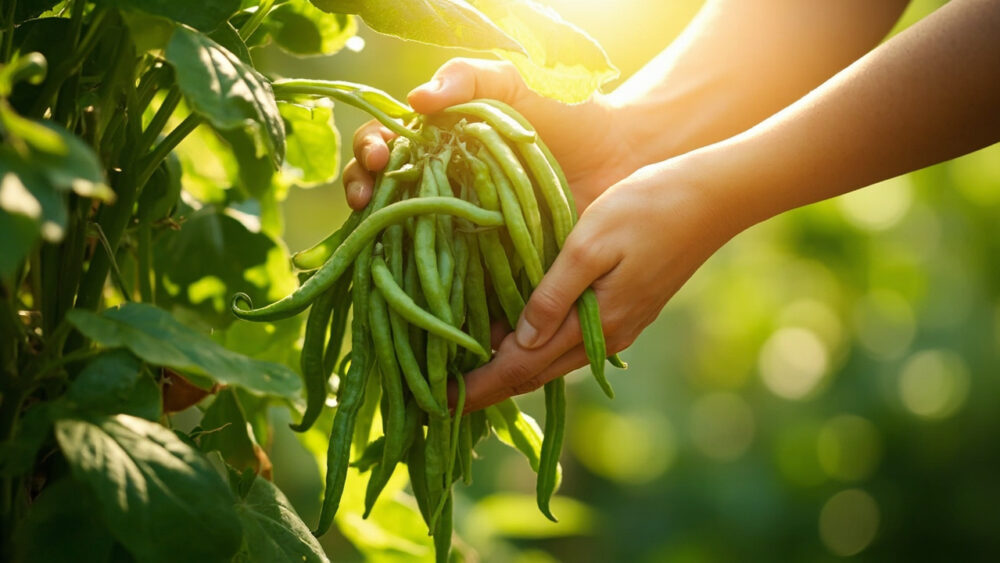
Green beans are ready to pick when the pods are firm, fully sized for the variety, and snap cleanly when you bend them, usually 50 to 65 days after planting and about 7 to 10 days after the flowers drop. You’re checking pods, not counting days on a calendar, because plants keep producing at different rates depending on heat and water. Get this window right and you get weeks of harvests. Get it wrong and the plant either quits early or hands you tough, stringy pods you have to fight through dinner.
Most people ruin their bean harvest one of two ways, and neither one feels like a mistake at the time. There’s also a sign almost everyone misreads, the one that makes gardeners think they’re too early when they’re actually right on time, and I’ll walk you through it below.
Stick with me through the how-to and storage basics, because the “Green Beans at a Glance” card at the very bottom is the one worth screenshotting before you walk back out to the garden.
The Real Ready Signs on the Plant
Forget the size chart on the seed packet for a second. The pod’s feel matters more than its length.
The snap test
Bend a pod in half. If it snaps cleanly with an audible crack, it’s ready. If it just folds or bends without breaking, give it another day or two.
The bulge test
Run your fingers along the pod. You should feel the pod walls smooth and slightly rounded, with only the faintest hint of the seeds inside. Obvious bumps means you waited too long.
Color and shine
Ready pods look bright, whether that’s green, purple, or yellow depending on variety, and have a slight sheen. Dull, matte pods are usually past peak.
Here’s the sign people get backward: a pod that still looks slightly small and slim is very often perfectly ready, not too early.
The Timing Window, and What “Too Late” Actually Costs You
Bush beans typically start producing 50 to 55 days after planting; pole beans run closer to 60 to 65 days, but then keep going for weeks longer. Once flowering starts, pods are usually pickable within 7 to 10 days.
If you pick too earlyyou lose very little. Small pods are tender and still fully usable, just lower yield per pick.
If you wait too longthe damage is real. Pods go fibrous and stringy, the plant redirects energy into maturing seeds instead of setting new flowers, and total production for the season drops. An overgrown pod left on the vine is the single biggest reason home harvests taper off early.
This is the honest answer to the question you’re probably about to ask next: no, an oversized pod does not “catch back up” once you finally pick it. It’s done. The best you can do is shell it for dried beans instead of tossing it.
So the real skill isn’t finding the ready pods, it’s not missing them.
How to Pick a Bean Without Wrecking the Plant
Bean plants are more fragile at the stem than people expect, especially bush varieties with shallow roots.
- Use two hands. Hold the stem above the pod steady with one hand and pull the pod down and away with the other. Yanking with one hand snaps the whole branch.
- Pinch or snip at the stem, not the pod. The pod’s own stem is where it separates cleanest; grabbing the middle of the pod and pulling tears the skin.
- Work the plant top to bottom. Ready pods tend to hang lower and mature first. Upper pods usually need another day or two.
- Pick every 1 to 3 days once production starts. Beans go from perfect to overgrown fast in warm weather, sometimes in 48 hours.
Rushing the pick is the other big mistake, the one that costs you branches instead of just pods.
What to Do in the First Hour After Picking
Green beans lose sweetness and crispness fast once off the plant, faster than most vegetables.
Get them out of the sun immediately. Move the harvest basket into shade or straight indoors. Pods sitting in a hot garden for even 30 minutes start softening.
Don’t wash them yet. Rinse right before you cook or store, not before, since wet pods in a bag go slimy faster.
If you’re not using them same day, refrigerate unwashed in a loose or perforated bag. They’ll hold decent quality for about 5 to 7 days in the crisper drawer, though flavor and snap are always best within the first two or three.
Once they’re safely stored, the next question is how to keep more coming.
Keeping the Harvest Going, or Wrapping It Up
Bush beans give you a concentrated flush, often most of their yield inside a 2 to 3 week window, then taper off. Pole beans spread production over 6 to 8 weeks or longer if you keep picking.
Consistent picking is what extends the harvest. Leaving mature pods on the vine signals the plant to stop flowering and finish its job, which is producing seed. Strip pods regularly and the plant keeps trying again.
For continuous bush bean supply through the season, many gardeners succession-plant a new short row every 2 to 3 weeks up until about 10 to 12 weeks before first fall frost.
If you want dried beans instead of fresh eating, let a portion of the pods go all the way to dry and rattly on the vine, then shell and store them in an airtight container once fully cured.
That’s the whole cycle: watch the pod, pick often, and the plant does the rest.
Green Beans at a Glance
- When to plant: after your last spring frost, once soil hits about 60 to 65 F, since cold soil rots the seed before it sprouts.
- Days to first harvest: roughly 50 to 55 days for bush types, 60 to 65 days for pole types.
- Spacing and depth: seeds 1 inch deep, bush beans 3 to 4 inches apart in rows 18 to 24 inches apart, pole beans 4 to 6 inches apart at the base of a trellis.
- Ready signs: pod snaps cleanly when bent, walls feel smooth with only a faint seed bulge, color is bright and slightly glossy.
- Pick frequency: every 1 to 3 days once flowering starts, since pods go from ready to overgrown within about a week.
- Storage: unwashed in a perforated bag in the fridge, good for about 5 to 7 days, best within the first 2 to 3.
- Keep it producing: harvest consistently and don’t let mature pods sit on the vine, or the plant stops flowering early.
Check pods, not the calendar, and pick a little early rather than a little late.
Do that consistently and the plant will keep feeding you far longer than the seed packet promised.