The fastest way to sort out types of birds of paradise is by growth habit: some stay under 4 feet and bloom on a windowsill, others build into 15 to 20 foot clumps that need a courtyard. Get that one distinction right and everything else, the leaf shape, the flower color, the hardiness zone, falls into place fast.
Most first-time buyers grab the common orange bird of paradise because it is what the nursery has out front, then get frustrated when it sits for three or four years without a single bloom. That is not bad luck. It is the wrong plant for a pot on a shaded patio.
Down at number 13 is a species most people misidentify on sight, confusing it for a totally different plant in the same family. Stick around for that one, plus the compact growers that actually bloom indoors, and a straight method at the very bottom for picking the right type for your space instead of your Instagram feed.
The Classic Strelitzia Types
These are the true birds of paradise, the genus Strelitzia, known for the sharp beak-shaped bloom that gives the whole family its name.
1. Strelitzia Reginae (Orange Bird of Paradise)
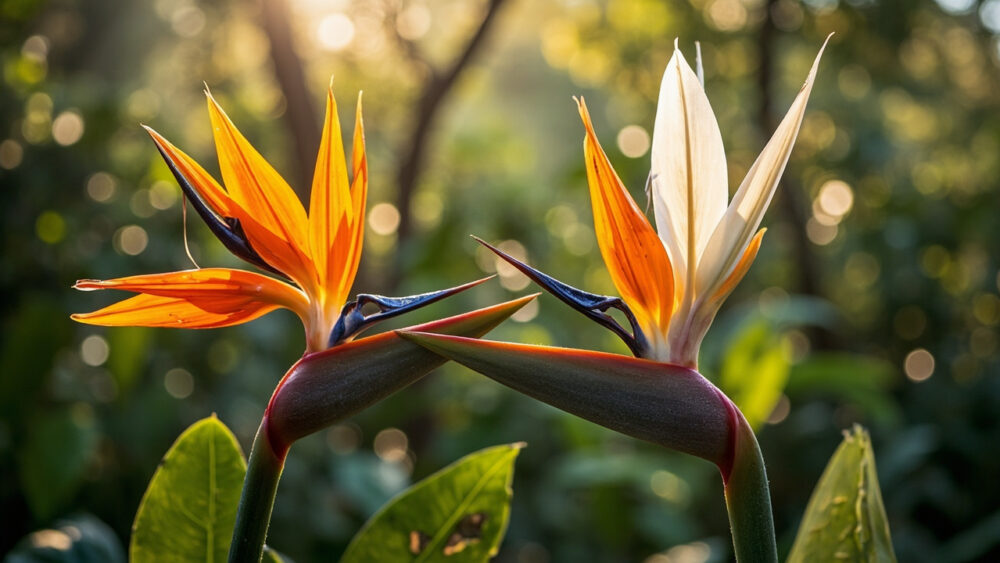
The one everyone pictures when they hear the name, with orange and blue crane-like blooms held above stiff paddle leaves on 3 to 5 foot stems. It needs full sun and several years of maturity before it flowers, and it sulks badly indoors without at least 6 hours of direct light a day. Hardy outdoors in zones 9 through 11, container grown elsewhere.
2. Strelitzia Nicolai (Giant White Bird of Paradise)
The banana-tree look-alike that ends up towering over a two-story house in the right climate, reaching 15 to 20 feet with a trunk-like base and huge glossy leaves that split in wind. Its flowers are white and deep blue rather than orange, and it is the one landscapers plant for that tropical, architectural silhouette. Give it room, because it will use it.
3. Strelitzia Juncea (Rush-Leaf Bird of Paradise)
The leafless oddball of the group, with narrow rush-like stems instead of broad paddles, giving it a sculptural, almost desert look. It handles wind and drought far better than reginae and works well in xeriscaping or as a striking accent by a pool. Same orange and blue bloom as the classic type, just on a plant that reads completely differently in the landscape.
4. Strelitzia Caudata (Mountain Strelitzia)
The cold-hardier tree form, native to higher elevations in South Africa, growing 15 to 30 feet with a distinct woody trunk over time. It tolerates brief light frost better than nicolai and produces white flowers with a similar structure. It is harder to find in nurseries but worth seeking out if you are pushing zone 8b and want the tree-form look without babying it every winter.
5. Strelitzia Reginae ‘Mandela’s Gold’
The yellow-flowered sport of the classic orange type, discovered as a natural mutation and now propagated for gardeners who want the same crane shape without the traffic-cone color. It has identical care needs and mature size to standard reginae, so choose it purely on color preference rather than any difference in growing difficulty.
That covers the true Strelitzias, but the bird of paradise name gets borrowed by several relatives that are not in this genus at all.
The Compact and Container-Friendly Types
If you want blooms indoors or on a small patio, these are the ones that actually deliver without a decade of waiting.
6. Strelitzia Reginae ‘Kirstenbosch Gold’
A named yellow selection bred specifically for more reliable, earlier flowering than a generic seed-grown orange plant. It stays in the same 3 to 5 foot range as standard reginae but is worth the extra cost if you have been burned before by a bird of paradise that refused to bloom for years.
7. Strelitzia Reginae ‘Humilis’ (Dwarf Orange Bird of Paradise)
The true dwarf of the orange type, topping out around 2 to 3 feet, which makes it the one realistic choice for a large pot on a sunny balcony. It still needs strong direct light and patience, usually three to four years, before its first bloom, but its small footprint means you can actually fit it near a bright south-facing window.
8. Caesalpinia Gilliesii (Yellow Bird of Paradise Shrub)
Not a Strelitzia at all, this is a fast-growing desert shrub with feathery fern-like foliage and clusters of yellow flowers with long red stamens that give it its bird of paradise nickname. It grows 6 to 10 feet, tolerates heat and poor soil that would kill a true Strelitzia, and suits hot, dry gardens in zones 8 through 11. It is deer resistant but toxic if ingested by pets or people, so keep grazing animals and small children away from the seed pods and call a veterinarian or poison control if you suspect ingestion.
9. Caesalpinia Pulcherrima (Red Bird of Paradise)
The showier cousin of the yellow shrub above, with orange-red flowers edged in yellow and the same feathery foliage, blooming almost continuously in hot climates. It reaches 8 to 12 feet, handles full sun and drought once established, and works as a fast, colorful hedge in zones 9 through 11. Same toxicity caution applies as with its yellow relative.
Those two shrubs prove the name travels well beyond the true Strelitzias, and the next group takes it even further from the tropics.
The Ground-Level and Foliage-Focused Types
These types trade height for texture, color, or a completely different growing style.
10. Strelitzia Reginae Var. Citrina
A pale lemon variant of the classic bloom, softer and creamier than ‘Mandela’s Gold’ rather than a true bright yellow. It is grown the same way as standard reginae and mainly appeals to collectors who want a subtler color in a mixed planting bed.
11. Heliconia Rostrata (False Bird of Paradise, Lobster Claw)
The rainforest impostor that gets sold as a bird of paradise online but belongs to an entirely different family, with pendant clusters of red and yellow claw-shaped bracts hanging down rather than pointing up. It wants consistent moisture, part shade to filtered sun, and warm humid air, making it a better match for a greenhouse or humid porch than a dry sunny patio. Zones 10 through 12 outdoors, otherwise a striking houseplant with high humidity needs.
12. Ravenala Madagascariensis (Traveler’s Palm)
Another false relative, often shelved next to true Strelitzias in garden centers because its fan of paddle leaves looks nearly identical at a young age. It eventually forms a massive single-trunk fan up to 30 feet tall and is genuinely a different genus, closely related but distinct from Strelitzia. Give it full sun, real space, and patience, since it is a long-term landscape commitment, not a patio plant.
13. Strelitzia Alba
The one most people mix up with either nicolai or caudata because all three form tree-like white-flowering clumps with similar height. Alba is distinguished by smoother, more rounded leaf tips and a slightly more upright, less spreading habit than nicolai. It is rarer in retail nurseries, mostly found through specialty tropical growers, and suits collectors in zones 9b through 11 who want a true species rather than the ubiquitous giant white.
14. Strelitzia Reginae ‘Ovata’
A broader-leafed selection of the standard orange type, with rounder, more overlapping paddle leaves that give it a fuller look even before it flowers. It is grown identically to reginae and chosen mainly for that denser foliage effect in a border planting.
15. Ensete Ventricosum ‘Maurelii’ (Red Abyssinian Banana)
The dramatic foliage stand-in that landscapers pair with true birds of paradise for a fuller tropical bed, technically a banana relative rather than a bird of paradise but sharing the same paddle-leaf silhouette in a deep burgundy red. It grows fast, 6 to 10 feet in a single season in warm climates, and gets treated as an annual or overwintered indoors anywhere below zone 9. It is not cold hardy and needs rich, consistently moist soil, unlike the drought-tolerant Strelitzias it is usually planted beside.
How to Choose the Right One
- Measure your actual space first: under 3 feet calls for a dwarf reginae, 8 feet and up calls for nicolai, caudata, or alba, and anything in between fits standard reginae or the Caesalpinia shrubs.
- Match your zone honestly: true Strelitzias want zones 9 through 11 outdoors, Caesalpinia shrubs handle hotter, drier zones 8 through 11, and everything else needs container life or a greenhouse in colder regions.
- Decide if you want bloom or foliage: if flowers matter most, pick reginae types or the Caesalpinia shrubs for faster color, since nicolai and alba take years and reward you mainly with structure.
- Be honest about light: anything less than several hours of direct sun a day means skip true Strelitzias entirely and consider Heliconia in bright indirect light instead.
- Weigh your patience for blooming time: named cultivars like ‘Kirstenbosch Gold’ bloom sooner than generic seed-grown plants, which can take four to seven years from seed.
- Check your water habits: true Strelitzias and Caesalpinia forgive missed waterings, while Heliconia and Ensete punish dry soil fast.
Pick by space and light before you ever pick by flower color, and you will end up with a plant that actually thrives where you put it.