The short answer: prune rhododendrons right after they finish blooming, not before, and not in fall or winter. You have a window of roughly two to four weeks after the last flowers fade to make your cuts, because that’s before the plant sets next year’s flower buds. Miss that window and you’re not ruining the shrub, but you are cutting off next spring’s flowers.
That’s the part most people get wrong, and it’s the single mistake that costs more blooms than any pest or bad winter. But there’s more to this than timing. How much you can safely remove depends on the plant’s age and how overgrown it already is, and there’s a specific cut location that determines whether new growth comes back thick or thin.
Stick with me through the how-to and I’ll flag the exact spots people cut wrong, what a properly pruned rhododendron looks like a month later, and the recovery mistake that turns a healthy shrub into a bare, woody skeleton. There’s also a save-able Rhododendrons at a Glance card at the bottom with every number in one place.
When to Prune, and When to Absolutely Leave the Shears Alone
Rhododendrons set their flower buds for next year during summer, just a few weeks after this year’s blooms drop. That means your pruning window is narrow: right after flowering ends, before new bud set begins. For most climates that’s sometime in late spring to early summer, depending on your zone and the variety.
If you prune in late summer, fall, or winter instead, you’re cutting off buds that are already formed. The shrub will survive fine. You just won’t get flowers where you cut.
Light shaping, snapping off spent flower trusses and removing dead wood, can happen anytime you spot it. Structural pruning is the part with a deadline.
Timing is easy once you know the rule, but knowing where on the branch to cut is where most people freeze up.
Tools and the One Prep Step That Actually Matters
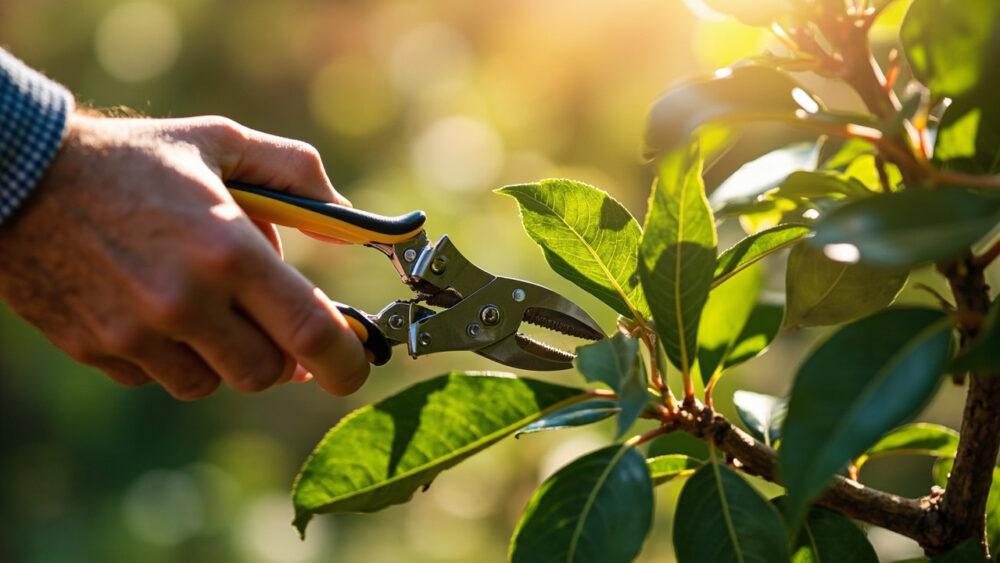
You need sharp bypass pruners for anything pencil-thick or smaller, and loppers or a small pruning saw for old woody stems over an inch across. Clean cuts heal faster and matter more on rhododendrons than on a lot of shrubs, since torn bark invites disease into wood that’s slow to callus over.
Wipe your blades with rubbing alcohol before you start, especially if you’ve used them on anything showing disease recently. Rhododendrons can pick up fungal issues through fresh wounds.
The prep step people skip: look the whole shrub over first and decide your goal before you make one cut. Are you deadheading, shaping, or renovating an overgrown plant? Each calls for a different amount removed, and cutting first, thinking later is how shrubs end up lopsided.
Once you know your goal, the actual cuts are simple.
How to Prune a Rhododendron Step by Step
Step 1: Deadhead spent blooms
Snap or snip off the dead flower truss just above the first set of leaves below it, using your thumbnail or pruners. This redirects energy into new growth and next year’s buds instead of seed production.
Step 2: Remove dead, damaged, or crossing wood
Cut these back to healthy wood or all the way to the main stem. You’ll know it’s dead if the bark is dry, brittle, or gray-brown all the way through when you scratch it with a nail.
Step 3: Shape lightly, cutting just above a whorl of leaves
For general shaping, cut branch tips back to just above a leaf whorl, the point where several leaves radiate out around the stem. New growth emerges from the buds at that junction, so this is where the plant branches from.
Step 4: For overgrown or leggy shrubs, cut back hard into old wood
Rhododendrons tolerate renovation pruning better than most people expect. You can cut main stems back to 6 to 12 inches from the ground if a shrub has gotten woody and bare at the base. Do this in stages over two to three years rather than all at once if the shrub matters to your landscape, since a full hard cut means no flowers at all the following spring.
The cut location matters more than the tool, and the whorl rule is the one thing to remember if nothing else sticks.
What to Expect in the Weeks After Pruning
Within two to four weeks you should see small new growth buds swelling at the cut points, especially just below where you trimmed. Leaves may look slightly stressed for a week or two after a hard cut, but that’s normal and not a sign of failure.
If you deadheaded only, you likely won’t notice much change beyond a tidier shrub and stronger growth by midsummer. If you did a renovation cut on old wood, expect a season with few or no flowers while the plant regrows its structure.
Water consistently after any significant pruning, especially a hard renovation cut. A stressed root system paired with a big top cut is a bad combination in a drought.
That regrowth period is exactly where the next mistake usually happens.
The Mistakes That Cost You Flowers
If you assumed pruning hard always means a stronger shrub next year, that guess is backwards for rhododendrons in the short term. A hard prune trades this year’s or next year’s flowers for long-term shape and health. That’s a fair trade on an overgrown shrub, but it’s not free.
- Pruning too late in the season: cutting after flower buds have already formed removes next year’s blooms.
- Cutting mid-branch instead of at a whorl: leaves bare, awkward stubs that regrow unevenly.
- Removing more than a third of the plant in one year: stresses the root system and can trigger dieback in a plant that was already struggling.
- Shearing rhododendrons like a hedge: this cuts leaves in half, browning the edges and ruining the natural form for a full season.
- Ignoring suckers at the base: if left, they compete with the main structure and can eventually take over from a grafted variety.
Avoid these five and pruning becomes routine maintenance instead of a gamble.
Rhododendrons at a Glance
- When to prune: right after flowering ends, within about two to four weeks, before next year’s buds form.
- When not to prune: late summer, fall, or winter, since flower buds are already set by then.
- Where to cut: just above a leaf whorl for shaping, or into old wood 6 to 12 inches from the ground for renovation.
- How much to remove: no more than about a third of the plant in a single year, unless doing a staged multi-year renovation.
- Tools needed: sharp bypass pruners for thin growth, loppers or a saw for wood over an inch thick, rubbing alcohol for cleaning blades.
- Recovery time: new growth buds visible in two to four weeks, full recovery from a hard cut can take a full season without flowers.
- Biggest mistake to avoid: shearing the shrub or pruning after buds have set, both of which cost you the next bloom.
Prune right after the flowers fade, cut above a whorl, and never take more than a third at once. Get those three things right and everything else about rhododendron care falls into place on its own.