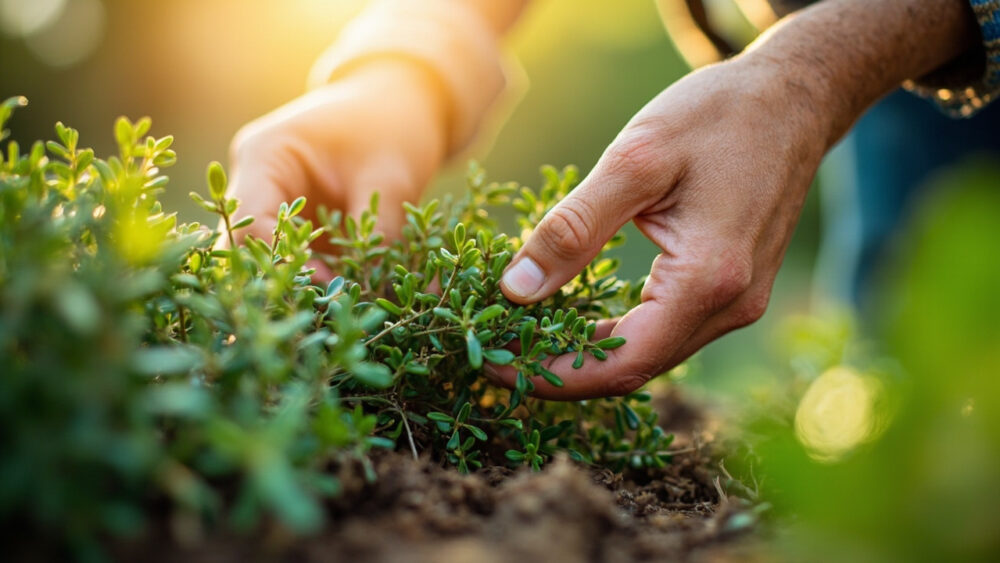
The short answer: harvest thyme just before it flowers, snipping the top third of each stem in the morning after the dew dries. Do that and the plant bushes out instead of going leggy. Wait until it’s in full bloom or hack it back too hard, and you’ve made either a bland harvest or a dead plant, depending on how badly you overdid it.
Most people get one part of this wrong without realizing it. They wait for thyme to “look ready” the way you’d wait on a tomato, but thyme doesn’t ripen. It just gets woodier and less flavorful the longer you leave it, which means the best harvest window is earlier than most gardeners assume.
There’s also a cutting mistake that quietly kills healthy plants over a season or two, a timing detail about time of day that actually changes the oil content in the leaves, and a storage step most people skip that turns a decent harvest into a musty one. Stick around, because the save-able Thyme at a Glance card at the bottom has every number in one place for your phone.
How to Tell Thyme Is Ready to Cut
Thyme is ready any time the plant has at least 4 to 6 inches of growth and looks bushy rather than sparse. Unlike fruit or root crops, there’s no single ripeness moment. You’re reading the plant’s stage of growth, not a countdown.
The stem test
Look at the lower stems. Once they’ve gone woody and brown rather than green and flexible, that portion is past its best flavor.
Harvest from the green, pliable growth above the woody base, never below it.
The bud stage
The single best flavor window is right before flower buds open, when you can see tiny buds forming but they haven’t popped into bloom yet. Essential oil content peaks here.
Once it’s a mistake most people don’t catch is waiting for a visual cue that never really arrives.
The Timing Window, and What Early or Late Costs You
In most climates thyme is ready for a first real harvest 60 to 90 days after transplanting, once the plant is established and actively growing. After that, you can cut every 2 to 3 weeks through the growing season.
Morning is not a suggestion. Cut after the dew has dried but before the heat of the day, ideally mid-morning. Thyme’s essential oils, the source of its flavor and aroma, are highest before the afternoon sun starts to evaporate them off the leaf surface. Cut the same plant at 2pm and you genuinely get a less flavorful harvest, not just a folk belief.
Harvest too early, before the plant has real root and stem structure, and you stunt it. Harvest too late, after it’s flowered heavily and gone woody throughout, and the leaves turn bitter and sparse, with most of the plant’s energy diverted into seed production instead of leafy growth.
Get the calendar window right and the clock still matters more than you’d think.
How to Actually Cut It Without Wrecking the Plant
Use clean scissors or garden snips, not your fingers pinching and tearing, which bruises the stem and invites rot at the cut.
- Identify the woody base: that’s the permanent structure of the plant, and it should never be cut into.
- Cut into the green growth above the woody part, taking the top 5 to 7 inches, or roughly the top third to half of each stem.
- Spread your cuts across the whole plant rather than shearing one side, so it regrows evenly.
- Stop at about one third of the plant’s total green growth in any single harvest during the growing season.
That one-third rule is the mistake that ruins most home thyme patches. Take more than that, especially late in the season, and the plant doesn’t have enough leaf left to photosynthesize its way back before it needs to harden off for winter. Established plants that are two years or older can tolerate a harder cut, down to about half, but a first-year plant needs restraint.
Cut like you’re trimming a hedge that has to survive winter, not like you’re clear-cutting a bed of lettuce.
What to Do in the First Hour After Cutting
Get cut thyme out of direct sun immediately. The same oils that make it flavorful start evaporating the moment the stem is severed, and a hot dashboard or sunny porch step will cook off aroma fast.
Rinse only if needed, and only if you’re not drying it for storage that day. Wet thyme going into a dehydrator or hanging bundle invites mold. If it’s garden-clean, skip the rinse and just shake off any loose soil or debris.
For same-day cooking, a jar of water on the counter like cut flowers keeps stems fresh for several days. For anything you’re not using within the week, move straight to drying or freezing rather than letting it wilt in the fridge drawer.
What you do in the next 24 hours decides whether this harvest tastes like something or tastes like hay.
Curing, Storing, and Keeping the Harvest Coming
To dry, bundle 4 to 6 stems with a rubber band and hang them upside down somewhere dark, dry, and airy for 1 to 2 weeks. Darkness matters more than most people think, since light bleaches out both color and flavor compounds during the slow dry.
You’ll know it’s fully dry when leaves crumble off the stem at a touch rather than bending. Strip the leaves, discard the woody stems, and store in an airtight jar out of direct light. Dried thyme holds good flavor for 6 to 12 months.
Freezing works too, and arguably keeps more of the fresh flavor. Chop leaves into ice cube trays with a little water or olive oil, or freeze whole small sprigs flat on a tray before bagging them.
To keep the plant producing all season, harvest regularly rather than in one big cut. Frequent light trims every 2 to 3 weeks push out new tender growth continuously, which is both better flavor and better for the plant’s long-term shape.
Stop harvesting hard about 4 to 6 weeks before your first fall frost so the plant can harden off, then leave it alone through winter and pick back up once new spring growth is a few inches long.
Thyme at a Glance
- When to first harvest: 60 to 90 days after transplanting, once the plant has bushy, established growth.
- Best time of day: mid-morning, after dew dries and before afternoon heat, for peak oil and flavor.
- Best growth stage: just before flower buds open, not after the plant is in full bloom.
- How much to cut: the top 5 to 7 inches of green stem, never into the woody base, and no more than one third of the plant per cut.
- How often: every 2 to 3 weeks through the growing season for continuous fresh growth.
- Right after cutting: keep it out of direct sun, skip rinsing if it’s clean and you’re drying it, and process within a day.
- Storage: air-dry hung in a dark, airy spot for 1 to 2 weeks, or freeze in oil or water, for flavor that holds 6 to 12 months.
Cut a little, often, before the flowers open, and thyme will keep feeding you all season.
Skip only one rule if you have to: never cut into the woody base.