Bougainvillea grows best planted in late spring after nighttime temperatures stay above 55°F, in full sun, in soil that drains fast and stays on the lean side. Give it six to eight hours of direct sun a day, water deeply but rarely, and resist the urge to feed it heavily, and you will get the papery, neon-bright bloom clusters this vine is grown for. Get any one of those wrong and you get a green, leafy vine that refuses to flower, which is the single most common complaint people have about this plant.
That leafy-no-bloom problem is the mistake that ruins most attempts, and it is almost never disease. It is almost always kindness: too much water, too much fertilizer, or a pot too big, all of which tell the plant it is safe to just grow leaves instead of bloom.
There is also a sign most people misread as pest damage or disease, and a stress response that actually helps the plant instead of hurting it. Stick around, because the save-able Bougainvillea at a Glance card at the bottom covers everything above in one glance for your next trip to the nursery.
When to Plant Bougainvillea
Wait until nights hold above 55°F and there is no frost risk left in your forecast. Bougainvillea is tropical at heart and a single freeze can kill a young plant outright, so timing is not a suggestion, it is survival.
In USDA zones 9 through 11, that usually lands anywhere from mid spring to early summer. Below zone 9, plan on growing it in a container you can bring indoors or into a garage before the first frost, since it will not survive winter in the ground.
Soil temperature matters almost as much as air temperature. If the soil feels cold to the wrist an inch or two down, the roots will sit and sulk instead of establishing, so give it a few extra warm weeks if you are borderline.
Get the timing right and the next decision, where you actually put it, does most of the remaining work for you.
Choosing the Spot and Prepping the Soil
Full sun is non-negotiable. Six hours minimum, eight is better. A bougainvillea in partial shade will survive for years and bloom for almost none of them, producing mostly vine and disappointment.
Pick a spot with sharp drainage. If you dig a hole and it fills with standing water after a hard rain, that spot will rot bougainvillea roots no matter how sunny it is. Raised beds, slopes, and containers all solve this if your native soil is heavy clay.
Skip rich, amended garden soil. Bougainvillea actually blooms better in soil that is a little poor and sandy than in soil loaded with organic matter, because lean soil pushes the plant toward flowering instead of leaf growth.
If you are working with clay, mix in coarse sand or fine gravel rather than compost, and consider a raised mound six to eight inches high so water moves through instead of pooling at the roots.
Once the spot is picked and the drainage is sorted, planting itself is quick, but the technique matters more than people expect.
Planting Bougainvillea Step by Step
1. Handle the root ball gently
Bougainvillea roots hate disturbance more than almost anything else you will plant this season. Water the nursery pot the day before so the root ball slides out clean, and avoid breaking it apart or aggressively teasing the roots the way you might with a tomato seedling.
2. Dig the hole right
Dig a hole twice as wide as the root ball but no deeper than it. Planting too deep, or piling soil against the woody base, invites stem rot.
3. Set it at the same depth
The top of the root ball should sit level with or very slightly above the surrounding soil, never below it.
4. Space for the mature size
Give shrub types 4 to 6 feet between plants and vining types trained on a trellis or wall 6 to 10 feet, since a mature bougainvillea sprawls far wider than the nursery pot suggests.
5. Backfill and water once, deeply
Backfill with the same lean soil you dug out, firm it gently, and water it in slowly until the area is saturated once. Do not fertilize at planting time, the roots need to establish first, not push new growth.
That first deep watering is also the last time you should water heavily for a while, and here is why that matters more than it sounds.
Watering and Feeding Through the Season
If you assumed more water and more fertilizer mean more flowers, that assumption is exactly what produces a bloomless bougainvillea. This plant flowers hardest when it is mildly stressed for water and kept lean on nitrogen.
Water new plants two to three times a week for the first month to establish roots, then taper off. Once established, water deeply only when the top 2 to 3 inches of soil are dry to the touch, which in warm weather might mean once a week, sometimes less.
Container plants dry out faster and need closer attention, sometimes water every few days in peak summer heat, but always let the surface dry between waterings.
Feed with a bloom-boosting fertilizer low in nitrogen and higher in phosphorus and potassium, applied every four to six weeks during the growing season. Skip nitrogen-heavy general fertilizers entirely, they build leaves at the expense of blooms.
Mild drought stress right before and during bud formation is actually the trick experienced growers use on purpose, letting the soil go properly dry for a few extra days to trigger a flush of color.
Get the water and food dialed back and most of your remaining problems solve themselves, but a few will still show up.
Problems That Actually Strike Bougainvillea
The sign most people misread is leaf and bract drop after a move, repotting, or a cold night, and it is not disease, it is a stress reflex. Bougainvillea drops leaves readily when unsettled and regrows them once conditions stabilize, so give it two to three weeks before assuming the worst.
Aphids and mealybugs are the most common actual pests, showing up as sticky residue or small clustered bugs on new growth and buds. Treat with insecticidal soap or a labeled horticultural oil, following the product label exactly, and check weekly during warm months.
Root rot from overwatering or poor drainage is the most serious threat and shows up as yellowing leaves, mushy stem tissue near the soil line, and a general decline that no amount of extra water fixes. Once rot reaches the main stem, recovery is unlikely and starting a new plant is usually faster than saving the old one.
Powdery mildew and fungal leaf spot can appear in humid, poorly ventilated spots, treated by improving air circulation and, if needed, a fungicide labeled for ornamental shrubs, applied per the label.
Bougainvillea’s thorns are sharp enough to draw blood, so wear gloves when pruning or training it, and keep in mind the plant is considered toxic to pets and mildly irritating to people if sap contacts skin or eyes; if a pet eats a meaningful amount, call your veterinarian rather than waiting to see what happens.
Once pests and rot are ruled out, the only question left is when you actually get to enjoy the payoff.
When Bougainvillea Blooms
Established bougainvillea blooms in flushes through the warm season, typically starting 8 to 12 weeks after a stress cue like a dry spell or a seasonal day-length shift, and continuing as long as heat and sun hold. In warm zones that can mean nearly year-round color with rest periods in between.
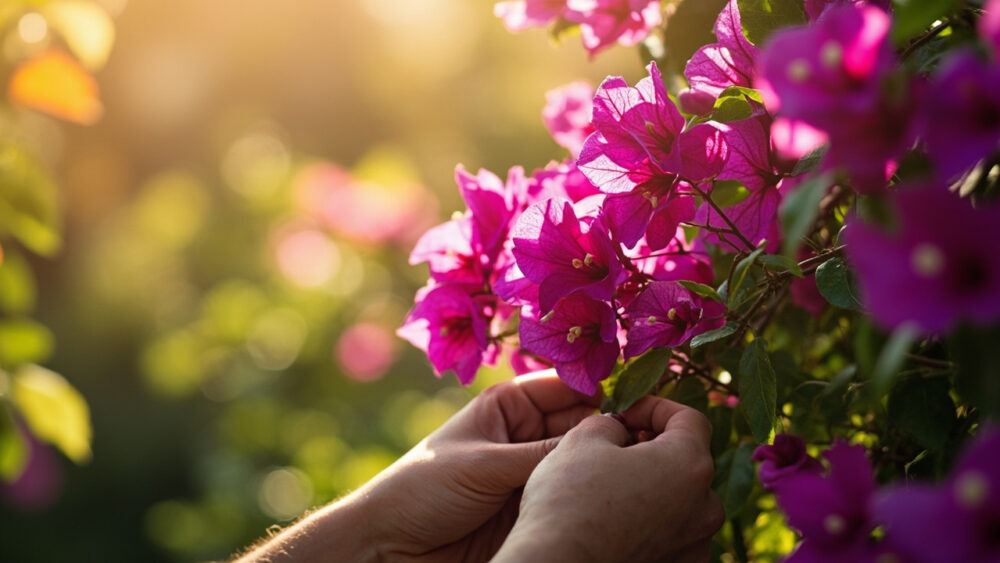
What you are seeing is not petals. The true flowers are the tiny white or yellow centers, and the vivid pink, orange, red, or purple parts are papery bracts, which is why the color holds so long after a real flower would have faded.
A first-year plant may only produce a modest show while it establishes roots. Don’t force it with extra fertilizer, an established root system is what produces the heavy bloom flushes gardeners expect by year two or three.
Prune spent bloom clusters and any leggy growth after a flush fades, which encourages the next round rather than letting the plant coast on old growth.
That rhythm of bloom, rest, and light pruning is basically the entire care routine for a mature plant, and everything else below is just the short version to keep on hand.
Bougainvillea at a Glance
- When to plant: after nights stay above 55°F with no frost risk, mid spring to early summer in zones 9 to 11, container-grown and brought indoors below that.
- Sun and soil: six to eight hours of direct sun, lean and fast-draining soil, avoid rich compost-heavy beds.
- Spacing and depth: plant at the same depth as the nursery pot, 4 to 6 feet apart for shrub types, 6 to 10 feet for trained vines.
- Watering: deep and frequent only while establishing, then only when the top 2 to 3 inches of soil are dry, less is more once mature.
- Feeding: low-nitrogen, bloom-boosting fertilizer every four to six weeks, skip nitrogen-heavy feeds entirely.
- Watch for: aphids and mealybugs on new growth, root rot from overwatering, leaf drop after stress that regrows on its own.
- Bloom timing: flushes through the warm season, often within 8 to 12 weeks of a dry-spell or day-length trigger, heaviest in year two and beyond.
The whole plant runs on one simple trade: less water, less fertilizer, more sun, more flowers.
Get that trade right and bougainvillea takes care of the rest itself.