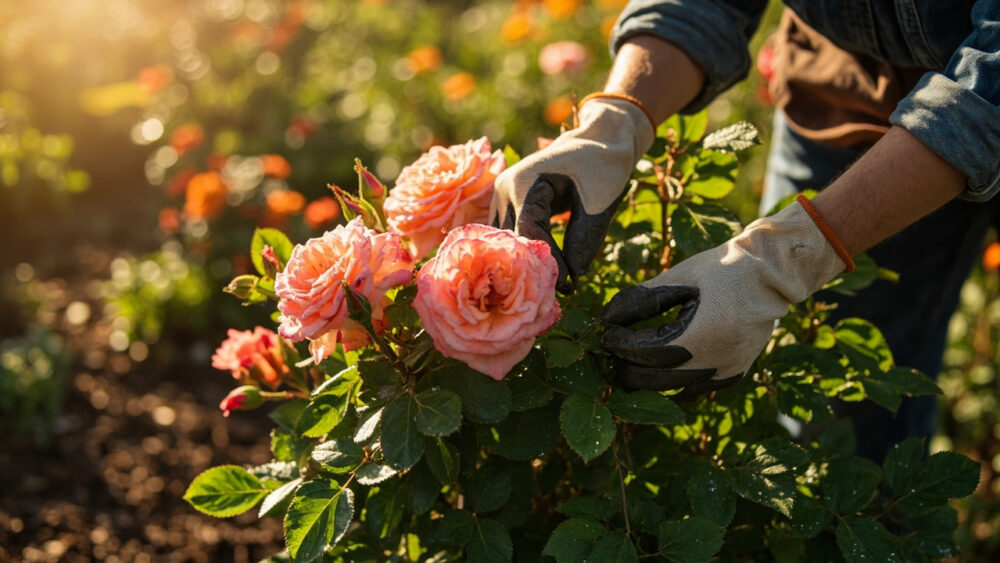
Drift roses care comes down to five things: full sun, well-drained soil, deep weekly watering, a hard late-winter pruning down to 12 to 18 inches, and almost nothing else. They are bred to be low-maintenance groundcover roses, and if you are babying one like a hybrid tea, you are working harder than the plant needs you to.
Most people who kill a drift rose do it in the first month, and it is almost never watering. It is planting depth or drainage, and I will show you exactly what to check.
There is also a bloom myth that trips up even experienced gardeners, and a pruning fear that keeps people from cutting these back hard enough to actually perform. Stick around, because the save-able Drift Roses at a Glance card at the bottom has the exact numbers for spacing, feeding, and pruning you will want pulled up on your phone this weekend.
Light, Placement, and Temperature
Drift roses want full sunsix hours minimum, and they bloom harder with eight or more. In hot climates (zone 8 and up) a little afternoon shade prevents scorched petals, but do not tuck them under trees or eaves chasing that shade. Filtered light all day gives you a leggy plant with three flowers on it.
They are hardy roughly zones 4 through 11 depending on the variety, and they take heat far better than they take deep shade. Good airflow matters as much as sun; cramming one against a fence or between shrubs invites the fungal problems we will get to later.
Placement fixes more problems than any product you could buy.
Planting Depth, Spacing, and the Mistake That Ruins Most Attempts
Here is the mistake: planting too deep or in a low spot that holds water. Drift roses are own-root plants, not grafted, so there is no bud union to worry about, but their crowns still rot if they sit wet. Plant so the top of the root ball is level with, or very slightly above, the surrounding soil, never below it.
Spacing runs 18 to 24 inches apart for a solid groundcover hedge, or 2 to 3 feet if you want each plant to keep its own rounded shape. Dig the hole twice as wide as the root ball but no deeper, and backfill with the native soil loosened up, not pure compost, which can create a bathtub effect that traps water around the roots.
Water deeply right after planting to settle the soil and knock out air pockets.
Get the hole right and watering becomes almost foolproof, which is the next thing to nail down.
Watering: How Much, How Often, and How to Tell
New plants need water two to three times a week for the first month while roots establish. After that, established drift roses want about 1 inch of water a week, delivered in one or two deep soakings rather than daily sprinkles.
Check the soilnot the calendar. Push a finger 2 inches down; if it is dry, water. If it is still moist, wait a day and check again. In containers, water when the top inch is dry, which in summer heat can mean every day.
Shallow, frequent watering trains roots to stay near the surface, where they dry out fast and struggle in heat. Deep, less frequent watering builds the root system that gets a drift rose through August without drama.
Water at the base, not overhead, since wet foliage overnight is an open invitation to fungal disease.
Soil, Potting Mix, and Feeding
Drift roses want soil that drains well but still holds some moisture, roughly the texture of a good garden loam. If your soil is heavy clay, work in compost across the whole bed, not just the planting hole, or the roots will stay trapped in a soggy pocket. In containers, use a quality potting mix with some added perlite or bark for drainage, in a pot at least 12 to 16 inches across.
Feeding starts once new growth appears in spring. A granular rose fertilizer or a balanced slow-release feed every 6 to 8 weeks through the growing season keeps blooms coming. Stop feeding 6 to 8 weeks before your first fall frost so the plant hardens off instead of pushing tender new growth into cold weather.
Overfeeding gives you soft, floppy growth and fewer flowers, so more is not better here.
Feeding gets the flowers going, but pruning is what actually controls how many you get.
Pruning, and the Fear That Costs You Blooms
Here is the guess almost everyone makes: that cutting a rose back hard will hurt it. With drift roses, the opposite is true. They bloom on new growth, so a hard prune is what triggers the next big flush.
In late winter or very early spring, once the worst frost danger has passed but before new leaves push hard, cut the whole plant back to 12 to 18 inches tall. Use clean, sharp bypass pruners and remove any dead, crossing, or blackened canes entirely. This looks brutal and feels wrong the first time you do it. It is exactly right.
Through the season, deadheading spent blooms encourages faster rebloom, though drift roses are also fairly self-cleaning and will keep flowering even if you skip it. A light shape-up trim after the first big flush can push a second wave.
Repotting container plants every 2 to 3 years, sizing up one pot size, keeps roots from getting crowded and bloom count from dropping off.
Pruned right, a drift rose rewards you fast, but only if you dodge the handful of problems that actually show up.
Problems Most Likely to Strike, and the Real Fixes
The good news: drift roses are bred for strong disease resistance and rarely get hit as hard as older rose types. But they are not immune.
- Black spot: dark spots with yellowing leaves that drop, worse in humid, still air. Improve airflow, water at the base, and remove fallen infected leaves. A fungicide labeled for roses can help if you catch it early, applied exactly per the label.
- Powdery mildew: a white, dusty coating on leaves and buds, common when nights are cool and days are warm. Prune for airflow and avoid overhead watering.
- Aphids: clusters of small soft-bodied insects on new buds and stems. A strong water spray or insecticidal soap knocks them back in most cases.
- Japanese beetles: chewed, skeletonized leaves and flowers in mid-summer. Hand-pick into soapy water in the morning when they are sluggish.
None of this means the plant is toxic to worry about around pets in a serious way. Roses are generally considered non-toxic to dogs and cats, though the thorns can cause physical injury and eating a large amount of plant material can upset a stomach. If a pet seems ill after chewing on one, call your veterinarian rather than guessing.
Catch these early and a drift rose shrugs them off within a couple of weeks.
How to Tell It Is Genuinely Thriving
A thriving drift rose pushes new reddish growth at the tips within a few weeks of its hard spring prune. Leaves should be a deep, even green with no yellowing between the veins.
Bloom pattern is your best gauge. Expect a strong flush in late spring, a rest, then repeat flushes every 5 to 6 weeks through summer into fall. If flowering stalls completely for months, suspect too much shade, overfeeding, or a pot that has gotten root-bound.
Canes should feel firm and green under the outer bark when scratched lightly with a thumbnail, not brown and brittle.
That is the whole plant, in front of you, telling you it is happy, and now here is everything worth saving in one place.
Drift Roses at a Glance
- When to plant: spring after your last frost, or in fall at least 6 weeks before your first hard freeze.
- Light needed: full sun, 6 hours minimum, 8 or more for the heaviest bloom.
- Spacing: 18 to 24 inches for a solid groundcover, 2 to 3 feet for individual shape.
- Watering: 2 to 3 times weekly while establishing, then about 1 inch weekly, checked by feel 2 inches down.
- Feeding: balanced or rose-specific fertilizer every 6 to 8 weeks in the growing season, stopped 6 to 8 weeks before first frost.
- Pruning: cut back hard to 12 to 18 inches in late winter or early spring for the biggest flush.
- Hardiness: roughly USDA zones 4 through 11 depending on variety.
Get the planting depth and the hard spring prune right, and everything else about drift roses takes care of itself.
They are one of the most forgiving roses you can grow, as long as you trust the cutting-back part.