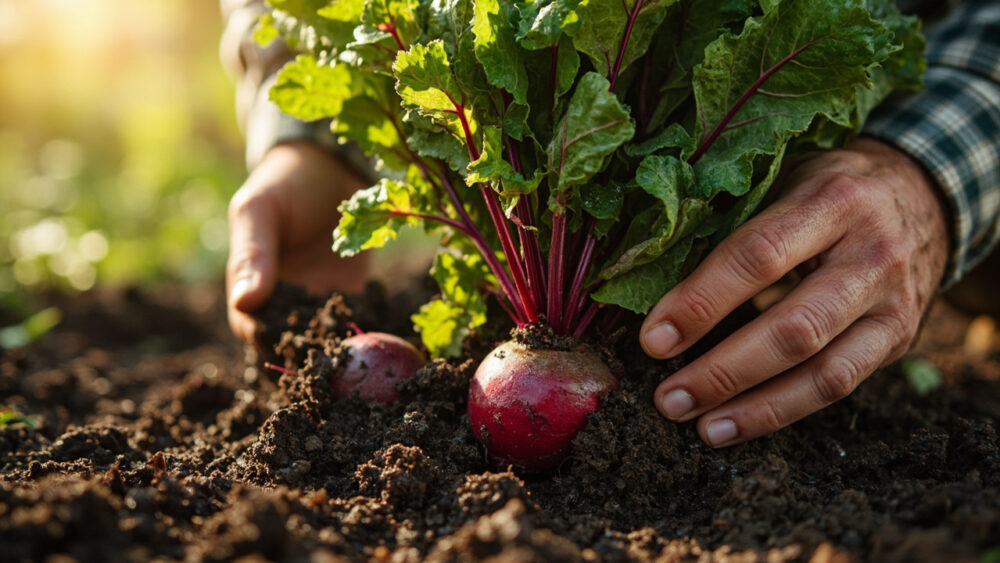
Beets move through five clear stages between seed and harvest: germination (5 to 14 days), the seedling stage with its first true leaves (weeks 2 to 3), leafy vegetative growth as the root starts swelling underground (weeks 3 to 7), root bulking where most of the size and flavor develop (weeks 7 to 9), and maturity, when the shoulders push up out of the soil and it’s time to pull. The whole trip from seed to plate runs about 50 to 70 days depending on the variety and how warm your soil is.
Most beet failures trace back to one stage that everybody rushes past without a second look, and it isn’t the one gardeners worry about.
There’s also a sign at the root-bulking stage that looks like trouble but usually isn’t, and a stall that looks fine on top but means an empty root below. Stick around and you’ll get the full beets growing stages breakdown plus a save-it-to-your-phone chart at the bottom with spacing, depth, and timing in one place.
Germination: Days 1 to 14
Beet seeds are actually small clusters, which is why you often get two or three seedlings sprouting from one spot. Soil needs to be at least 50°F to germinate at all, but 60 to 85°F gets you sprouts in a week instead of two.
Plant seeds a half inch to one inch deep, about 1 inch apart, in rows 12 to 18 inches apart. Keep the soil surface consistently damp. This is the stage most people botch, and not for the reason you’d think.
The mistake isn’t planting too deep. It’s letting the top half inch of soil crust over and dry out between waterings, which beet seeds cannot punch through.
Check the soil with a finger daily until you see green, because germination is where most beet attempts quietly end before they ever really start.
Seedling Stage: Weeks 2 to 3
Once sprouted, you’ll see a pair of rounded seed leaves followed by the first true leaves, which look more like miniature chard leaves with reddish veins. The plant is small, fragile, and easy to overlook next to faster crops.
This is thinning time, and it’s non-negotiable. Because beet seeds sprout in clusters, you’ll almost always have two or three seedlings crowded together.
Snip (don’t pull, to avoid disturbing neighboring roots) the weaker ones so you end up with one seedling every 3 to 4 inches. Skip this and you’ll get a cluster of skinny, misshapen roots fighting each other for space instead of one good beet.
Thin now, because the plant you leave behind is the only one that gets to become dinner.
Leafy Growth and Early Root Formation: Weeks 3 to 7
The top growth takes off here. Leaves get bigger, the color deepens, and if you gently brush soil away at the base you’ll notice the crown starting to thicken, a small pale bump where the root will form.
This is the stage everyone assumes is just about leaves, but it’s actually where the root’s final size gets decided. Beets need steady, even moisture through this window, roughly 1 inch of water a week between rain and irrigation.
Inconsistent watering here, wet then bone dry then wet again, is what produces woody, cracked, or oddly shaped roots later, even though the damage doesn’t show up until harvest. Side-dress lightly with a balanced fertilizer once leaves are 4 to 5 inches tall, but go easy on nitrogen, since too much gives you gorgeous greens and a disappointing little root.
The root is quietly deciding its future right now, weeks before you’ll see any proof of it above ground.
Root Bulking: Weeks 7 to 9
This is the payoff stage. The root swells noticeably, and you’ll start to see the shoulder of the beet, the top curve of the root, pushing up at the soil surface.
If you assumed a beet shoulder poking above ground means something’s wrong, that’s the guess that makes people yank beets weeks too early. It’s normal. Beets grow with their crown at or slightly above soil level, unlike carrots or parsnips, which stay buried.
What actually signals trouble at this stage is a shoulder that looks cracked, split, or has gone corky and tough. That usually means an uneven watering swing, often a dry spell followed by a heavy soak.
Keep moisture steady, keep weeds pulled so they’re not stealing water and nutrients, and resist judging size by what you see, since a good third of the root is still below the surface.
A visible shoulder is progress, not a problem, and that’s exactly when the countdown to harvest really starts.
How to Tell Healthy Progress From a Stall
Healthy beets show a slow, steady increase in shoulder width week over week, leaves that stay upright and deep green, and new leaf growth continuing from the center. A stalled beet keeps its leaves but the root barely changes size for two or three weeks straight.
Stalling is almost always heat stress (beets sulk above 85°F consistently), nutrient-poor soil, or overcrowding that never got corrected. Pull one test beet if you’re unsure. A stalled root often looks fine but tastes woody and bland, a sign it never got the steady conditions it needed.
Catching a stall early still gives you time to water more consistently and mulch to cool the soil, but a beet stalled for a month rarely catches up fully.
Know what a stall looks like now, because the next stage moves fast once conditions are right.
Maturity and Harvest: Weeks 8 to 10 (Varies by Variety)
Most beet varieties are ready when the shoulders are 1.5 to 3 inches across, though you can pull them smaller for tender baby beets any time after about 6 weeks. Check by gently brushing soil away and eyeballing the width, not by days on a calendar, since soil temperature swings the timeline by a week or more either direction.
Beets left too long in warm soil get woody, fibrous, and lose sweetness. Beets pulled too early are technically fine, just small.
Harvest by loosening soil with a garden fork rather than yanking by the leaves, which tend to snap off and leave the root stuck. Twist gently as you pull.
That’s the full arc, and here’s the part worth saving before you head back out to the garden.
Beets at a Glance
- When to plant: 2 to 3 weeks before your last frost, once soil hits at least 50°F, and again in late summer for a fall crop in most zones.
- Depth and spacing: plant seeds a half inch to 1 inch deep, thin seedlings to 3 to 4 inches apart, with rows 12 to 18 inches apart.
- Germination time: 5 to 14 days depending on soil temperature, faster above 60°F.
- Water needs: about 1 inch per week, kept as steady as possible, since swings between dry and soaked cause cracked or woody roots.
- Days to maturity: 50 to 70 days from seed, or as early as 6 weeks for baby beets.
- Harvest sign: shoulders visible at the soil surface, 1.5 to 3 inches wide, loosened with a fork rather than pulled by the leaves.
- Biggest risk stage: germination, where a crusted, dry soil surface stops seeds cold before they ever sprout.
If you remember one thing, remember this: beets are decided underground long before you see proof of it above.
Keep the water steady from seedling to harvest, and the rest mostly takes care of itself.