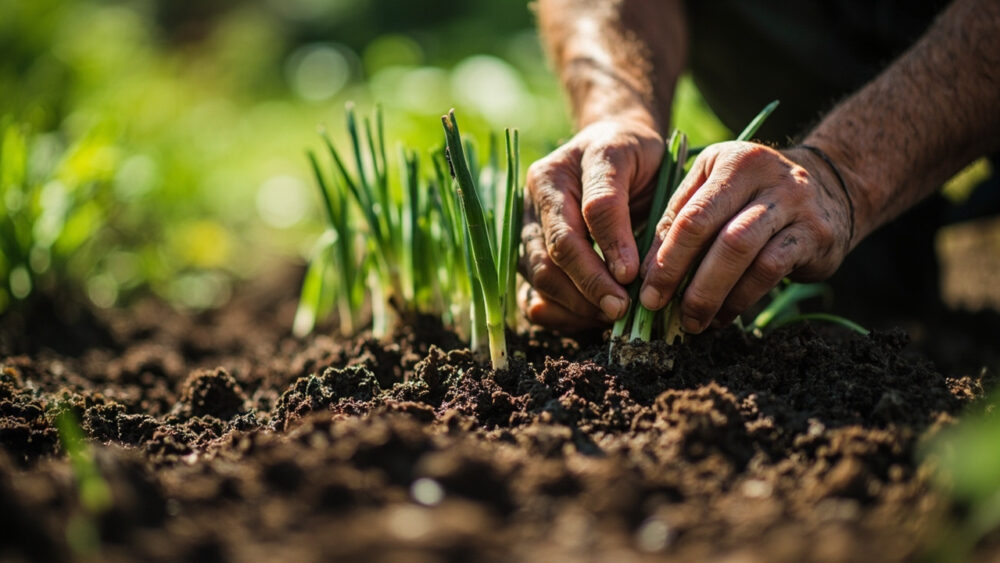
Growing onions from seed means starting indoors eight to ten weeks before your last frost, since onions need a long, slow season to bulk up before they’re ready to bulb. You sow the seed a quarter inch deep in a seed tray, keep it around 65 to 75 F until it sprouts, then grow it under strong light for two months before it ever sees the garden. It sounds simple, and the sowing part is. The part that trips people up happens months later, and it has nothing to do with watering or fertilizer.
Here’s the mistake that ruins most home-grown onion crops: the seedlings look fine, the transplant goes fine, and then in midsummer the bulbs stay small no matter what you do. That’s almost never a soil problem. It’s a daylight problem, and most people never figure out why until the season’s already over.
There’s also a sign at the top of the plant that tells you exactly when to stop watering and start curing, and most gardeners either miss it or panic when they see it. Stick with me through each stage and I’ll flag it when it happens. The complete rundown, spacing, depth, timing, all of it, is saved in the “Onions at a Glance” card at the very bottom, so you can screenshot it before you head out to the garden.
When to Start Onion Seeds
Onions are one of the few garden vegetables where starting indoors isn’t optional if you want full-size bulbs. Count back eight to ten weeks from your average last frost date and that’s your sowing window. In most of the US that lands somewhere in late winter, January in warmer zones, February or even early March further north.
Direct sowing outdoors works only in mild-winter regions, zones 8 and up, where you can sow in fall or very early spring and let onions grow through a cool season without ever hitting a hard freeze while young. Everywhere else, direct-sown onion seed just doesn’t have enough season length to bulk up before summer heat and daylight shift trigger bulbing.
If you missed the indoor window, onion sets or transplants are the honest backup plan, not seed.
Sowing Onion Seed, Step by Step
The process itself is straightforward once you know the four things onions actually care about: depth, medium, temperature, and light.
Depth and medium
Sow seed about a quarter inch deep in a light, well-draining seed-starting mix, not garden soil. Onions can be sown thickly, a half inch apart or even touching, since you’ll thin or separate them later. A shallow flat or cell tray both work fine.
Temperature
Keep the tray around 65 to 75 F until germination. A seedling heat mat helps a lot if your house runs cool. Once seedlings are up, they actually prefer it a little cooler, 60 to 65 F, to grow stocky instead of leggy.
Light
This is where most indoor onion starts fail quietly. A sunny windowsill is not enough light. Onion seedlings need 14 to 16 hours a day under a strong grow light kept just a couple inches above the leaf tips, raised as they grow. Without it, they flop over and never recover their strength.
Get the light right and germination is almost the easy part.
Germination: What’s Normal and When to Worry
Onion seed germinates in 7 to 14 days at the right temperature, sometimes up to three weeks if your space runs cool. The first sign is a thin, grass-like green loop pushing through the surface. That loop straightens up over a day or two.
If nothing’s shown by three weeks, the seed was likely too old. Onion seed loses viability fast, often within a year or two of purchase, so always check the date on the packet before you blame your technique.
A common early scare is a seedling that comes up with the old seed husk still stuck to its tip. Leave it alone. It usually drops off on its own within a few days, and pulling at it can snap the seedling.
Once your seedlings are a few inches tall and grassy-looking, they’ll actually look like a scruffy patch of chives, which is normal and not a sign anything’s wrong.
Hardening Off and Transplanting
About one to two weeks before your last frost, start hardening off. Set the tray outside in a sheltered, shaded spot for an hour or two the first day, adding more time and sun exposure daily over a week to ten days. Onions tolerate cool weather well and can handle a light frost once hardened, but skipping this step invites transplant shock that stalls growth for weeks.
Transplant into the garden a couple weeks before your last frost date, once seedlings are pencil-thick, about 3 to 5 inches tall.
Trim the tops back to about 3 inches before planting if they’ve flopped over; it reduces transplant stress and makes them easier to handle.
Plant about 1 inch deep, 4 to 6 inches apart, in rows spaced 12 to 18 inches. Firm the soil gently around the roots so they’re not left in an air pocket.
Get spacing right here and you avoid the second most common onion mistake of the whole season.
Season-Long Care
Onions have shallow roots, so they need consistent moisture, about 1 inch of water a week including rain, right up until a few weeks before harvest. Let the top inch of soil dry between waterings, but don’t let the bed go bone dry for long stretches.
Weeds are the real threat here, more than pests most seasons. Onions don’t compete well with weeds because of that shallow root system, so keep beds weeded by hand or with a shallow hoe, and mulch lightly to suppress regrowth.
Feed with a nitrogen-rich fertilizer every few weeks through early summer to build leaf mass, since more leaves generally means a bigger bulb later. Stop nitrogen once bulbs start swelling and pushing the soil surface apart, usually by midsummer, and let the plant shift its energy into the bulb instead of the tops.
Now here’s that daylight issue I mentioned earlier.
The Daylight Trap Nobody Warns You About
Onions bulb in response to day length, not the calendar and not soil fertility. Varieties are bred as short-day, intermediate-day, or long-day types, and planting the wrong type for your latitude is the single biggest reason home-grown onions stay small no matter how well you cared for them.
Short-day types need about 10 to 12 hours of daylight to trigger bulbing and suit southern growers, roughly zones 7 and warmer. Long-day types need 14 to 16 hours and suit northern growers, zones 6 and colder. Intermediate types split the difference and work across a middle band of the country.
If you grew a short-day variety far north, or a long-day variety far south, the plant simply never gets the trigger it needs and bulbs stay undersized even in perfect soil. Check the seed packet for the day-length type before you ever sow, not after a disappointing harvest.
Get the right type for your latitude and the rest of the season mostly takes care of itself.
Signs of Harvest, and the Warning Everyone Misreads
Onions tell you they’re done in a way that looks alarming if you don’t know what it means: the tops flop over and fall to the ground on their own, usually in mid to late summer. That’s not disease and it’s not a sign of stress. It’s the plant finishing its job.
Once 50 to 75 percent of the tops have fallen over, stop watering and let the soil dry out. Within a week or two, gently pull or lift the bulbs with a garden fork.
Cure them somewhere warm, dry, and shaded with good airflow, a covered porch or garage works well, for two to three weeks until the outer skins are papery and the necks are fully dry. Skipping the cure is the reason many home-grown onions rot in storage within weeks instead of lasting months.
Once cured, trim the tops to an inch or two and store in a cool, dry, well-ventilated spot.
That’s the full arc from seed tray to storage basket, and now here’s the card worth saving before you head outside.
Onions at a Glance
- When to start seed: eight to ten weeks before your last frost date, indoors under strong light.
- Sowing depth: about a quarter inch deep in a light seed-starting mix, kept at 65 to 75 F to germinate.
- Germination time: 7 to 14 days typically, up to three weeks in cooler conditions.
- Transplanting: a couple weeks before last frost, once seedlings are pencil-thick, 3 to 5 inches tall.
- Spacing: 1 inch deep, 4 to 6 inches apart, rows 12 to 18 inches apart.
- Day-length type: match short-day, intermediate, or long-day varieties to your latitude, this decides bulb size more than anything else.
- Harvest signal: tops flop over on their own in mid to late summer, then stop watering and cure bulbs two to three weeks before storage.
If you remember one thing from all of this, remember the day-length type on the seed packet.
Everything else about growing onions from seed is patience and consistency, but that one detail decides whether you get a bulb or a scallion.