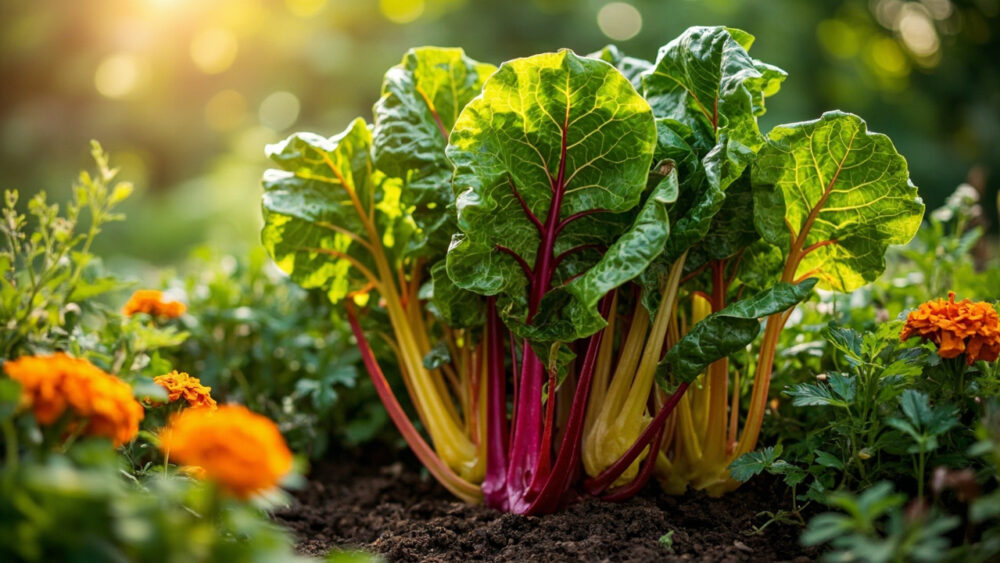
The best companion plants for swiss chard are bush beans, onions and garlic, and low-growing herbs like dill and cilantro, because they fix nitrogen chard needs, confuse the leaf miners and aphids that go after chard, or use space chard leaves entirely without competing for it. Avoid planting chard near other beets and spinach, which pull the same soil nutrients and invite the same leaf miners into a crowded bed. That’s the short answer, but there’s more worth knowing before you start digging.
Most people planting a chard bed make one specific spacing mistake that does not show up until six weeks in, when the leaves stop growing and the whole row looks stunted. There is also a companion pairing that gardening lore repeats constantly, and it does not actually hold up once you look at what each plant is competing for underground.
Stick around for the Swiss Chard at a Glance card at the bottom, it’s the save-to-your-phone version of everything below: spacing, timing, soil, and the exact companions in one list.
Why Companion Planting Matters More for Chard Than You’d Think
Chard is not a fussy plant. It tolerates heat, cold snaps down to the mid 20s F once established, and mediocre soil better than most greens.
Its real vulnerabilities are leaf miners, aphids, and nutrient competition, since chard is a heavy feeder that pulls nitrogen and potassium hard for months of continuous cutting. Good companions solve one of those three problems. Bad ones make all three worse at once.
Here’s exactly which plants earn a spot next to your chard, and why each one works.
The Best Companions for Swiss Chard
Bush Beans
Beans fix nitrogen in the soil through bacteria on their roots, which directly feeds chard’s appetite for nitrogen over a long harvest season. Plant bush beans 4 to 6 inches from chard, since pole beans get tall enough to shade chard more than it wants.
Beans also do not compete for the same soil layer chard’s shallow roots use.
That’s one problem solved, but pest pressure is the bigger one for most chard growers.
Onions, Garlic, and Chives
The sulfur compounds in alliums mask the scent chard gives off, which is what leaf miners and aphids actually navigate by. Tuck onion sets or garlic cloves in the gaps between chard plants, about 4 inches out from the base.
They take up almost no lateral root space, so you are not sacrificing chard’s growing room to get the pest confusion benefit.
This is the single most efficient companion pairing for a small bed, since it solves your worst chard pest problem for free.
Next up is the pairing that surprises people: herbs that do double duty as pest control and dinner.
Dill, Cilantro, and Other Umbellifers
These herbs, once they flower, attract predatory wasps and hoverflies that hunt aphids and leaf miner larvae. Let a few plants bolt to flower on purpose rather than cutting them back for kitchen use.
Plant them 8 to 10 inches from chard so their taproots and chard’s roots are not fighting in the same six inches of soil.
You get a pollinator draw, pest control, and an herb harvest from a few square feet.
Now for the plants that will quietly wreck a chard bed if you put them in the wrong spot.
What to Never Plant Next to Swiss Chard
Beets and Spinach
Chard, beets, and spinach are all in the same botanical family, and they draw on the same nutrients at the same depth in the soil. Plant them together and you get three crops competing hard for nitrogen and boron, with the weakest plants stunting first.
Worse, they share the same pests and diseases, so a leaf miner or a case of cercospora leaf spot moves through all three like they’re one plant. If you already planted beets nearby, don’t panic and rip everything out. Just watch nitrogen levels closely and consider a light side dressing of compost or blood meal partway through the season.
The fix isn’t complicated, but the layout question is where most beds actually go wrong.
Laying Out the Bed So Nothing Fights for Root Space
Space chard plants 8 to 12 inches apart in rows 18 inches apart, and resist the urge to crowd them tighter even when the seedlings look tiny. Chard’s mature root system spreads wider than the leaves suggest, and packed rows are the number one reason chard stalls out at half its normal size.
Put nitrogen fixers like bush beans on the north or windward side of the bed so they don’t shade chard during the hottest part of the day, and tuck alliums into the border rather than mixing them through the center rows where they’ll compete for the same digging space at harvest time.
Give chard the center of the bed and let the companions work the edges.
The Companion Myth That Does Not Hold Up
If you’ve read that chard and lettuce make great neighbors because they’re both leafy greens with similar care needs, that’s the guess almost everyone makes, and it’s backwards. Lettuce and chard actually compete hard for the same shallow moisture and light in the top few inches of soil, and lettuce’s fast, shallow roots often win early, leaving chard’s slower start stunted before it gets going.
Similar care needs is exactly why two plants often make bad neighbors, not good ones, since they’re drawing on the identical resource at the identical time. If you want a leafy companion, pick one with a different growth habit and root depth, like a bush bean or a bulb allium, rather than another shallow-rooted green.
Match plants by what they need, not by how much they resemble each other.
Swiss Chard at a Glance
- When to plant: two to three weeks before your last spring frost, once soil hits about 50 F, or again six to eight weeks before your first fall frost for a cool season crop.
- Spacing: 8 to 12 inches between plants, 18 inches between rows, thinned once seedlings show their second set of true leaves.
- Depth: sow seeds about half an inch deep in loose, moist soil.
- Best companions: bush beans, onions, garlic, chives, and umbellifer herbs like dill and cilantro left to flower.
- Never plant nearby: beets, spinach, or other same-family greens that compete for nitrogen and share leaf miner and leaf spot pressure.
- Feeding: chard is a heavy nitrogen feeder over a long harvest, so side dress with compost or a balanced organic fertilizer every four to six weeks once cutting begins.
- Watch for: leaf miners leaving tunnels in leaves and aphid clusters on new growth, both eased by allium neighbors and predatory insects drawn in by flowering herbs.
Get the spacing and the alliums right and most chard problems never show up at all.
Everything else on this list is just fine-tuning around that one decision.