Growing figs from seed means soaking the seeds, sowing them a quarter inch deep in warm, moist seed mix, and waiting anywhere from two to eight weeks for germination, then settling in for a long haul. You are looking at three to five years before you see any fruit, and here is the part nobody tells you upfront: the fig you grow won’t match the parent. Fig seedlings are genetic wildcards, so that sweet Brown Turkey or Celeste you got the seeds from could give you something bland, seedy, or barely worth the counter space.
That is not a reason to skip this. It is a reason to go in with the right expectations, because most people who try this quit somewhere around month two when nothing seems to be happening, or they kill the seedling in week one by doing the one thing that feels helpful but isn’t.
Below, I will walk you through sowing, germination, hardening off, and the long slow season of care that eventually gets you to fruit, plus the honest timeline nobody puts on the seed packet. Stick around to the end for the Figs at a Glance card, the saveable version of everything here you’ll want pulled up on your phone the next time you’re standing over a seed tray wondering if you’ve killed it.
When to Start Fig Seeds
Start fig seeds indoors, not outside, regardless of your climate. Figs need steady warmth to germinate, and outdoor soil almost never holds that consistency in early spring. Sow indoors about 8 to 10 weeks before your last frost date, so the seedlings have real size on them by the time it’s warm enough to move outside.
Direct sowing outdoors works only in true fig country, USDA zones 8 through 11, where soil temperatures sit reliably in the 70s. Even there, indoor starting gives you far better odds. Cold, damp soil is where fig seeds rot before they ever crack.
Timing matters less than warmth here, so don’t panic about hitting an exact week.
Sowing Fig Seeds Step by Step
Fig seeds are tiny, and how you handle these first steps decides most of your success or failure right here.
Step 1: Extract and rinse the seeds
Scoop seeds from a very ripe fig, then rub them in a strainer under running water to remove the pulp. Pulp left on the seed encourages mold in the tray.
Step 2: Soak for 24 hours
Soak the cleaned seeds in room-temperature water for 24 hours. This softens the seed coat and noticeably speeds up germination.
Step 3: Sow shallow
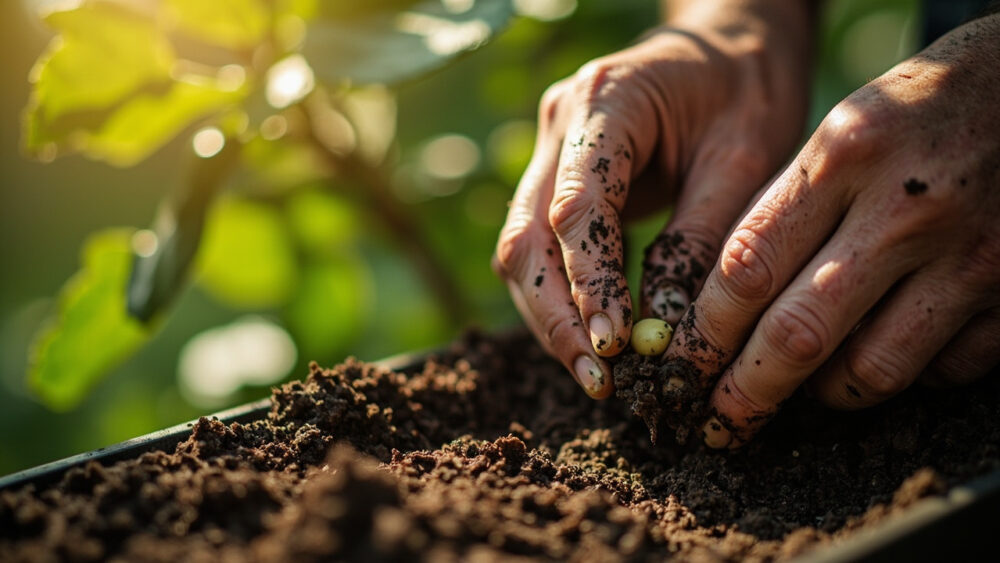
Press seeds into a moist, well-draining seed starting mix, then cover with about a quarter inch of mix, no deeper. Fig seeds are small and don’t have the reserves to push up through heavy soil.
Step 4: Keep it warm and bright
Set the tray somewhere that holds 70 to 80°F, on a seedling heat mat if your house runs cooler. Once seedlings emerge, they need strong light immediately, a sunny south window at minimum, a grow light if you have one.
Get this part right and germination becomes mostly a waiting game.
Germination: What’s Normal and What’s Not
If you assumed fig seeds pop in a week like lettuce or beans, that guess is what sends people to the compost bin too early. Fig germination is genuinely slow and uneven. Expect anywhere from two to eight weeks, sometimes longer, with seeds sprouting in scattered batches rather than all at once.
Keep the mix consistently damp, never soggy, the entire time. A tray that dries out even once during that long wait can kill seeds that were close to sprouting.
Mold on the surface is common and not automatically fatal. Scrape it off, improve airflow, and keep going. What actually signals failure is a tray that’s shown zero movement past the eight to ten week mark with consistent warmth and moisture. At that point, restart with fresh seed.
Patience here is the whole game, and it sets up the next mistake almost everyone makes.
Hardening Off and Transplanting
The mistake that ruins the most seedlings at this stage is moving them outside too fast. Fig seedlings that go straight from a warm windowsill into full sun and wind get scorched or snapped within a day.
Harden off gradually over 7 to 10 days once your seedlings have their second or third set of true leaves and nighttime temperatures are staying above 50°F. Start with an hour or two in dappled shade, add time and sun exposure daily, and bring them in if a cold night threatens.
Transplant into individual pots once seedlings have at least two sets of true leaves, using a well-draining potting mix. Figs hate wet feet, so a pot with real drainage holes is non-negotiable, not a nice-to-have.
Give it that slow transition and you’ve cleared the second-biggest failure point after germination.
Growing Figs Through the Season
Once established, fig seedlings are forgiving compared to a lot of fruit trees, but they still have real needs. Water when the top inch of soil feels dry, not on a fixed schedule. Overwatering, not underwatering, is what actually kills potted figs, since soggy roots rot fast.
Feed lightly during the growing season with a balanced fertilizer at about half the label strength every four to six weeks. Figs in containers exhaust their soil’s nutrients faster than figs in the ground.
Full sun, six or more hours a day, produces the sturdiest growth. In zones below 7, plan on bringing potted figs indoors or into a garage for winter, since seedling figs have far less cold tolerance than a mature, established tree.
This is also the stretch where your patience gets tested the hardest, because growth looks slow even when everything’s going right.
Feed and water steadily through this stretch and the tree does the rest on its own timeline.
When Will It Actually Fruit
Here’s the honest answer to the question you’re already forming: a fig grown from seed typically takes 3 to 5 years to produce its first fruit, sometimes longer in a container versus in the ground. That’s noticeably slower than a cutting or a nursery-bought tree, which can fruit within a year or two because it’s already a mature clone.
You’ll know fruiting is close when the tree develops a strong branching structure and starts pushing out figs, small green nubs at leaf joints, in spring or early summer. Not every seedling fig produces well, and some never do, which circles back to that genetic-lottery point from the intro.
If fruit quality ends up disappointing after all that wait, the fix isn’t starting over from seed again. It’s taking a cutting from a tree you already know and like, which grows true to that parent every time.
Knowing that upfront is what makes the next few years feel worth it instead of frustrating.
Figs at a Glance
- When to plant: start seeds indoors 8 to 10 weeks before your last frost, needing 70 to 80°F to germinate reliably.
- Depth and medium: sow a quarter inch deep in moist, well-draining seed starting mix, never garden soil.
- Germination window: two to eight weeks, uneven and slow, so don’t judge a tray before ten weeks of steady warmth and moisture.
- Hardening off: transition outdoors over 7 to 10 days once nights stay above 50°F and seedlings have two or three sets of true leaves.
- Water and light: water only when the top inch of soil is dry, and give six or more hours of direct sun once established.
- Time to fruit: 3 to 5 years from seed, versus 1 to 2 years for a rooted cutting or nursery tree.
- The catch: seed-grown figs don’t match the parent tree, so fruit quality is a genuine surprise every time.
Growing figs from seed rewards patience more than skill, and the seed itself is the cheap, easy part.
If you want a fig you already know you’ll love, save the seed-growing for curiosity and root a cutting from that tree instead.