You grow Concord grapes by planting a dormant bare-root or potted vine in early spring once the soil can be worked, spacing plants 6 to 8 feet apart along a sturdy trellis in full sun, and pruning hard every winter after that, because Concords fruit on new growth off last year’s wood and an unpruned vine turns into a tangle of leaves with no grapes. Get the trellis and the pruning right and Concords are genuinely one of the easiest fruits you can grow. Get either wrong and you will get a vine that looks great for three summers and produces nothing.
There is a mistake almost everyone makes in year one, and it has nothing to do with watering or fertilizer. It is about what you do to the vine right after you plant it, and it feels wrong when you do it.
There is also a sign people misread every August, mistaking grapes that look ripe for grapes that are ready. And there is the honest answer to the question you are probably already forming: how long until this thing actually fruits. Stick around for that, and save the “Concord Grapes at a Glance” card at the very bottom before you head out to the yard.
When to Plant Concord Grapes
Plant in early spring, as soon as the ground thaws and can be dug, ideally 2 to 4 weeks before your last expected frost. Concord vines are dormant and hardy at this stage, so a light frost after planting does no damage.
Bare-root vines go in earliest, while still dormant. Potted vines can go in a bit later, through mid spring, as long as soil temperature is above roughly 50°F.
Concords are reliably hardy in zones 4 through 8, which is a big part of why they became the classic American backyard grape. Gardeners in zone 3 can grow them against a south-facing wall for extra winter protection.
Fall planting works in mild-winter areas, but spring is safer almost everywhere because it gives roots a full season to establish before winter.
Timing the planting is the easy part, the site you pick matters a lot more.
Choosing the Spot and Preparing the Soil
Concords need full sun, at least 6 to 8 hours a day. Less sun means fewer, smaller, sourer grapes, even if the vine itself looks healthy.
Good drainage matters as much as sun. Grapes hate wet feet, so avoid low spots where water pools after rain.
Airflow is the part beginners skip. Plant along a fence line, wall, or open trellis where breeze moves through, not tucked into a shaded corner between shrubs, because still, damp air is exactly what invites fungal disease later.
Soil pH between 5.5 and 6.5 is ideal. Work a few inches of compost into the top 8 to 10 inches of soil before planting, but skip heavy nitrogen fertilizer at this stage, since Concords actually perform worse in overly rich soil, producing lush leaves and weak fruit.
Once the site is picked and the soil is loosened, the trellis needs to go up before the vine does.
Planting Concord Grapes Step by Step
1. Set up support first
Install a simple two-wire trellis, with wires at about 3 feet and 6 feet high, strung between posts. Do this before planting so you never disturb new roots later.
2. Dig the hole
Dig a hole twice as wide as the root system and just as deep as the vine was growing before, usually 10 to 12 inches. Bare-root vines should have roots spread out, not coiled or crammed in.
3. Space vines correctly
Set plants 6 to 8 feet apart in the row. Crowding is a common error, since a mature Concord vine easily spreads 10 feet of canopy and needs the room to breathe.
4. Plant and water in
Backfill with native soil, not straight compost, firming gently as you go. Water deeply right after planting, about 1 to 2 gallons, to settle soil around the roots.
5. Cut it back hard
This is the step that feels wrong. Immediately after planting, cut the vine back to just 2 or 3 buds above the soil line.
It looks brutal. It is also exactly what forces the plant to put its first-year energy into roots instead of a sprawl of weak top growth it cannot support yet.
Skip this step and you will spend the next two years fighting a floppy, unproductive vine instead of building a strong one.
Watering and Feeding Through the Season
Water new vines once or twice a week through the first summer, enough to keep the top 6 inches of soil lightly moist, not soggy. Established vines, two years and older, are quite drought-tolerant and need supplemental water mainly during dry stretches of three weeks or more.
Hold off on fertilizer the first year beyond the compost you already worked in. Starting in year two, feed lightly in early spring with a balanced fertilizer or an inch of compost, then stop feeding by midsummer.
Feeding late into summer pushes soft new growth that will not harden off before frost, which is a real cause of winter dieback. More nitrogen is not a fix for a struggling grape vine, it is usually the cause.
Get the feeding timing right and most of what strikes your vine next becomes manageable, not fatal.
Problems That Actually Hit Concord Vines
Powdery mildew and black rot are the two diseases most likely to show up, especially in humid climates or crowded plantings. You will see a white-gray dusty coating on leaves, or small dark, sunken spots on fruit that eventually shrivel into hard black “mummies.”
Good airflow and thinning excess leaves around the fruit clusters in midsummer prevent most of it before it starts. If it takes hold anyway, a fungicide labeled for grapes, applied according to the product label, is the standard response, started early in the season rather than after symptoms are visible.
Japanese beetles chew ragged holes in leaves in early to midsummer. Handpicking into soapy water works for light infestations, and a labeled insecticide is the option for heavier ones.
Birds are the most reliable pest of all. As grapes ripen, netting draped over the trellis is the only fix that consistently works, and you will want it on before the fruit turns fully sweet, not after.
Once the vine is past its early threats, the only real question left is how to tell when the grapes are actually ready.
When and How to Harvest Concord Grapes
Concord grapes ripen in late summer to early fall, typically September in most growing regions, roughly 150 to 160 days after the vine leafs out in spring. Expect your first real harvest in year three, sometimes a light one in year two, since young vines need that time to establish before they fruit well.
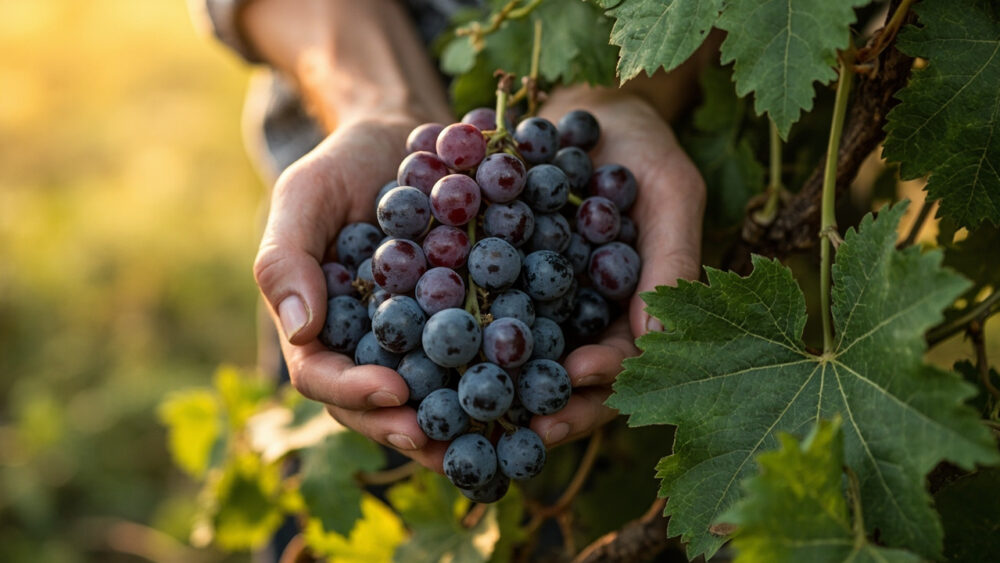
Here is the sign almost everyone misreads: color is not the test. Concords turn deep purple-blue weeks before they are actually ready, so a fully colored grape can still be tart and underripe.
The real test is taste and give. Ripe Concords taste sweet with that classic musky “grapey” flavor, not sharp or acidic, and the berries feel slightly soft rather than firm when you squeeze gently. Grapes also detach easily from the stem with a light tug when ripe; if you have to pull hard, give it another few days.
Harvest by cutting whole clusters off with scissors or shears rather than pulling individual berries, which bruises the fruit and tears the vine.
Concords do not ripen further once picked, unlike some fruit, so taste-test a berry or two from a cluster before you commit to harvesting the whole vine.
That is the whole cycle from bare vine to full basket, and the quick-reference version is right below.
Concord Grapes at a Glance
- When to plant: early spring, 2 to 4 weeks before last frost, once soil can be worked and is above about 50°F.
- Sun and spacing: full sun, 6 to 8 hours daily, vines spaced 6 to 8 feet apart on a two-wire trellis.
- Planting depth: same depth the vine grew at before, roots spread in a hole twice as wide as the root mass.
- First cutback: prune the new vine down to 2 to 3 buds right after planting to force strong root growth.
- Water and feed: weekly water the first summer, light balanced feeding each spring starting year two, stop feeding by midsummer.
- Main threats: powdery mildew, black rot, Japanese beetles, and birds, managed with airflow, thinning, and netting.
- Harvest window: late summer into September, roughly 150 to 160 days from spring leaf-out, judged by taste and gentle give, not color alone.
Get the trellis, the spacing, and that first hard pruning cut right, and the vine does most of the rest of the work itself.
Everything after that is just patience through year two and three, and a good pair of shears in September.