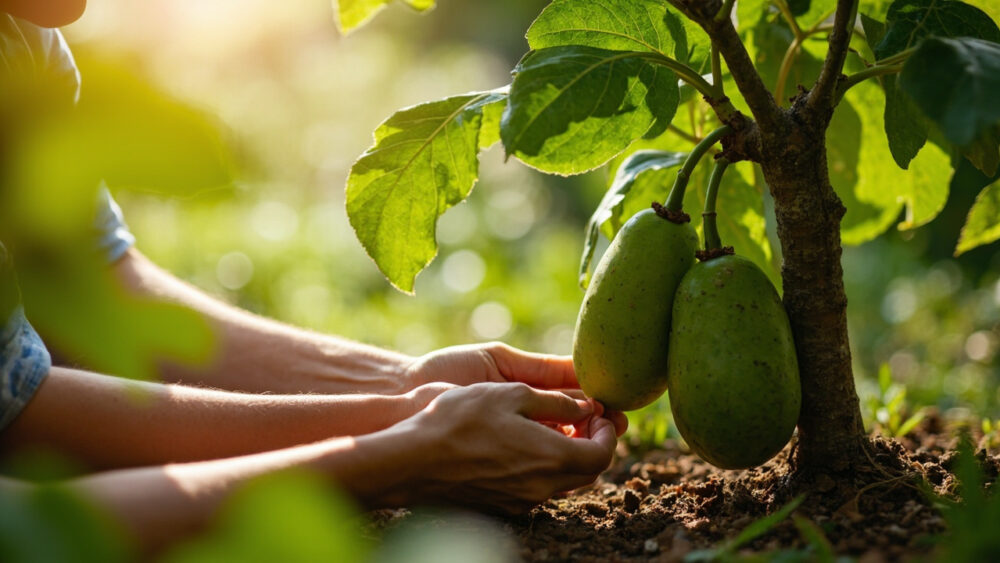
Growing pawpaw means giving it shade for the first two years, then full sun once it fruits, deep loose soil, consistent moisture, and a second unrelated tree nearby for pollination. Get those five things right and you will eat homegrown pawpaw in three to five years, sooner if you start with a grafted tree rather than a seedling. Skip any one of them and you will get a stalled sapling that limps along for a decade.
Most people who ask how to grow pawpaw make the same mistake right out of the gate: they plant it like a peach tree, in full blazing sun, and it sulks or scorches. There is also a pollination trap that catches almost everyone with a single tree, and a ripeness test that has nothing to do with color or squeeze.
Stick with this and you will get the full timeline, the soil prep that actually matters, and the feeding schedule that gets a young tree to bearing age faster. The save-and-screenshot Pawpaw at a Glance card is waiting at the bottom once you have the real picture.
When to Plant Pawpaw
Plant potted pawpaw trees in early springonce the danger of hard frost has passed but before the heat of summer sets in, or in early fall at least six weeks before your first expected frost. Soil temperature matters less here than for direct-seeded vegetables, but you want workable soil, not frozen or waterlogged mud.
Pawpaw is hardy in USDA zones 5 through 8, sometimes 9 with afternoon shade in the hottest climates. It leafs out late in spring, often after everything else in your yard, so do not panic in April when it still looks like bare sticks.
Fall planting works well in milder zones because the roots get to settle in before next summer’s heat arrives.
Choosing the Spot and Prepping the Soil
This is where the full-sun assumption trips people up. If you assumed pawpaw wants a hot, sunny spot from day onethat guess stunts more young trees than any pest does. In the wild, pawpaw grows as an understory tree, and seedlings under two years old need partial shade or dappled light to avoid leaf scorch.
Once established, mature trees want six or more hours of sun to fruit heavily, so the real answer is shade first, sun later. A spot with morning sun and afternoon shade for the first two seasons, opening up to more light as the tree matures, threads that needle nicely.
Pawpaw wants deep, slightly acidic soil in the 5.5 to 7.0 pH range, moist but well drained. It has a fleshy taproot that hates being disturbed, and it hates standing water even more.
Work compost into the planting area to a depth of 12 to 18 inches, and skip any low spot where water pools after rain.
Soil Prep Checklist
- Loosen soil 12 to 18 inches deep across a 3-foot circle
- Mix in 2 to 3 inches of compost or aged manure
- Confirm drainage: water should not pool for more than a few hours
- Test pH if you can, aim for 5.5 to 7.0
Get the ground right now, because you will not get a second chance once that taproot goes down.
Planting Pawpaw Step by Step
Pawpaw’s taproot is brittle and resents transplant shock, so speed and gentleness matter more here than with almost any other fruit tree.
Steps to Plant a Pawpaw Tree
- Dig the hole twice as wide as the root ball and just as deep, no deeper. Planting too deep smothers the crown and is one of the fastest ways to kill a young pawpaw.
- Handle the root ball minimally. Keep it moist and shaded from the moment you remove it from the pot until it is in the ground, ideally under 10 minutes total.
- Set the tree so the soil line on the trunk matches the surrounding ground level.
- Backfill with the loosened native soil mixed with compost, firming gently as you go to remove air pockets.
- Water in immediately with a slow, deep soak, at least 2 gallons per tree.
- Mulch 2 to 3 inches deep, keeping it a few inches back from the trunk.
- Shade young trees with shade cloth, a tomato cage wrapped in burlap, or a nearby structure if the spot gets more than a few hours of direct summer sun.
Space trees 8 to 10 feet apart if you are planting a grove or hedgerow, or wider if you want each tree to develop a full canopy on its own.
Here is the part almost nobody expects when they buy their first tree: one pawpaw, alone in a yard, will very likely never fruit.
The Pollination Problem Nobody Warns You About
Pawpaw flowers are pollinated mainly by flies and beetles, not bees, and they are self-incompatible, meaning a tree generally cannot pollinate itself or a genetically identical clone. You need two genetically distinct treesmeaning two different seedlings or two different grafted varieties, planted within about 30 feet of each other.
If you only have room for one tree, hand-pollination is realistic and not difficult. Use a small artist’s brush to transfer pollen from the flower’s anthers of one tree to the stigma of another in the morning, when flowers are open and slightly sticky.
Flowers appear in mid to late spring before or as the leaves emerge, maroon to brown in color and easy to miss if you are expecting something showy.
Solve the pollination puzzle now, because no amount of watering or feeding fixes a tree with no mate.
Watering and Feeding Through the Season
Young pawpaw trees want consistently moist soil, never bone dry and never waterlogged. Water deeply once or twice a week for the first two growing seasons, more often during stretches of heat above 85°F, less if you are getting regular rain.
Check moisture by pushing a finger 2 inches into the soil near the root zone; if it comes out dry, water. Established trees, three years and older, tolerate short dry spells but still fruit better with steady moisture through summer.
Feed lightly. A balanced, slow-release fruit tree fertilizer applied once in early spring is enough for young trees; mature bearing trees benefit from a light second feeding after fruit set. Follow the product label rates rather than guessing, since pawpaw is easy to overfeed and push into excess leafy growth instead of fruit.
Mulch does a lot of the moisture work for you if you keep it topped up through summer.
Problems That Actually Show Up
Pawpaw is refreshingly free of serious pest and disease pressure compared to most fruit trees, which is one of its best selling points. The main visitor you will meet is the zebra swallowtail caterpillar, which feeds exclusively on pawpaw leaves.
Some defoliation from these caterpillars is cosmetic and the tree recovers fine. Only intervene if a young tree is being stripped repeatedly before it has had a chance to establish, and then stick to hand removal or a labeled, targeted product rather than a broad insecticide.
Peduncle borer and pawpaw fruit flies can occasionally damage fruit in some regions, showing up as small holes or premature fruit drop. Sanitation, meaning picking up dropped fruit promptly, keeps pressure down without spraying anything.
Root rot from soggy soil is the real threat, and it comes back to that drainage check you did before planting.
The bigger challenge with pawpaw is never really pests, it is patience, which brings us to harvest.
When and How to Harvest Pawpaw
Pawpaw ripens in late summer into early fall, typically August through October depending on your zone and variety, and grafted trees can start bearing in as little as 2 to 4 years versus 5 to 8 years for a seedling grown from seed.
Skin color is a weak signal and the biggest guess people get wrong. Some varieties stay green even fully ripe, while others yellow or blush. Do not wait for a color change that may never come.
The real tell is give and drop. A ripe pawpaw yields slightly to gentle thumb pressure, similar to a ripe avocado, and often detaches from the tree with the lightest tug or falls on its own.
Smell is your backup check: ripe fruit has a distinct tropical, banana-and-mango aroma at the stem end. Harvest slightly underripe if you are worried about squirrels or raccoons beating you to it, since pawpaw continues to soften over a few days on the counter, much like a pear.
Unripe pawpaw is not toxic but tastes starchy and unpleasant, so there is no harm in a slightly early pick if wildlife pressure is heavy.
Once you get that first true ripe pawpaw in hand, the whole three-year wait makes sense, and everything you need to repeat it is right below.
Pawpaw at a Glance
- When to plant: early spring after frost risk passes, or early fall at least six weeks before your first frost, zones 5 through 8 or 9 with afternoon shade.
- Sun needs: partial shade for the first two years, six or more hours of sun once mature to fruit well.
- Spacing: 8 to 10 feet apart for a grove, wider for full individual canopies.
- Soil: deep, moist, well drained, slightly acidic at pH 5.5 to 7.0, amended 12 to 18 inches deep.
- Pollination: plant two genetically distinct trees within 30 feet, or hand-pollinate with a small brush in the morning.
- Watering: deep soak once or twice weekly for young trees, check soil 2 inches down before watering established trees.
- Harvest cue: gentle give to thumb pressure, easy detachment from the branch, tropical aroma at the stem, typically late summer into early fall.
Get the shade, the second tree, and the soil drainage right, and pawpaw more or less grows itself from there.
Everything else, the color, the calendar date, the fertilizer brand, matters far less than those three.